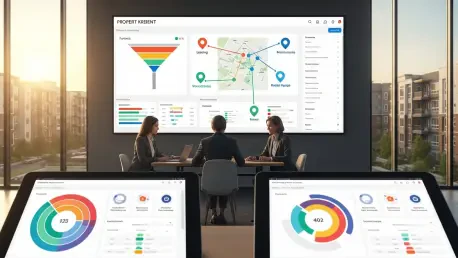

Capital flowed toward clarity as property managers demanded automation that saves hours, not hypotheticals that promise insight without action, and that urgency met its moment when AppFolio opened the year with a beat-and-raise that linked hard numbers to an AI-native operating model. The company’s approach centered on intelligence embedded in everyday work—leasing handoffs, maintenance triage, resident messaging, and back-office reconciliation—so value showed up where it counted: faster cycle times, cleaner data, and fewer manual touchpoints. That design choice mattered in a market confronting stabilizing home prices, elevated borrowing costs, and uneven supply. Instead of selling an add-on, AppFolio built a system of work, then let usage speak. As AI-driven actions surged and margins widened, guidance moved higher, signaling product-market fit as much as fiscal discipline.
Q1 Performance and Guidance
Financial Outperformance and Raised Outlook
Momentum was visible in the headline figures. Revenue reached $262 million for the quarter, up 20% year over year, while GAAP operating income climbed 50% to $51 million. Operating discipline also showed in ratios: GAAP operating margin landed at 19.4% of revenue, up from 15.5% a year earlier, and non-GAAP operating margin improved to 27.3% from 24.3%. Taken together, the mix of growth and expanding profitability reflected an engine running more efficiently as product-led adoption scaled. The company lifted full-year revenue guidance to a range of $1.110 to $1.125 billion and raised its non-GAAP operating margin outlook to 26.0% to 28.0%, indicating visibility into pipeline quality, attach rates for services, and a cost base that benefits from automation rather than headcount alone.
That shift from linear expense growth to software leverage did not arrive by accident. Embedded AI reduced internal handling while improving customer outcomes, which, in turn, lowered the need for incremental support against rising volumes. The signal was not only in percentages but in cadence: higher throughput without elevated churn, stable unit economics as usage deepened, and collections improving as payments moved digital. Markets tend to reward this pattern because it implies durability rather than a promotional spike. Guidance, then, read less like optimism and more like a translation of observed operating data into the rest of the year. It pointed to repeatable wins in core workflows, which built a bridge from tactical quarter to sustained trajectory.
Platform Scale and Services Mix
Scale expanded on both sides of the equation: more units and more activity per unit. Managed units increased 8% year over year to 9.5 million, showing that new wins and expansions continued even as operators scrutinized budgets. Value Added Services contributed meaningfully, with $201.4 million in revenue from offerings such as tenant screening and e-payments. These services did more than lift the top line; they stitched workflows together, reducing swivel-chair work and driving faster decision cycles. When screening integrates with leasing, and when payments flow straight into ledgers, time shrinks and errors fall. That is the stickiness story in practice: a platform that removes steps becomes harder to replace because process becomes native to the software.
Cross-sell strength carried another implication: as customers adopted adjacent capabilities, they standardized on shared data models, which improved AI’s context and accuracy. This feedback loop—more services, richer signals, better recommendations—helped push engagement further into daily routines. Rather than a collection of tools, the platform operated like a unified system with transaction rails, analytics, and automated agents layered into the core. Revenue mix benefited, but so did resilience, since a diversified services base tends to smooth volatility when macro conditions shift. Building on this foundation, the company effectively turned product depth into recurring behavior, which reinforced retention and lengthened customer lifetimes.
AI-Native Product Execution
Embedded Intelligence and Adoption Intensity
The defining design choice was to embed AI at the task layer, not bolt it onto the interface. AppFolio Realm-X now touches more than 99% of nearly 23,000 customers in some form, and the metric that mattered—AI-driven actions—rose sevenfold year over year. That detail suggested real work moved through models daily, not sporadic testing. For leasing teams, it meant automating initial outreach, prequalifying prospects, and scheduling tours without handoffs. For back offices, it meant reconciling payments faster and flagging anomalies before month-end closes. By binding intelligence to outcomes, the platform avoided the common trap of analytics that inform but never act, and customers felt the difference in hours returned to the calendar each week.
Moreover, embedded AI sharpened routing and prioritization, two levers that drive material productivity. For example, maintenance tickets augmented with image analysis and structured descriptions reached vendors with clearer scopes, raising first-visit fix rates. Resident communications shifted from batch email to context-aware replies, reducing confusion over balances or lease clauses. This approach naturally led to fewer manual escalations and a lighter support load for property managers. Crucially, the company framed AI as a standard part of the workflow rather than a premium feature, which normalized usage and quelled resistance. When intelligence is the default, adoption is not a campaign; it is a habit formed by better outcomes with every click.
Agentic Automation with Realm-X Performers
Agentic automation marked the next turn of the flywheel. Realm-X Performers—autonomous software agents tailored to roles—saw usage surge nearly 500% quarter over quarter, signaling a shift from insight to execution. The Leasing Performer advanced leads end to end by capturing prospect details, answering availability questions, and placing tours on calendars with minimal staff input. That continuity mattered because pipeline attrition often hides in small gaps between systems and teams. Closing those loops raised conversion without adding headcount, a direct throughline to margin expansion. Similar dynamics played out in Maintenance, where the Performer analyzed photos, assigned priority levels, generated work orders, and coordinated vendor follow-ups, turning reactive firefighting into managed flow.
Resident Messenger rounded out the trio by automating payment queries, clarifying lease terms, and initiating renewal conversations at the right time. Small as those tasks may seem in isolation, they consumed disproportionate staff time when handled piecemeal. With Performers owning the routine, humans handled exceptions, reconciliations, and relationship moments. The effect showed up both internally and on-site: faster response times, fewer missed updates, and steadier satisfaction scores. In practice, this agentic layer brought autonomy to the last mile where value is either captured or lost. It also clarified a product philosophy: design agents that know the job, not just the dataset. As usage compounded, the case for an AI-native platform grew from promise into a pattern that repeated across portfolios.
Market Dynamics and Competitive Position
Demand Drivers in a Pressured Real Estate Backdrop
Property managers faced a complex set of tradeoffs as home prices stabilized, mortgage rates stayed elevated, rent growth tempered, and supply shifted unevenly across metros. Efficiency became nonnegotiable. Leasing teams needed higher-quality leads and fewer no-shows. Maintenance required triage that fixed more issues on the first visit. Back offices pushed to accelerate cash flow while minimizing errors. Within that matrix, AI-native tools that could optimize pricing, streamline maintenance, and smooth resident communications offered concrete relief. Multifamily and industrial operators, managing large and varied inventories, leaned into modernization to maintain service levels while controlling costs, particularly as regulatory and compliance demands layered onto everyday tasks.
The appetite for modernization also reflected a preference for workflow-centric solutions over stitched-together stacks. Legacy systems could store records, but they struggled with orchestration: moving information seamlessly from lead to lease, from ticket to invoice, from message to action. Cloud-native platforms with embedded intelligence filled that gap by treating data as a live asset, not an archive. As portfolios expanded across regions and asset types, the complexity penalty grew, making automation a lever rather than a luxury. This backdrop explained the rising use of tools that turned insights into outcomes. It also clarified why adoption intensity, not just seat counts, has become a leading indicator of software value in real estate operations.
Competitive Stance and Confidence Signals
Against a market projected to approach $31 billion this year, AppFolio’s stance differentiated on integration and intelligence. Competing with names like Yardi Systems and RealPage, the company leaned into a cloud-based, AI-native architecture that unified leasing, maintenance, communications, and payments into a single operating surface. That cohesion reduced friction where legacy platforms often required custom bridges or manual exports. Margin trends reinforced the point: GAAP operating margin improved to 19.4% from 15.5% a year ago, and non-GAAP rose to 27.3% from 24.3%, aligning product adoption with operating leverage. Capital allocation sent its own message as management repurchased 703,000 Class A shares for $125 million during the quarter.
Investor and analyst signals converged around the same thesis: product-led growth, rising margins, and durable engagement. A Strong Buy consensus and an average 12-month target pointing to meaningful upside suggested confidence in the company’s ability to compound execution from this base. The practical takeaway for operators was equally clear. Prioritize platforms that automate the entire loop—diagnose, decide, do—rather than tools that stop at reporting. Measure outcomes in lead conversion, first-visit fix rates, collection times, and support tickets avoided. Evaluate agentic modules by how well they mirror real roles and cut handoffs. Taken together, those steps reduced operational drag and protected yield, and they positioned adopters to benefit as AI moved from pilot to plumbing across property management.