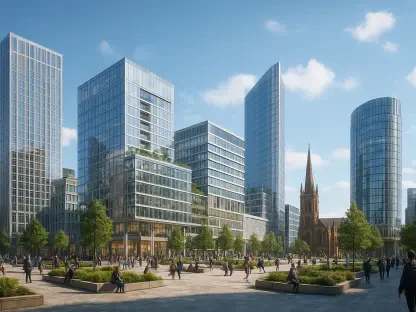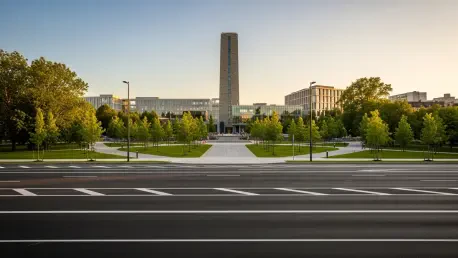

The silhouette of the Chicago South Side is undergoing its most radical transformation in a century as the Obama Presidential Center prepares for its grand opening on June 19, signaling a massive shift in the city’s architectural and social landscape. While the center itself stands as a monumental $850 million project funded through private donations, the actual physical integration of the campus into the historic Jackson Park has required a sophisticated and expensive orchestration of public resources. This development represents one of the most significant public-private partnerships in modern urban history, blending private ambition with the essential expansion of city infrastructure. The scale of the endeavor is evident not just in the rising stone towers but in the fundamental reshaping of the surrounding roadways, utilities, and public spaces. As the facility moves toward its debut, the focus has increasingly shifted toward the nearly $200 million in taxpayer-funded enhancements that allow the site to function within the broader city grid.
Infrastructure Overhaul and Public Investment
Since the beginning of the heavy construction phase in 2026, the Chicago Department of Transportation has aggressively managed a series of capital projects totaling approximately $123.3 million to modernize the local transit network. These expenditures are part of a larger $174 million state allocation designed specifically to facilitate the center’s integration into the existing urban fabric of the South Side. One of the most visible changes involves the permanent closure and removal of a half-mile stretch of Cornell Drive, which previously served as a high-speed six-lane highway cutting through the park. This asphalt has been replaced with permeable surfaces and walkable green spaces, effectively stitching back together sections of the park that were historically divided by heavy vehicular traffic. Such a radical reconfiguration of the city’s arterial layout demonstrates a prioritization of pedestrian access and environmental restoration over traditional car-centric planning, marking a significant policy shift for the regional transportation authority.
Beyond the removal of old thoroughfares, the city has invested heavily in expanding the capacity of surrounding roads to mitigate the expected influx of tourists and daily visitors. Stony Island Avenue has undergone extensive widening, and new lanes have been added to DuSable Lake Shore Drive to ensure that the surrounding neighborhoods do not become paralyzed by the center’s operations. To address the chronic flooding issues that have long plagued the low-lying areas of Jackson Park, engineers installed a state-of-the-art pump station and modernized the drainage systems in the pedestrian underpasses. These utility upgrades, while less visible than the grand library tower, are critical components of the $200 million public investment. The synchronization of these projects was necessary to prevent the new campus from overwhelming the local infrastructure, ensuring that the modernization of the electrical grid and water management systems benefits the entire community rather than just the immediate campus of the presidential center.
Urban Planning and Preservation Debates
The fundamental transformation of Jackson Park has sparked a complex dialogue regarding the balance between modern urban revitalization and the preservation of historic landscapes. City officials and the Obama Foundation have consistently presented the project as a catalyst for economic growth, viewing the $850 million investment as a much-needed spark for community development on the South Side. From their perspective, the infrastructure improvements represent a long-overdue modernization of a public space that had been neglected for decades. The project organizers argue that by replacing a highway with parkland and upgrading outdated utilities, they are fulfilling a contemporary vision of urban life that prioritizes health, accessibility, and community gathering. This vision emphasizes the center not as an isolated monument, but as an active participant in the daily lives of Chicagoans, providing new avenues for education, recreation, and cultural engagement in a previously underserved area of the city.
In contrast to the optimistic narrative of progress, groups like Jackson Park Watch have raised significant concerns about the disruption of the park’s original design, which was meticulously crafted by Frederick Law Olmsted. These critics argue that the widening of major thoroughfares and the insertion of massive modern structures “slice and dice” the historic integrity of the site, which was listed on the National Register of Historic Places. The debate centers on whether the trade-off of historic aesthetic coherence for modern utility is a net gain for the public. Preservationists contend that the scale of the new roadways and the height of the main buildings overshadow the naturalistic beauty Olmsted intended to provide for city dwellers. This tension between historical preservation and modern urban needs highlights the challenges inherent in large-scale public-private ventures, where the desire for high-impact development often competes with the cultural obligation to protect the legacy of historic urban planning.
Community Integration and Future Prospects
The broader impact of the project extends beyond transportation, as seen in the inclusion of high-quality public amenities funded through diverse financial channels. For instance, the site now features a $4.4 million universally accessible playground, which was entirely funded by the Obama Foundation to serve local families. Furthermore, the campus includes a new branch of the Chicago Public Library, supported by a $5 million grant from the MacArthur Foundation, bridging the gap between a private presidential center and a public service institution. These elements serve to ground the massive development in the daily needs of the neighborhood, providing spaces that are free and open to everyone regardless of their interest in the presidential exhibits. The combination of private philanthropic funds and public infrastructure creates a hybrid model of urban development, where the success of the central institution is measured by how well it serves the immediate needs of the surrounding residents.
The completion of the infrastructure work established a new benchmark for how major metropolitan areas manage the logistical demands of high-profile cultural landmarks. By integrating flood mitigation, pedestrian safety, and transit capacity into a single coordinated effort, the city successfully navigated the complex requirements of a multi-year construction schedule. Moving forward, the focus must shift to the long-term maintenance of these new assets and the continued monitoring of traffic patterns to ensure the neighborhood remains accessible. Stakeholders were encouraged to maintain an open dialogue regarding the park’s ecological health, ensuring that the newly created green spaces thrived and the public investment yielded its promised community benefits. This strategic approach provided a template for future developments, proving that large-scale private projects could be leveraged to secure essential public upgrades that would otherwise have remained unfunded for the foreseeable future.