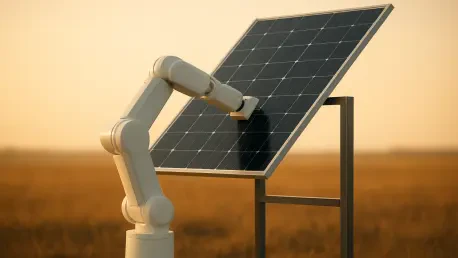

Advanced field robotics are transitioning from theoretical evaluations to practical applications that meet the rigorous standards of outdoor utility-scale construction. As global energy markets pivot toward sustainable infrastructure at an unprecedented pace, the scale of solar farm development has surpassed the capacity of traditional manual labor methods. These massive sites often span thousands of acres, requiring the precise positioning and securing of hundreds of thousands of individual solar modules. Each component represents a logistical challenge that demands extreme accuracy under punishing environmental conditions. In response, engineering and construction firms are no longer viewing robotics as a luxury but as a foundational requirement for project viability. This transition is marked by a sophisticated integration of artificial intelligence and heavy machinery, capable of operating in dusty, high-heat, and uneven terrains. The result is a fundamental reorganization of how large-scale energy projects are executed today.
Addressing Industry Challenges Through Automation
Enhancing Safety and Precision in the Field
The primary motivation behind the adoption of autonomous systems centers on the critical need to protect human workers while maintaining the aggressive installation schedules required for grid modernization. Traditional utility-scale solar construction is an intensely physical endeavor, where human crews must manually lift and maneuver solar modules that frequently weigh more than 80 pounds. Performing this task thousands of times a day in remote, sun-drenched locations leads to significant rates of fatigue, heat exhaustion, and long-term musculoskeletal injuries. By reassigning these high-strain, repetitive movements to robotic units, companies are effectively mitigating the most dangerous aspects of field work. This shift allows human technicians to transition into supervisory roles, where they oversee technical alignment rather than serving as the primary source of heavy lifting. This redistribution of labor creates a much safer and sustainable job site environment.
Beyond immediate safety benefits, these AI-driven systems provide a level of precision and consistency that is difficult to sustain with manual crews over long shifts. Machines do not suffer from performance degradation that occurs during the hottest parts of the day or toward the end of a demanding work week. In the context of solar installation, even minor deviations in module alignment can lead to structural stresses or reduced energy harvest over the twenty-five-year lifespan of the asset. Robotic installers utilize advanced sensors and computer vision to ensure each panel is seated perfectly within its racking system, regardless of the dust or glare present at the site. This technological consistency reduces the need for expensive rework and quality control inspections after the initial installation phase is completed. Furthermore, the ability to operate during nighttime hours expands working windows, keeping projects on track even when conditions are too harsh for people.
Bridging Labor Gaps Through Operational Consistency
The renewable energy sector is currently navigating a period of chronic labor scarcity that threatens to slow the pace of the global energy transition. Finding and retaining a workforce willing to operate in the isolated, harsh environments where utility-scale solar farms are typically built remains a significant obstacle for developers. High turnover rates in these physically demanding roles often lead to delays and increased training costs, which can undermine the economic feasibility of large-scale projects. Automation offers a vital buffer against these demographic and economic challenges by reducing the total number of personnel required for the most grueling tasks. This does not imply a reduction in overall employment but rather a shift in the type of labor required to build the modern grid. By automating repetitive work, companies can attract a new generation of tech-savvy workers who are more interested in operating and maintaining advanced robotics than manual lifting.
Operational predictability is another major advantage gained by integrating robots into the construction lifecycle of a solar facility. When project managers rely on manual labor, they must account for human factors, including illness, transportation logistics in remote areas, and the natural variance in individual work speeds. In contrast, a fleet of robots provides a steady, measurable rate of production that can be modeled with high accuracy months before a project breaks ground. This reliability is particularly valuable for investors and stakeholders who demand strict adherence to timelines and budgets. By having a guaranteed baseline of installation speed, engineering firms can better coordinate the delivery of materials and the deployment of specialized electrical teams. This synchronization minimizes the downtime often seen on large sites where different phases of the project must wait for others to finish. The result is a more professional approach to energy development.
Strategic Deployments and Technological Milestones
Real-World Success: Burns & McDonnell and Gritt
A prominent example of this technological evolution is the collaboration between the engineering powerhouse Burns & McDonnell and the specialized robotics firm Gritt. This partnership reached a significant milestone at the 346-megawatt Gibson City Solar Project in Illinois, where the teams successfully deployed AI-powered units to handle the heavy lifting of solar module installation. Unlike previous attempts at automation that relied on fixed tracks, this deployment demonstrated that modern robots can effectively navigate the unpredictable variables found on a live construction site. The machines were tasked with lifting, positioning, and mounting thousands of modules, a feat that required constant adjustment to account for subtle changes in the terrain and the orientation of the racking structures. The success of this project served as a powerful validation of the “field-ready” status of robotics, proving that these systems are now capable of meeting the demands of utility-scale energy projects.
The core of the Gritt system’s innovation lies in its modular approach to automation, which allows standard, off-the-shelf construction machinery to be transformed into autonomous workers. By retrofitting existing equipment with a suite of sensors, cameras, and proprietary artificial intelligence, the system avoids the need for expensive, bespoke hardware that is difficult to repair in the field. This AI is designed to learn from its surroundings, treating every acre of the project site as a data-rich environment for improvement. As the robot encounters different soil densities, wind speeds, and lighting conditions, it refines its handling algorithms to optimize speed and safety. This continuous feedback loop ensures that the technology does not remain static; instead, it becomes more resilient and efficient with every subsequent installation. This adaptability is crucial for the solar industry, where project sites range from flat desert plains to rocky meadows and rolling hills.
Maximo: Setting New Standards for High-Speed Installation
The AES Corporation has significantly advanced the state of the art with its development of Maximo, a purpose-built, AI-powered robot engineered specifically to handle the complexities of solar panel placement. Maximo distinguishes itself through its heavy reliance on cloud-based simulation and a proprietary data engine that allows the machine to refine its decision-making in real time. This capability was put to the test at the Bellefield project in California, where a fleet of these units successfully installed over 100 megawatts of solar capacity. This achievement marked a decisive shift from small-scale pilot testing to sustained, high-volume commercial production. By utilizing sophisticated computer vision and machine learning models, Maximo can identify the precise orientation of racking bolts and fasteners, ensuring that every module is secured to exact engineering specifications. The system’s ability to process visual data in milliseconds allows it to maintain fluid motion.
The data collected from the Bellefield deployment indicated that robotic systems achieved a rate of one module per minute, effectively doubling the output per person when compared to traditional methods. Industry leaders recognized that this surge in productivity was essential for scaling to gigawatt-level projects where manual installation became impractical. The strategic takeaway from these implementations focused on the transition to a human-in-the-loop model, where skilled workers managed machine logistics and technical oversight. Future success required the industry to adopt standardized digital twins and cloud-based coordination tools to ensure robots and humans operated in perfect sync. Stakeholders acknowledged that the removal of heavy lifting from the field was the key to attracting a tech-driven workforce. Consequently, the integration of autonomous machines provided a scalable solution that secured economic viability while prioritizing the safety of the field crews.