
Listen to the Article
Underground construction has never been forgiving. Tunneling projects operate under conditions that surface-level work rarely demands: unpredictable geology, zero natural light, confined spaces, and equipment failures that can cascade quickly when there’s no easy exit. The consequences of getting it wrong are severe. In 2025, a tunnel under construction in Telangana (India) suddenly collapsed during excavation, killing workers and putting the future of this vital infrastructural project in question. That’s just one of the many incidents that underscore how little margin for error exists underground.Yet global demand for tunneled infrastructure continues to climb. Rail links, utility corridors, road bypasses, and similar projects aren’t slowing down. What is slowing down is the pool of skilled workers capable of executing them safely. That gap is pushing construction firms and research institutions toward a practical question: which technologies can carry some of the load? As demonstrated by the Korea Institute of Civil Engineering and Building Technology (KICT), artificial intelligence applied to tunnel boring machines (TBMs) is increasingly part of that answer.
Why Tunneling Pushes Equipment and Operators to Their Limits
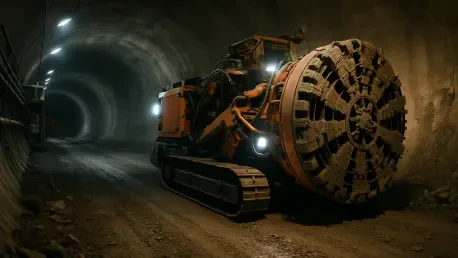
A TBM is not a single machine so much as a mobile underground system. Even a relatively compact unit, such as a 3.5-meter-diameter TBM, stretches 100 to 120 meters in length. It also contains roughly 20 actuators, thousands of onboard sensors, and dedicated surveying equipment specifically for tracking its position underground. Choi Soon-wook, a principal researcher at South Korea’s Korea Institute of Civil Engineering and Building Technology (KICT), puts it like this: “You can think of the entire machine as a single factory.”Running that factory means monitoring over 100 variables simultaneously: advance speed, blade rotation, directional heading, ground pressure readings, segment installation status, and more. Unlike a surface operation, conditions can’t always be anticipated. Pre-excavation geotechnical surveys provide operators with a baseline, but actual subsurface conditions only become apparent once excavation is underway. These can be rock hardness variations, unexpected water ingress, or unstable ground. This means that decisions have to be made in real time, often in physically demanding and psychologically taxing environments.
That combination of complexity and pressure is precisely what makes TBM operation a highly specialized trade. It is also why automating tasks to ease the operator’s burden is seen as a major priority.
A Skills Shortage with No Easy Fix
The construction industry is facing a well-documented labor shortage across many trades, but the TBM operator gap has particular consequences for project delivery. Qualified operators are scarce because the role demands years of hands-on experience. What’s more, few workers prefer underground to surface operations. “People tend to avoid underground work, and the difficulty is so high that even experienced individuals feel the pressure,” notes KICT’s Choi. In other words, this isn’t a temporary pipeline problem that better recruitment alone can solve. Retirement attrition is ongoing, and the specialized nature of the role means it can’t be filled quickly with general construction workers. On complex tunnel projects, operator availability directly affects schedules. Delays tied to labor gaps lead to cost overruns and, in some cases, compromised safety oversight when less experienced personnel are placed in roles they’re not fully prepared for.The practical response from contractors and researchers isn’t to replace operators outright, but to reduce the cognitive burden placed on them and make each operator more effective. That’s where automation enters the conversation.
From Pre-Set Rules to Machine Learning
According to Choi, earlier attempts to automate parts of TBM operation existed, but hit a ceiling. Rule-based systems, where the machine follows pre-defined instructions for specific conditions, work reasonably well in stable, predictable environments. Tunneling is anything but predictable. For example, choosing a tunneling method requires precise assessments of settlement troughs. However, each step in this process falls under a different workflow environment and team responsibility. It also produces outputs in a different format. A system that can only follow fixed rules can’t adapt when the ground behaves differently from what the survey suggested.KICT’s current research takes a different approach based entirely on AI. Their team is building a system that learns from operational data rather than following static instructions. The architecture links the TBM’s control system to a cloud-based operating system, enabling real-time data collection and automated adjustments across the machine’s functions.Their first objective was a tightly scoped but technically meaningful task: automatically synchronizing excavation speed with the conveyor belt speed that transports removed material to the rear of the machine. Keeping those two in sync sounds straightforward. But in practice, it requires continuous monitoring and micro-adjustments as ground conditions shift. KICT first validated the approach on a single actuator at their facility in Goyang, then scaled it to full TBM equipment. In August 2024, the system ran a live field demonstration at the Siheung-Ansan power tunnel excavation site in Gyeonggi Province.
What This Means for Projects and Operations
The immediate benefit of partial TBM automation is workload reduction. When the system handles continuous monitoring and routine control adjustments, the operator’s attention can stay on those judgment calls where automated models fall short of human experience and perception.
The longer-term value is in data accumulation. After all, the more the system operates, the more accurately it can respond to new conditions. Each tunnel drive adds to the dataset. Over time, this enables the model to expand into more complex variables, such as directional control, and with a stronger foundation of real-world examples to draw from.
For contractors and project owners, this trajectory matters beyond individual job sites. A system that progressively reduces dependency on a shrinking expert workforce while maintaining safety and throughput addresses one of the industry’s most persistent structural problems. It also positions early adopters to run projects with smaller specialist teams, which becomes a competitive advantage in the face of tight labor markets.
Conclusion
Tunneling has always required people who combine deep technical knowledge with the ability to make fast decisions in physically unforgiving conditions. That combination is genuinely difficult to develop and harder to replace. KICT’s program underscores how AI can tackle data-intensive, repetitive parts of the operator’s role, freeing up human judgment for where it matters most.
Incremental, data-driven automation, built on real operational evidence rather than theoretical models, can meaningfully shift how work gets done and who’s needed to do it.
For construction firms planning major tunneling programs in the next five to ten years, the question isn’t whether automation will factor into TBM operations. It’s how quickly the data will mature, and whether their procurement and workforce strategies are positioned to take advantage of it when it does.