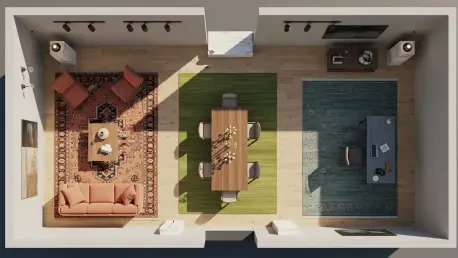

Design plans rose or fell on the rug this year because the floor carried more visual weight than any single wall, cabinet run, or sofa silhouette, and that shift raised the stakes for color decisions that once felt low risk. Open layouts leaned on rugs to draw borders around conversation, dining, and work zones, while hard surfaces like stone, tile, and microcement benefited from a layer that absorbed echo and softened glare. As homes blended vintage finds with clean-lined pieces, color on the floor proved either the quiet diplomat that stitched styles together or the loud voice that drowned out the rest. The consensus among designers landed clearly on warmth, nuance, and tonal depth—choices that read as lived-in rather than lacquered. The smartest rugs grounded rooms now and left room for change later, handling natural light and daily wear without looking tired or trapped in a trend.
What to Avoid in 2026 Rugs
Flat, Ultra-Bright Rugs and Hyper-Synthetic Primaries
A rug sprawled across a living room acted like a painted field, so when that field arrived in a single-note neon or a flat primary, it commandeered the scene and left little room for subtlety. Designers flagged a recurring issue: ultra-vivid blocks locked the palette and forced everything else to behave, even when the rest of the room wanted to evolve. Under daylight, printer-grade reds and highlighter blues read harsh and reflective; under warm lamps, they skewed plastic and abrupt. The result wasn’t simply bold; it was brittle. That brittleness shortened a rug’s useful life, because color fatigue set in faster on the floor than on a single stool or vase. The fix emerged in redirecting punch to vertical planes—lacquered millwork, a confident wall hue, or a sculptural lounge chair—while letting the rug steady rather than shout.
This approach didn’t outlaw saturation; it demanded depth. When a saturated hue carried modulation—russet leaning into umber at the edges, indigo clouded with slate, marigold warmed by a trace of brown—it behaved beautifully in mixed light and across seasons. Think of how a hand-knotted piece with abrash varied from knot to knot, or how a vegetable-dyed kilim drifted across a family of golds instead of parking on a single Pantone chip. That built-in shift made rooms feel more human and forgave small clashes elsewhere. In practice, a layered terracotta rug paired easily with caramel leather, oxidized brass, and blackened steel, while a chalked navy supported both crisp linen and walnut. By resisting hyper-synthetic primaries, the floor stopped dictating and started collaborating, leaving the door open to future fabric swaps or art rotations.
Cool, Flat Neutrals and Camouflage With the Floor
The long march of cool gray flattened spaces by stripping warmth from surrounding materials, especially woods and stone that relied on a soft undertone to feel rich rather than sterile. On rugs, icy blue-grays and flat taupes looked “dead” in late afternoon shadow, which made adjacent colors appear sallow or overbright. In kitchens and great rooms where stainless steel, glass, and porcelain already skewed cool, another cold layer on the floor compounded the effect and reduced dimension. Designers steered away from these defaults, stressing that a rug should add life, not drain it. When a neutral was needed, it worked better with a whisper of clay, tobacco, or olive—tones that nodded to age or patina and lifted pale upholstery rather than washing it out.
Camouflage created a different but equally stubborn problem: rugs that nearly matched the floor failed to do their most basic job of defining space. Pale beige on pale oak disappeared in photographs and in person, muddling the edges of seating areas and even increasing the chance of a stubbed toe or a tripping corner. Mid-gray on gray concrete performed similarly, dissolving into the slab until furniture floated unanchored. Introducing contrast—through a deeper field, a border tone, or visible variegation—restored clarity. A sand-and-saffron Oushak on white oak framed a dining zone without shouting; a walnut-tinged jute over limestone read as a distinct plane. Even in minimalist rooms, that contrast made the plan legible, helping the eye track circulation and giving furniture a stage rather than a blur.
What Works Instead
Warm, Earthy, Nuanced Palettes and Time-Tested Patterns
Designers leaned into palettes that felt pulled from clay, bark, spice, and dusk sky—ochres and terracottas, warm oranges and dry golds, maroons with a hint of brown, and blues and greens tempered to chalk rather than candy. These colors played well with mixed metals and the popular combination of plaster, oak, and travertine, bridging warm and cool finishes with ease. A saffron-laced field brightened matte black hardware without competing; a raisin red enriched oak grain and stabilized cream boucle. Crucially, these palettes handled real light. Morning sun warmed them; evening shadow deepened them; neither washed them out. That elasticity protected against the “wrong light at the wrong hour” problem that sank so many cooler, flatter rugs in open plans with shifting exposures.
Pattern mattered less as decoration and more as a delivery system for layered color. Persian and Oushak designs, kilims, and restrained geometric weaves had color stories honed over centuries—balanced, complex, and adaptable. Their fields and borders packed several related hues, which meant sofas, drapery, and throws could stay quieter while the floor carried the visual conversation. Even in modern solids, multi-tonal yarns or abrash introduced the same principle at a subtler scale. A terracotta ground that drifted through almond, rust, and sienna worked under both brass and nickel; a blue-green that moved from slate to sea-glass kept pace with seasonal textiles. Rather than chase novelty, rooms benefited from rug colors that suggested history, lightened high-contrast schemes, and wore beautifully as fibers relaxed.
Deep Greens as a Grounding Base
Among alternatives to gray, deep, muted greens emerged as the workhorse base that anchored rooms without cooling them down. Forest, moss, and loden tones evoked outdoor earth and canopy, giving saturated companions—saffron, mustard, crimson, indigo—a place to land without clashing. In practice, a moss rug under a walnut dining table steadied brass candlesticks and indigo linen; in a living area, a loden field harmonized with terracotta pottery and aged leather, tying disparate textures into a single gesture. Green’s elastic undertone—able to skew warm with yellow or cool with blue—let it bridge metal finishes and wood species, which simplified decisions across a renovation. It also photographed reliably, staying calm on camera where cooler neutrals often pinged blue.
Building on that reliability, the most resilient schemes paired green grounds with small infusions of variance: a striated weave that shifted from olive to pine, a border kissed with tobacco, a medallion reading slate at noon and bottle at dusk. Those moves made spaces feel layered from day one, and they reduced the pressure to decorate every surface. Actionably, the next steps followed a clear sequence: sample at least two undertones of green against the intended flooring, verify contrast by photographing the swatch across morning, midday, and evening light, and test a warm and a cool accent textile on top to confirm range. Clients who adopted this method reported that the rug set the cadence for the room and then receded gracefully as art, lamps, and collected objects changed. The result felt grounded, adaptable, and quietly confident.