
A visitor stepping from a quiet Palo Alto street into a Mary Gordon garden discovered that the ground itself seemed to guide intent, nudging a slower pace, turning the head toward a framed canopy, and revealing destinations in patient sequence rather than spectacle. Across seven decades and more than 1,000 commissions, this Palo Alto–based landscape architect built a language of freehand curves, brick “bones,” and layered views that made compact lots feel generous and large estates feel composed. This year marks her 100th birthday, a moment that sharpened attention on why her spaces still read as clear and comforting even when plant palettes, ownership, and climate have shifted. The answer lies in a method that privileged experience over display, disciplined structure under naturalistic form, and craftsmanship that could translate a pencil’s arc into a path that feels inevitable underfoot.
Hand-Drawn Vision, Lived Experience
Mary Gordon held that a compass cannot teach the hand how a body moves through space, so she drew curves freehand and kept doing so long after plotters and CAD became standard. The resulting lines were not stylistic flourishes; they were kinesthetic cues. Paths narrowed slightly to encourage a pause, then widened at nodes where sightlines were designed to rest. Low grade changes did quiet work, slowing a stride and setting up glimpses to the next focal point. Rather than one commanding vista at the threshold, views were orchestrated in chapters: a clipped hedge gave way to filtered light through layered canopy, a sculpture aligned with a distant oak, a water surface pulling the eye along a soft S-curve that existed only because it was drafted by feel, not formula.
That insistence on drawings made by hand tied aesthetics to tempo. Gordon choreographed motion much like a stage director sets blocking, with foreground, midground, and background crafted to read differently at five, fifteen, and fifty feet. Borrowed views—redwood crowns, foothill contours, golf-course openness at the edge—were positioned as narrative turns that enlarged scale without surrendering privacy. Clients routinely described the difference as the line between a yard and a garden: the former showed its contents at once; the latter invited visitation. In interviews, homeowners remembered how children learned the routes—where to run, where to climb, where to sit—and how the garden’s pacing changed with seasons and light. The design did not demand attention; it earned it.
The Hardscape Bones
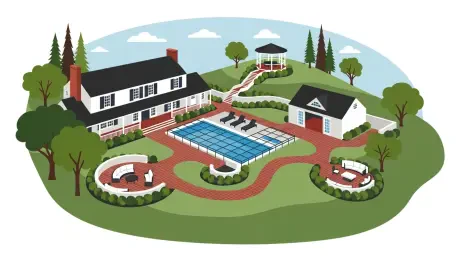
Beneath the softness, brickwork carried the plot. Gordon spoke of hardscape as the bones of a garden, and the phrase was literal in her Atherton commission near Sharon Heights. Curving paths negotiated grade, linked destinations, and reconciled the Colonial house’s right angles with a landscape that wanted to move. Where her pencil traced a sweep, masons cut brick to tighter radii near inside curves and elongated joints on the outside, so motion read as continuous rather than segmented. Walls rose where containment was needed, dropped where sightlines demanded release, and edges did the often invisible work of holding planting shapes so beds felt alive but never unruly.
Those bones also absorbed change. Trees aged, shrubs cycled, and tastes shifted, yet the brick set the terms of circulation and use. Even utility vanished into the framework: compost, bins, potting counters, and hose spigots disappeared behind low walls and high shrubs aligned to paths rather than planted as afterthoughts. At the Atherton site, the pool sat between the house and a modest pool house, half-veiled so the glimmer tempted from specific vantage points without dominating every view. A Lombard Street–like ascent to a hilltop gazebo translated whimsy into a practical route with landings tuned to conversation and breath. Structure and service were present, but they yielded the scene to experience.
Layering and House Integration
Planting was built as a system of depth rather than a palette of parts. Canopy trees set the ceiling, understory trees and large shrubs formed walls, ground covers knit edges to keep soil shaded and lines legible. Gordon used layering to fold space, placing clipped forms against looser textures so eyes could calibrate distance. Privacy came from layered overlap rather than monolithic screens, which allowed air and borrowed views to pass through. In Atherton, glimpses of redwoods and foothills were framed like paintings, extending perception beyond the property line while interruptions—a hedge, a brick return—restored intimacy before the garden drifted into openness again.
Integration with the house made this choreography coherent. Windows served as calibrated viewfinders, each composed for a distinct outdoor scene, so rooms felt longer and brighter. Kitchen sink to herb bed was one sequence; a living room fireplace to a rose garden was another. French doors opened not to indifferent patios but to outdoor rooms scaled to the interior’s dimensions. The Colonial architecture in Atherton gained a companion rather than a competitor: brick echoed trim color and coursing proportions, and curved paths softened the house’s symmetry without erasing it. This indoor–outdoor reciprocity anticipated a Californian lifestyle now taken for granted, where thresholds are fluid, and the garden is not backdrop but extension.
Evolution and Cultural Impact
Gordon trained under Garrett Eckbo, Robert Royston, and Edward Williams, absorbing a modernist emphasis on clarity, legible circulation, and site specificity. Early work showed crisp geometry—rectilinear patios, axes, grids—that conveyed order with confidence. Over time, she bent those principles toward biomorphic expression. The Atherton garden embodied this synthesis: disciplined adjacencies and calibrated nodes wore a naturalistic surface; curves read as organic yet delivered modernist legibility. This evolution mirrored a wider mid- to late-century shift in California residential design, which embraced biophilic cues and informality without surrendering rigor. The point was not looseness; it was life.
Her cultural footprint extended beyond private fences. As one of California’s earliest licensed landscape architects and, later, as chair of the Palo Alto Planning Commission from 1965 to 1980, she argued for Baylands and foothill protections that now define the region’s green edges. Real estate listings in neighborhoods like Atherton Meadows and Crescent Park began touting a “Mary Gordon garden” as an amenity, a phrase that signaled quiet luxury rooted in experience rather than ostentation. Media coverage by regional outlets amplified that value, while clients described family rituals shaped by her sequences: morning coffee at a specific bench, summer parties that unfolded along the brick, children learning to swim in a pool revealed, not announced. The reputation rested on how these places worked, not simply how they looked.
Enduring Principles: Applying Gordon’s Lessons Now
The staying power of Gordon’s work offered practical guidance that could be adapted to current constraints. First, draw for movement before drawing for objects. Map the primary loop a person will take from door to door, then place destinations where that loop wants to slow—seating, water, a borrowed view held by a single trunk or crafted aperture. Second, invest in bones. Even modest budgets could prioritize edge definition, durable materials, and accurate grading. Brick, stone, or concrete need not be lavish, but joints, radii, and alignments had to be right; poor geometry broadcasted itself for decades. Third, layer for depth and light, not just for species count. Structure canopies to cast dapple, use midstory to shape privacy in bands, and underplant to keep soil cool and sightlines legible.
A final lesson concerned stewardship. Gordon’s gardens endured because ownership changes respected the framework, editing plants while preserving path logic and view choreography. For homeowners today, that meant documenting circulation, nodes, and framed views as the design’s “spine” before swapping plant material for drought tolerance or habitat value. It also suggested hiding utility as a design act: build screens as continuations of edges; place work zones along secondary routes; recess lighting and irrigation control where they supported, not interrupted, experience. Applied with care, these moves delivered the same quiet clarity that defined the Atherton property and scores of Bay Area projects, demonstrating that longevity was not an accident but a craft practiced over time.