
With over a decade of experience navigating the complex intersection of architectural design and facility management, Luca Calarailli has become a leading voice in the evolution of modern workspaces. His work focuses on how technological innovation can solve the age-old problem of noise in environments that demand both collaboration and deep focus. In this discussion, we explore the nuanced world of noise mitigation, from the integration of lighting and sound in planar fixtures to the critical importance of material health and air quality in high-traffic zones. We also dive into specialized solutions for data centers and moisture-rich environments, examining how the marriage of sustainability and durability is shaping the next generation of commercial interiors.
The Sabin LAYER series introduces a fascinating concept where lighting isn’t just an afterthought but an integral part of the acoustic strategy. How do these planar fixtures allow for more organic spatial organization, and what advice do you have for designers trying to balance visual hierarchy with technical performance like a 0.85 NRC rating?
The beauty of a system like the LAYER series is that it frees the designer from the rigid, grid-like constraints of traditional ceiling layouts. By utilizing non-centered apertures, we can align high-quality lighting—ranging from 2700K to 4000K at a 90+ CRI—directly over circulation paths or conference tables without moving the entire acoustic footprint. To maintain that crucial 0.85 NRC rating, designers should focus on the layering of the dual PET felt shapes, whether they are using discs, obrounds, triangles, or rectangles, to create a staggered sound-absorption field. It is essential to remember that these fixtures offer lumen outputs from 750 to 3,000, so you are effectively managing the sensory experience of the room twice over. My advice is to use the sewn perimeter edges as a visual guide to define different zones within an open plan, ensuring that the acoustic “weight” of the room is distributed where people actually gather.
In high-traffic commercial zones, we often see a conflict between durability and air quality. When you are looking at products like the Econetic Core, how does the absence of formaldehyde and Red List chemicals shift the project certification landscape, and what specific cues tell you to choose High Impact panels over the standard HardSide version?
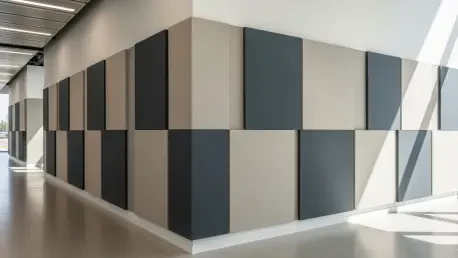
When a product is certified as DECLARE Red List Free and meets CDPH 01350 VOC emissions standards, it simplifies the path toward LEED or WELL certifications, which are increasingly mandatory for Class A office spaces. The use of a natural, formaldehyde-free binder in these fabric-wrapped fiberglass panels ensures that we aren’t off-gassing harmful chemicals into the very air our occupants breathe. In terms of selection, I tell my clients to look at the “elbow height” of a room; if a panel is installed in a narrow corridor or a shared amenity space where equipment or people are likely to brush against the walls, the High Impact panel is the only logical choice. While both options feature hardened edges for a crisp look, the High Impact version is specifically engineered to resist the physical deformation that occurs in those bustling, high-velocity environments.
Data centers are notorious for low-frequency hums that can disrupt entire neighborhoods. Given the complexity of these environments, how does a structural grid system with a 0.90 NRC rating change the operational dynamic, and why is domestic manufacturing compliance becoming such a critical factor for these mission-critical facilities?
In a data center, you aren’t just dealing with human speech; you are fighting the relentless, low-frequency drone of high-decibel fans and generators. Utilizing DATAZONE ceiling panels on a DynaMax structural grid allows us to hit an NRC of 0.90, which is a massive win for reducing the acoustic bleed that affects both the staff inside and the communities living just outside the facility walls. Operationally, the flexibility of 2’ x 2’, 2’ x 4’, and 4’ x 4’ panel sizes allows for easier access to the complex overhead infrastructure that these centers require. Furthermore, the shift toward Build America, Buy America (BABA) Act compliance is no longer optional for many projects; having a domestic manufacturing chain ensures that mission-critical timelines aren’t derailed by the volatility of international shipping. This compliance, combined with the sustainability metrics of the SUSTAIN portfolio, means we are building facilities that are as responsible as they are functional.
Fitness centers and hospitality hubs present a unique challenge where moisture and physical wear can quickly degrade acoustic treatments. How do materials like wood fiber and portland cement provide a long-term solution here, and what does a realistic maintenance routine look like for panels that need to withstand constant “abuse”?
Spaces like indoor gyms or hotel pool areas are incredibly unforgiving, which is why the EchoWool system—comprised of aspen wood fibers and portland cement—is such a game-changer. This inorganic mix provides a natural resistance to moisture that would cause traditional acoustic tiles to sag or grow mold within a few months. Because these panels are modular and can be factory- or field-painted, they offer a customizable aesthetic that doesn’t compromise the material’s inherent toughness. For a maintenance routine, you are looking at simple periodic vacuuming or a light wipe-down, which is a breath of fresh air for facilities teams used to replacing delicate materials. These panels are built for “abuse resistance,” meaning they can take the occasional impact from sports equipment or heavy foot traffic without losing their structural integrity or acoustic properties.
We are seeing a move toward more tactile, layered wall applications using recycled materials. How do modular textured tiles, like the Mirage collection, help designers bridge the gap between “cold” office environments and warm, sound-controlled spaces, and what metrics should facility managers use to measure their success beyond just the NRC?
The Mirage collection uses 100% polyester fiber with a minimum of 80% post-consumer recycled content, which immediately appeals to the growing demand for sustainable, circular-economy products. By using six different modular patterns, designers can create sculpted surfaces that catch the light and add a sense of movement to a room, effectively “warming up” a space that might otherwise feel clinical. When evaluating success, I tell facility managers to look at “speech privacy” and “occupant dwell time” rather than just the raw NRC numbers. If people are choosing to hold meetings in a previously avoided “loud” corner because the textured tiles have diffused the echoes and made the space feel more intimate, that is your ultimate metric of success. The lightweight nature of these tiles also means they can be installed as layered applications, allowing for a 3D effect that doubles as a high-performance sound dampener.
What is your forecast for the future of workplace acoustic design?
I believe we are moving away from “corrective” acoustics—where we add panels to fix a noisy room—toward “integrated” acoustics, where the sound-absorbing materials are indistinguishable from the architecture itself. We will see a surge in multi-functional materials that act as thermal insulators, light diffusers, and acoustic absorbers all at once, much like the wood-fiber and PET felt solutions we see emerging now. Sustainability will also become much more granular; it won’t just be about “recycled content,” but about the total carbon footprint of the manufacturing process and the ease of recyclability at the end of the product’s life. Ultimately, the workplace of the future will be a “sensory-tuned” environment where sound, light, and air quality are managed by a single, cohesive design philosophy that prioritizes human well-being above all else.