
Imagine an urban center spanning five million square feet that functions not merely as a transit hub but as the beating heart of a metropolis designed to alleviate the demographic weight of a traditional capital city. The Xiong’an Railway Station represents a massive shift in urban planning, serving as the physical and digital gateway to the New Area in northern China. This grand structure provides a tangible manifestation of how modern infrastructure can bridge the gap between high-speed connectivity and sustainable living. By linking Beijing, Tianjin, and Hebei, the station facilitates a balanced economic corridor that breaks the cycle of over-centralization. Its existence is a strategic masterstroke, proving that secondary urban hubs can possess the sophistication of established centers while maintaining a focus on ecological harmony. As the anchor of this region, the facility transforms travel from a chore into a seamless transition between dynamic economic zones.
Advanced Engineering: The Digital Foundation of Modernity
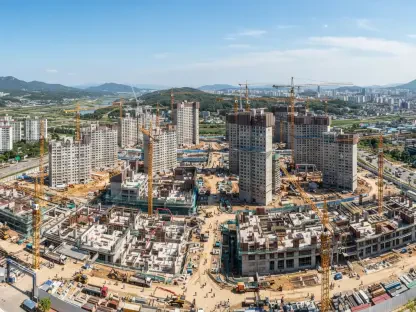
Construction of this monumental facility relied on Building Information Modeling rather than outdated blueprints, allowing for an unprecedented level of precision in every joint and conduit. This digital-first strategy enabled engineers to simulate various structural scenarios in a virtual environment before building, fostering collaboration that prevented costly errors. More than 70 distinct technological innovations were integrated into the design phase, ranging from advanced climate simulation to structural stress testing. By centralizing all project data, the China State Construction Engineering Corporation ensured that different teams could work on complex electrical systems without spatial conflicts. This method did more than just speed up the process; it created a permanent digital twin of the station that allows for real-time monitoring of structural health, ensuring the building remains resilient for decades as a centerpiece of the regional high-speed rail network.
Robotic Systems and Architectural Integrity
Beyond the digital framework, the physical manifestation of the station utilized robotic automation to achieve a standard of craftsmanship that would be nearly impossible through manual labor alone. Specialized welding robots were deployed across the site to standardize steel components, ensuring that every weld met rigorous safety specifications while maintaining a rapid pace of assembly. This mechanical precision is perhaps most visible in the extensive use of fair-faced concrete, a material choice that demands perfection because the concrete surface remains exposed as the final finish. There is no plaster or paint to hide imperfections, requiring formwork that was executed with surgical accuracy to create the smooth, industrial aesthetic that defines the interior halls. Such a commitment to structural honesty reflects a trend in high-tech architecture where the beauty of the building is found in the flawless execution of its primary materials and robust engineering.
Connectivity: Shaping a Regional Economic Corridor
The station serves as the vital nexus of the Beijing-Xiong’an intercity railway, where trains reach speeds of up to 217 miles per hour to bridge the distance between the capital and the new area. This high-speed link has effectively rewritten regional geography, shortening what used to be a long journey into a brief 50-minute commute that encourages the decentralization of industry. Passengers can reach the Daxing International Airport in under 20 minutes, making the station an indispensable cog in the global transportation machine. This rapid connectivity is not just about speed; it is about creating a flexible labor market where experts from Beijing can easily collaborate with tech startups. The infrastructure supports a vision where distance is no longer a barrier to innovation, allowing the new city to function as a high-tech satellite that absorbs the administrative functions and commercial vitality once confined to the crowded streets of the traditional urban core.
Solar Integration and Ecological Sustainability
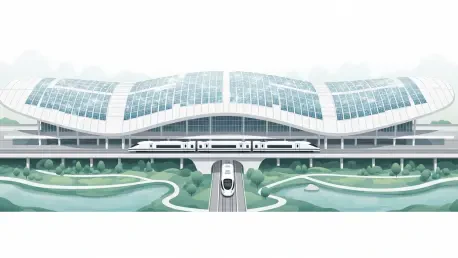
Sustainability is integrated into the very roof of the building, which functions as a massive, high-efficiency power plant. Covered with 452,000 square feet of solar panels, the roof is designed to capture maximum sunlight and convert it into millions of kilowatt-hours of clean electricity every year. This localized energy production significantly offsets the facility’s carbon footprint, providing enough power to run internal lighting and ventilation systems while reducing demand on the regional grid. By shifting toward renewable sources, the station serves as a blueprint for how massive infrastructure can transition from a resource consumer to a resource generator. This approach saves thousands of tons of coal annually, contributing directly to national decarbonization targets. The design proves that large-scale civil engineering projects can coexist with ecological goals, using innovative surfaces to create functional benefits that extend far beyond the transit experience.
Strategic Implementation: Moving Toward Holistic Management
Urban planners and global architects recognized that the successful deployment of the Xiong’an hub necessitated a shift toward more holistic urban management strategies. It was determined that the integration of digital twins into municipal governance allowed for more responsive city services, ranging from traffic management to emergency response. Decision-makers focused on the necessity of fostering diverse social layers within the tech-centric city to ensure it did not become a sterile corporate park. This required the implementation of mixed-use zoning and the preservation of green spaces around the rail corridors to support a high quality of life. The project illustrated that the true value of high-tech infrastructure lay in its ability to adapt to human needs rather than forcing residents to adapt to rigid systems. Planners successfully integrated retail and cultural zones within the transit hub to encourage community engagement and commercial growth.
Future Considerations: Establishing Resilient Communities
Future considerations for smart city development prioritized the security of data networks and the accessibility of autonomous transit systems for all demographics. It was observed that the station provided a sandbox for testing artificial intelligence in crowd management, which was later scaled to other metropolitan areas. Stakeholders ensured that the high-speed rail network remained affordable to maintain its role as a public service rather than an exclusive luxury. The focus shifted toward long-term environmental monitoring to measure the station’s impact on local biodiversity and groundwater levels. These actions secured a resilient framework for a society that prioritized both technological advancement and social connectivity. By treating the station as a living laboratory, officials were able to refine the balance between rapid growth and sustainable development. This ensured that the transition from an engineering marvel to a vibrant community was handled with precision.