
The architectural landscape of modern cities presents a striking paradox where glass-and-steel monoliths equipped with integrated digital nervous systems stand beside decades-old structures still reliant on manual maintenance and analog controls. While new constructions are designed from the ground up with smart sensors and high-speed fiber optics, the vast majority of existing commercial and residential properties remain shackled by aging infrastructure that cannot easily support modern data demands. This digital divide has historically made the prospect of smart building evolution seem like an expensive luxury reserved for the elite tier of real estate. However, the emergence of industrial-grade wireless retrofitting has fundamentally changed the economic and logistical equation for property owners. By utilizing sophisticated serial-to-WiFi modules and decentralized networking, these older buildings can now bypass the prohibitive costs of invasive rewiring and join the ranks of intelligent, responsive environments. This transition is not merely about convenience; it is a critical step in making global urban centers more efficient and sustainable.
Breaking the Physical Barriers: The Cost of Copper Infrastructure
The traditional method of automating a building requires thousands of feet of physical cabling to connect every sensor, motor, and controller to a central management platform. In an established structure, the process of laying this cable often resembles a major renovation project rather than a simple technological upgrade, involving drilling through reinforced concrete or trenching through historical flooring. These invasive procedures are not only expensive in terms of labor and materials but also represent a significant disruption to tenant operations, often leading to lost rental income or project delays. Furthermore, many buildings from the mid-twentieth century lack the dedicated utility shafts or riser space necessary to accommodate the sheer volume of modern networking cables. This physical bottleneck has long prevented property managers from implementing the high-resolution data tracking needed to optimize utility usage and streamline maintenance schedules across their facilities.
Beyond the logistical hurdles of physical installation, the long-term reliability of wired networks in large-scale buildings is often compromised by the very environment they are meant to monitor. Heavy machinery, industrial motors, and massive electrical panels generate substantial electromagnetic interference that can easily corrupt data flowing through unshielded or poorly routed communication lines. When data packets are lost or corrupted, building management systems lose their ability to provide real-time insights, forcing facility managers to revert to reactive maintenance strategies. Instead of addressing a minor mechanical drift before it causes a failure, teams are often left waiting for a total breakdown or a tenant complaint to identify a problem. Wireless retrofitting eliminates these physical and environmental constraints by creating a robust, non-invasive data layer that can be deployed in a fraction of the time required for traditional wiring, providing a clear path forward for aging assets.
Elevating Safety Systems: Proactive Monitoring for Critical Assets
Elevators represent one of the most mechanically complex and safety-critical components within any multi-story building, yet they are often the most difficult to integrate into a smart network. Traditional monitoring for these systems involves complex traveling cables that must move with the elevator car, creating a high-wear environment where physical connections frequently fail over time. By integrating industrial wireless serial-to-WiFi modules directly into the control cabinets located at the top of the shaft, engineers can establish a permanent data link without the need for expensive vertical cabling. This setup allows for the continuous transmission of performance metrics, such as floor position, door cycle count, and motor temperature, directly to a centralized cloud platform. The result is a high-definition view of the elevator’s operational health that was previously impossible to achieve without a complete and costly replacement of the entire control system.
The shift toward wireless connectivity in elevator shafts has profoundly enhanced the safety protocols and response times within residential and commercial communities alike. Industrial wireless modules are engineered with specialized electromagnetic shielding to withstand the intense interference generated by high-power traction motors and brake systems. This specialized hardware ensures that the connection remains stable even in the most electrically noisy environments, enabling a transition to proactive monitoring. If a door sensor begins to lag or a motor draws more current than normal, the system flags the anomaly immediately, allowing technicians to intervene before a malfunction or passenger entrapment occurs. Such implementations have demonstrated the potential to reduce manual inspection workloads by nearly fifty percent, as staff can focus their efforts on specific issues identified by data rather than performing routine checks on functioning equipment.
Optimizing HVAC Performance: Energy Management and Centralized Control
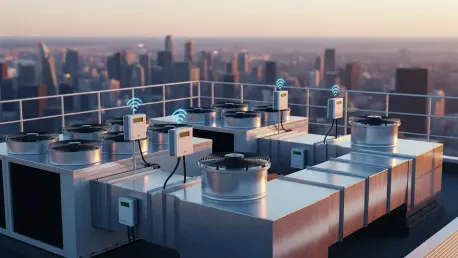
Heating, Ventilation, and Air Conditioning systems are typically the largest consumers of electricity and gas in a commercial building, yet they often operate as a collection of isolated islands. In many older facilities, units on different floors or even different wings of the same floor are not connected to each other, leading to situations where heating and cooling systems compete against one another simultaneously. Wireless retrofitting provides a solution to this fragmentation by attaching compact wireless modules to the existing serial ports of each unit. This creates a unified network that allows facility managers to aggregate environmental data to a central dashboard for facility-wide oversight. With this level of visibility, it becomes possible to synchronize the behavior of every HVAC component, ensuring that the building operates as a cohesive unit rather than a series of disconnected and often inefficient machines.
The operational improvements gained from centralized wireless visibility are most evident in the significant reductions in energy consumption and labor costs. Automated load balancing allows the building management system to adjust the output of each HVAC unit based on actual occupancy levels and the time of day, preventing the waste of energy in empty offices or conference rooms. Buildings that have embraced these wireless upgrades have reported nearly a twenty percent drop in total energy consumption, which directly contributes to lower operating costs and a smaller carbon footprint. Additionally, the ability to perform remote adjustments and manual overrides from a smartphone or tablet eliminates the need for maintenance staff to physically visit every mechanical room for routine temperature checks. This efficiency allows personnel to dedicate their time to high-value technical tasks, further improving the overall productivity of the facility management team.
The Technical Blueprint: Industrial Modules and Transparent Transmission
The transition to a smart building environment depends entirely on the reliability of the underlying hardware, which is why industrial-grade wireless modules are essential for these retrofits. Unlike consumer-level devices that are prone to failure under stress, industrial modules are specifically designed to operate in the harsh conditions found in machine rooms and mechanical penthouses. These components can endure extreme temperatures, high humidity, and constant vibration without losing connectivity or suffering from hardware degradation. Their plug-and-play architecture is a critical feature for large-scale adoption, as it allows standard building technicians to install and configure the hardware quickly. By simplifying the installation process, property owners can avoid the high costs associated with hiring specialized network engineers, making the evolution to smart technology more accessible to a wider range of property types.
A defining technical characteristic of these modules is the concept of transparent transmission, which allows data to move from legacy equipment to modern servers without being modified. This ensures that the original logic and programming of the elevator or HVAC controller remain completely intact, which is vital for maintaining manufacturer warranties and safety certifications. The wireless module acts as a seamless bridge between the older machine ports and the modern WiFi network, translating physical signals into digital packets that can be analyzed by advanced software. This compatibility across different brands and generations of hardware makes wireless retrofitting a universal solution for diverse building portfolios. By preserving the integrity of existing equipment while adding a layer of modern intelligence, these modules provide the technical foundation necessary for the rapid and cost-effective evolution of the global building stock.
Strategic Integration: The Path Toward Global Carbon Neutrality
The ongoing shift toward wireless retrofitting reflects a broader strategic movement within the real estate industry toward lightweight and non-invasive smart building models. Industry leaders have increasingly moved away from the era of heavy cabling, recognizing that the cost-benefit analysis now heavily favors wireless solutions that leverage existing network assets. This democratization of technology has allowed mid-sized and older buildings to access levels of intelligence and efficiency that were once the exclusive domain of the world’s most expensive skyscrapers. As global sustainability goals and strict carbon neutrality regulations become more prevalent, the ability to wirelessly monitor and manage energy-hungry equipment has transitioned from an optional upgrade to a functional necessity for remaining competitive in the modern real estate market.
Decision-makers who finalized their transition to wireless frameworks during the period from 2026 to 2028 secured a significant competitive advantage in operational resilience and cost management. They discovered that the data gathered through these retrofits provided the evidence needed to justify further investments in green technology and building automation. To build on this success, property owners should now conduct comprehensive audits of their current equipment ports to identify every opportunity for a wireless bridge. Prioritizing the integration of HVAC and elevator systems offered the fastest return on investment, but the potential for wireless sensors to monitor water usage, lighting, and air quality should not be overlooked. By adopting a modular and scalable approach to technology, stakeholders ensured that their buildings remained adaptable to future innovations while meeting the immediate demands of a more sustainable and data-driven world.