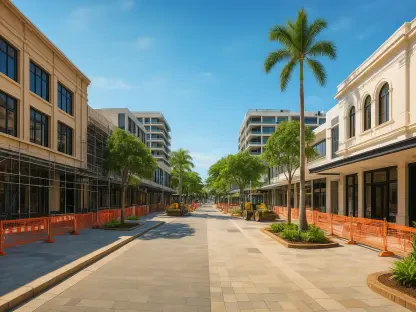

The rhythmic, industrial heartbeat of the Seoul metropolitan area has stuttered into an eerie silence as thousands of cement mixers sit idle while their drum rotations slow to a permanent halt. Across the skylines of the capital and its surrounding provinces, the usual roar of construction has been replaced by an unsettling quiet that threatens the very foundation of the national economy. While a meager trickle of 20% to 30% of standard concrete volume continues to flow through non-union channels, this supply is nowhere near the volume required to sustain high-stakes infrastructure and massive residential developments.
The industry now faces a merciless ticking clock that dictates every operational decision because concrete is a highly volatile substance. If the material is not poured within 90 minutes of leaving the production plant, it becomes physically unusable, turning every stalled delivery truck into a potential logistical and structural disaster. This narrow window of opportunity means that even minor delays at picket lines can render entire batches of cement worthless, forcing contractors to choose between abandoning pours or risking the integrity of their buildings.
The 90-Minute Clock: Silence Over Seoul’s Skylines
The current labor action by the ready-mixed concrete transport union has moved beyond a localized grievance, evolving into a systemic threat to the most vital economic sectors of South Korea. From the massive semiconductor manufacturing hubs in Pyeongtaek to the high-density residential towers rising in the capital, the disruption has created a cascading effect that touches everyone from project managers to future homeowners. This strike matters specifically because it targets the very inception of the vertical supply chain; without the steady arrival of concrete, the progress of the entire nation essentially grinds to a halt.
For over a week, the stagnation has forced site managers to send workers home as the vertical advancement of structural skeletons remains frozen in time. Unlike other supply chain disruptions where materials can be stockpiled, the perishable nature of ready-mixed concrete makes it impossible to build a buffer against labor instability. Consequently, the strike has created a bottleneck that prevents secondary trades, such as electrical and plumbing installation, from beginning their work, leading to a total halt in productivity across hundreds of major sites.
A Week of Stagnation: Why the Transport Union Strike Hits Different
Construction firms are currently staring down a dual-headed monster of immediate financial liabilities and long-term engineering challenges that could compromise building quality for decades. Most industrial contracts include “liquidated damages” clauses, which impose steep financial penalties for every single day a project exceeds its scheduled delivery date. As supply chains remain frozen, these daily penalties are accumulating into ruinous sums, threatening the solvency of smaller subcontractors who operate on razor-thin margins and have no leverage in labor negotiations.
Simultaneously, engineers are being forced to grapple with the technical complications of “joint construction” techniques. This process requires extra labor and reinforcement to connect old concrete layers with new ones after a significant delay, increasing both the cost and the complexity of projects that were already over budget. These cold joints, if not managed with extreme precision, can lead to structural weaknesses or water seepage, forcing firms to invest in additional quality control measures that further drain their remaining resources.
The Economic and Technical Toll: Frozen Supply Chains
Industry leaders, represented by the Construction Association of Korea, are mounting a legal defense by petitioning the government to classify the strike as a “force majeure” event. This designation would provide a critical legal shield, theoretically protecting contractors from the aforementioned liquidated damages and allowing for legitimate deadline extensions. Such a move would be modeled after the protections provided during the global pandemic, acknowledging that the strike is an external event beyond the reasonable control of individual construction companies.
However, experts warn that even with legal relief, the secondary risk of a “compressed” work schedule once the strike ends will be difficult to manage. In an effort to make up for lost time and meet the revised contractual obligations, firms may be forced to rush the remaining phases of construction. This acceleration historically leads to a heightened risk of catastrophic onsite accidents as safety management protocols are strained under the pressure of unrealistic catch-up milestones.
Legal Precedents: The Force Majeure Defense
To navigate this crisis, construction managers adopted a multi-pronged strategy that focused on meticulous legal documentation and safety reorganization. Firms began recording every disruption in extreme detail to support future force majeure claims while simultaneously revising their safety management protocols for the eventual transition back to full-capacity operations. These proactive measures were designed to ensure that when the mixers finally returned to the roads, the rush to finish would not come at the expense of human life or structural stability.
The industry ultimately prioritized long-term structural integrity over artificial deadlines, signaling a fundamental shift in how South Korea managed its infrastructure risks. Stakeholders moved toward more resilient supply chain models that factored in labor volatility as a constant variable rather than an unforeseen anomaly. This transition ensured that future projects were better equipped to handle the high-pressure environment of the metropolitan construction sector, prioritizing a culture of safety that would endure long after the silence over the skylines ended.