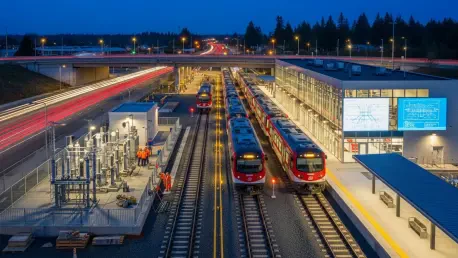

For generations, a direct train ride to the Loop from Altgeld Gardens or West Pullman remained an aspiration mapped in planning documents but missing from the city’s spine, and that historic gap finally narrowed as crews broke ground on the Chicago Transit Authority’s Red Line Extension—5.5 miles and $5.7 billion of concrete, steel, and policy resolve aimed at connecting the Far South Side to 24-hour rail service. The plan promised four new stations at 103rd, 111th, Michigan near 116th, and 130th, plus a rail yard around 120th to keep the system running reliably. Early works were visible: demolitions to clear the right-of-way, utility relocations to avoid conflicts, and the first drilled shafts and concrete pours to anchor future elevated structures. Framed as the largest capital project in CTA history, the RLE also targeted more than 12,500 construction jobs, while design-builder Walsh-Vinci Transit Community Partners pursued a delivery approach meant to hold schedule and cost to account.
From Promise to Groundbreak: Scope, Schedule, and Team
The RLE moved from decades of studies into active construction under a design-build contract awarded in 2024 to Walsh-Vinci Transit Community Partners, aligning engineering and construction under one roof to compress timelines and reduce change-order friction. The alignment extended the Red Line from 95th Street to near 130th Street, bridging neighborhoods that long relied on buses threading congested arterials. Each new station carried a multimodal brief: island platforms served by frequent trains, canopies for weather protection, off-street bus bays to streamline transfers, protected bike access and parking, and walkable connections built into redesigned intersections. Park-and-ride capacity aimed to draw riders from farther south and east, while the new yard near 120th promised better fleet staging and midday storage, boosting the Red Line’s round-the-clock reliability and peak headways.
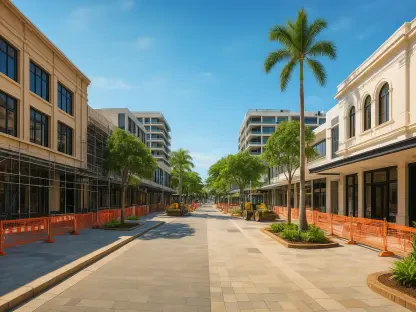
On-the-ground activity matched that brief. Utility crews documented, relocated, or protected buried lines to prevent later conflicts, while contractors drilled caissons and formed columns for guideway spans that would lift trains above traffic chokepoints. Property acquisition and clearance progressed block by block, opening a linear work zone for track foundations and subgrade drainage systems that would manage stormwater and protect ballast. Station packages advanced through preliminary engineering, with vertical circulation cores planned to meet ADA requirements and fare arrays designed for contactless payments. The construction calendar pointed to station building beginning in 2027, a sequence that allowed structural work and systems installation—traction power, signaling, communications—to proceed in parallel. Through this staging, the project knitted the Far South Side into the regional network rather than leaving riders to rely on slow bus transfers to reach the Red Line’s current terminus at 95th/Dan Ryan.
What Comes Next: Actions to Lock in the Benefits
The final stretch of delivery depended on converting political momentum into predictable cash flow after a turbulent funding episode, when more than $2 billion linked to the RLE and Red and Purple Modernization had been frozen in a dispute over diversity and inclusion programs. A federal court ordered DOT and FTA to resume payments in March, restoring certainty that underwrote contractor staffing, material orders, and long-lead systems procurements. Building on that footing, the path forward centered on three moves: locking the risk register with clear owner-contractor responsibilities; sequencing utility, guideway, and systems work to minimize rework; and publishing quarterly progress dashboards that documented budget, change orders, and workforce outcomes. With those guardrails in place, the design-build model delivered shorter feedback loops between field crews and designers, a critical advantage on a corridor with tight footprints and adjacent residences.
Turning rail access into durable neighborhood gains also hinged on concrete steps that went beyond ribbon cuttings. Local hiring and apprenticeship targets worked when paired with funded pre-apprenticeship training and childcare support, so job access extended to residents who had been sidelined by rigid schedules or certification gaps. Station-area planning benefited from zoning updates that balanced transit-oriented development with anti-displacement tools—property tax relief for long-time owners, small-business stabilization grants, and site control strategies to bank parcels for mixed-income housing. First/last-mile design matured when city agencies synchronized bus schedules with Red Line frequencies and built protected bike lanes that actually connected to station doors, not just nearby arterials. Safety planning, from lighting to platform edge detection and camera coverage, complemented wayfinding that was legible across languages and abilities, ensuring the system welcomed new riders on day one.