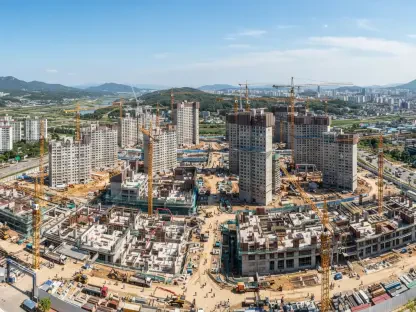
The British landscape, once defined by towering cranes and sprawling infrastructure developments, has recently transformed into a cautionary tale of economic vulnerability as industrial activity reaches its lowest point in several years. The sharp downturn observed in the United Kingdom construction sector signals a fundamental shift in market confidence, as builders grapple with a convergence of unfavorable global events and domestic financial pressures. Data from the S&P Global purchasing managers’ index reveals a staggering drop to 39.7, a figure that highlights a deep contraction far beyond the expected fluctuations of a typical business cycle. This decline has permeated every corner of the industry, from massive civil engineering projects to the essential development of residential housing and commercial office spaces. Developers are now facing an environment where the risks of proceeding with scheduled work often outweigh the potential rewards, leading to a standstill that threatens the long-term health of the national economy through 2026.
Drivers of the Current Industrial Stagnation
The Impact of Global Conflict: Energy and Logistics
Geopolitical instability has emerged as the primary catalyst for the current crisis, with the ongoing conflict in the Middle East specifically driving up the costs of essential utilities. The escalation of regional tensions, often referred to in industrial circles as the Iran war, has triggered a volatile spike in global energy prices that flows directly into the operational budgets of British construction firms. Suppliers, burdened by their own rising overheads, are increasingly passing these transportation and fuel costs down to builders through aggressive surcharges. This phenomenon has created the fastest rate of cost inflation since 2022, forcing companies to reconsider the viability of existing contracts. For many firms, the sudden increase in diesel and electricity prices has wiped out profit margins that were already thin. Approximately two-thirds of surveyed businesses reported that their cost burdens have become unmanageable, directly citing the instability of international fuel markets as the reason for their recent project cancellations.
The historical significance of this financial squeeze cannot be overstated, as current purchasing costs are rising at a rate rarely seen in the past three decades of data collection. Aside from the unique and highly volatile period following the global pandemic, the current trajectory represents the steepest climb in raw material expenses recorded in thirty years. This is not merely a localized issue but a systemic failure driven by the interconnected nature of modern logistics and energy consumption. As shipping lanes become more dangerous or expensive to navigate, the delivery of specialized components and raw materials like steel and timber has slowed to a crawl. The resulting delays have created a ripple effect, where stalled sites continue to accrue security and equipment rental costs without generating any progress or revenue. This environment of persistent inflation has discouraged new investment, as developers are unable to accurately forecast the final cost of a build, leading to a defensive posture across the entire United Kingdom.
Sector Performance: Housing and Infrastructure Trends
The contraction is not limited to a single niche but has spread aggressively through the civil engineering and residential housing sectors, which were previously the backbone of the industry. Homebuilders have been particularly hard-hit by a combination of high material costs and a cooling demand for new properties, as potential buyers face their own financial constraints. Large-scale infrastructure projects that once provided stable long-term employment for thousands of contractors are now being delayed or scaled back to preserve capital. This widespread retreat from active construction has led to the weakest performance metrics seen in the last five months, continuing a downward trend that established itself at the very beginning of the current year. Market analysts observe that the commercial sector is also suffering, with businesses hesitant to commit to new office spaces or retail developments while the economic outlook remains so bleak. This lack of demand creates a vacuum that is difficult to fill without significant state intervention.
Beyond the physical limitations of the market, there is a pervasive sense of psychological hesitation among business clients who traditionally drive private development. These stakeholders are increasingly risk-averse, opting to delay spending decisions rather than committing to long-term projects in a climate of geopolitical uncertainty. This scarcity of new contracts has created a fierce competition for the few available jobs, often driving prices down to unsustainable levels for the winning bidders. The fragility of the sector is further evidenced by the fact that even well-established firms are struggling to maintain their order backlogs. Without a steady stream of new project commencements, the industry faces a period of prolonged stagnation that could take years to reverse. The convergence of high build costs and the uncertainty regarding future interest rates has made it nearly impossible for developers to judge the correct timing for land purchases, effectively freezing the pipeline for future residential and commercial growth.
Navigating the Financial Crises in Development
Economic Uncertainty: Interest Rates and Project Viability
Interest rate volatility has introduced a level of complexity to project financing that few developers were prepared to manage during this current fiscal period. As borrowing costs remain high, the threshold for project viability has shifted, making many previously approved plans financially impossible to execute in the current climate. This financial strain is compounded by the fact that lenders have become more cautious, demanding higher levels of collateral and more rigorous stress-testing for any new construction loans. For small and medium-sized enterprises, this tightening of credit represents an existential threat, as they lack the cash reserves of larger corporations to weather a long-term downturn. The inability to secure affordable financing has resulted in a significant number of “shovel-ready” projects being mothballed indefinitely. Consequently, the industry is seeing a consolidation of power, as only the most capitalized firms can afford to maintain their presence in an increasingly expensive and exclusive market.
Logistical hurdles have further complicated the financial landscape, as international shipping delays continue to extend the timelines for essential project completions. When materials are delayed by weeks or months, the interest on construction loans continues to accumulate, adding thousands of pounds to the total cost of a project without adding any value. This synergy between logistical failure and financial pressure has forced many firms to seek domestic suppliers, only to find that local production cannot keep up with the demand or match the pricing of global markets. The resulting supply-demand imbalance has led to localized bidding wars for basic materials, further driving up the cost of construction for everyone involved. Industry experts emphasize that until there is a stabilization in both energy prices and global shipping routes, the risk of moving forward with large-scale developments will continue to outweigh the potential rewards. This cautious approach is now the standard operating procedure for the majority of the British construction sector.
Strategic Adjustments: Lessons From the Downturn
The construction industry eventually recognized that traditional growth models were insufficient for surviving such a sustained period of high inflation and geopolitical strife. Many firms transitioned toward more agile project management styles, prioritizing smaller, modular developments that required less upfront capital and offered faster turnover rates. This shift allowed some contractors to maintain cash flow while avoiding the massive risks associated with long-term, high-budget infrastructure projects. Others sought to diversify their portfolios by moving into the renovation and retrofitting markets, focusing on improving the energy efficiency of existing structures rather than breaking ground on new ones. These strategies provided a temporary buffer against the worst effects of the market contraction, although they did not entirely replace the revenue lost from the decline in major residential and commercial builds. These adjustments highlighted the necessity of flexibility in an era where global events can disrupt local industry in a matter of weeks.
Professional organizations and developers ultimately concluded that a closer partnership between the private sector and government agencies was required to restore stability. Efforts were made to streamline planning permissions and provide more robust financial guarantees for essential housing projects, which helped to slowly rebuild the depleted project pipeline. Builders also invested more heavily in domestic supply chains, reducing their reliance on volatile international shipping routes and protecting themselves from future fuel surcharges. These actions collectively established a more resilient foundation for the industry, ensuring that when economic conditions finally began to normalize, the sector was prepared to scale up operations efficiently. The focus shifted from pure expansion to long-term sustainability and risk mitigation, a lesson learned through the harsh realities of the mid-decade slump. This proactive approach to structural reform ensured that the industry remained capable of meeting the nation’s housing and infrastructure needs despite the significant challenges it encountered.