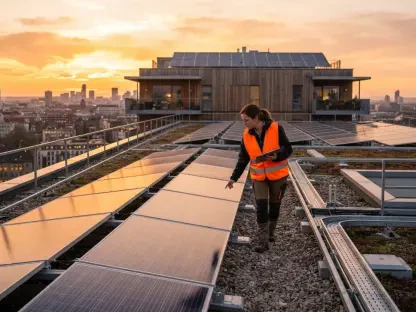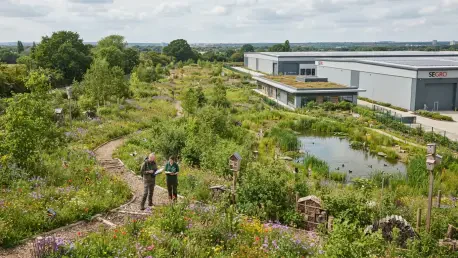

The integration of advanced botanical science into the sprawling corridors of logistics real estate signifies a decisive transition from traditional industrial utility toward a model of regenerative land stewardship. The collaboration between SEGRO, a preeminent developer of industrial property, and Kew Reach—an expert partnership involving the Royal Botanic Gardens, Kew, and Greensphere Capital—marks a transformative milestone in commercial land management. Centered on the Slough Trading Estate, this initiative introduces a comprehensive ten-year biodiversity enhancement program designed to bridge the gap between heavy industrial operations and ecological health. By embedding scientific rigor into landscape architecture, the project establishes a scalable blueprint for how the industrial sector can proactively address climate resilience and habitat restoration.
The Slough Trading Estate represents one of Europe’s most significant industrial hubs, housing over 320 businesses and supporting approximately 15,000 employees. Its immense scale makes it an ideal testing ground for high-impact environmental strategies that go beyond simple aesthetics. The core objective of this partnership is to implement “green infrastructure” that strengthens wildlife habitats while improving the working environment for a massive workforce. This ensures that large-scale commercial developments contribute positively to broader national ecological goals. The program seeks to demonstrate that industrial density and biological diversity are not mutually exclusive but can be harmonized through expert planning.
The Evolution of Industrial Land Use and Ecological Responsibility
To grasp the significance of this partnership, it is necessary to examine the historical trajectory of industrial development. For decades, industrial estates were designed with a purely utilitarian mindset, prioritizing paved surfaces, massive warehouses, and logistical efficiency over natural integration. This “gray infrastructure” approach often led to the fragmentation of local ecosystems and exacerbated the urban heat-island effect. However, as global awareness of biodiversity loss and climate change intensified, the property sector faced increasing pressure to modernize its approach to land management.
The shift toward “green logistics” represents a fundamental change in industry values. Foundations laid by early sustainability movements have evolved into sophisticated corporate social responsibility frameworks. Today, the real estate industry recognizes that land surrounding industrial buildings—once seen as dead space—is a vital asset for environmental mitigation. This historical context underscores why the SEGRO and Kew Reach partnership is so significant; it replaces the outdated model of ornamental greenery with a scientifically backed strategy that views industrial land as a functioning part of the natural world.
Implementing Science-Led Biodiversity Strategies
The Role: Rigorous Data and Expert Ecological Guidance
A defining characteristic of this program is its total reliance on peer-reviewed science rather than generic landscaping practices. SEGRO has enlisted Kew Reach to provide specialized insights from researchers and ecologists associated with the Royal Botanic Gardens, Kew. This team conducted a meticulous assessment of the estate’s existing landscape and operational constraints. The resulting program involves the introduction of approximately 500 trees and shrubs, but the selection process was uniquely rigorous. More than 300 plant species were analyzed against factors such as carbon sequestration, drought tolerance, and flood resilience. This data-driven approach ensures that the chosen flora provides maximum ecological value while supporting the health of the surrounding Slough community.
Long-Term Climate Resilience: Future-Proofing the Estate
One of the most forward-thinking aspects of the Slough initiative is its focus on the future climate. The environmental conditions that trees will face in the coming decades differ significantly from historical norms. As rainfall patterns shift and temperatures rise, the resilience of industrial flora becomes a critical concern for asset protection. The ten-year duration of the program reflects a commitment to long-term survival rather than short-term optics. This period covers the years 2026 through 2034, aligning with the estate’s Simplified Planning Zone. By planning for a decade of growth, the partnership ensures that the landscaping matures into a self-sustaining ecosystem capable of providing cooling and natural flood management as the climate evolves.
Expanding Ecological Impact: The Property Portfolio Strategy
While the Slough Trading Estate serves as the immediate focus, the implications of this partnership extend across a massive property portfolio. The collaboration resulted in the creation of a bespoke, regionalized planting guide that serves as a practical framework for development teams. This document allows for the implementation of scientifically backed landscape strategies across diverse geographic locations. By considering regional environmental variations, the guide helps property managers select species suited to local soil types and weather patterns. This ensures that every project, from data centers to logistics hubs, benefits from the same level of ecological scrutiny, setting a new standard for national estate management and ensuring consistency in biodiversity net gain.
Emerging Trends in Sustainable Industrial Development
The partnership between SEGRO and Kew Reach aligns with several emerging trends shaping the future of the built environment. There is a clear move toward “Nature-Positive” development, where the goal is not just to minimize harm but to actively improve the environment. Regulatory shifts are increasingly mandating that developers leave the natural environment in a better state than they found it. Furthermore, technological innovations in “PropTech” are allowing developers to monitor the health of these new ecosystems in real-time using sensors and satellite imagery. In the coming years, more industrial sites will likely incorporate sophisticated water recycling systems and “living walls” that integrate directly with building structures to provide natural insulation.
Strategies: Integrating Biodiversity into Commercial Assets
For businesses looking to replicate this success, several actionable strategies emerge from this model. First, it is essential to prioritize “functional” biodiversity over “ornamental” landscaping; plants should be chosen for their specific environmental benefits, such as air filtration or water absorption, rather than just their appearance. Second, long-term maintenance must be factored into the initial design phase to ensure that green investments do not fail during periods of extreme weather. Collaboration with scientific institutions provides the necessary data to justify these investments to stakeholders. Additionally, companies should look at their land holdings holistically, creating regional planting guides that allow for consistency while respecting local ecological nuances.
Redefining the Industrial Landscape for the Future
The partnership between SEGRO and Kew Reach represented a sophisticated evolution in the “industrial estate” concept. It moved away from the view of industrial land as purely utilitarian, reimagining it as a productive part of the natural landscape. By combining scientific prestige with operational scale, the initiative addressed the urgent needs of climate adaptation and biodiversity restoration. The project demonstrated that the built environment could evolve to become more resilient and ecologically valuable. Stakeholders recognized that “planting well” was far more effective than simply “planting more,” establishing a model where research and practical management converged to protect assets. Moving forward, the industry adopted these regionalized guides to ensure that every new development contributed to a wider network of corridors that supported both economic productivity and environmental health.