
As an expert in construction and urban design, Luca Calarailli has spent a career analyzing how the built environment shapes human interaction. With a particular focus on the intersection of heritage and innovation, he has become a leading voice in the transformation of neglected urban spaces. Our conversation today centers on the ambitious revitalization of the former Bell College site in Hamilton—a project that represents a $52 million investment in the future of the local community. We explore the complexities of managing historic brownfield sites, the strategic integration of diverse housing tenures, and the profound impact that well-designed public spaces have on the long-term vitality of a neighborhood.
This project involves a $52 million investment to revitalize a site with a long history as both a military barracks and a college. What are the specific technical challenges of prepping such a historic brownfield location, and how do you balance preserving local heritage with modern infrastructure needs?
Transforming a site with the history of the Hamilton Barracks and the subsequent Almada Street Campus requires a deep understanding of site evolution. With a $52 million investment, the primary challenge often lies in remediating land that has served heavy-duty institutional purposes for decades before it can support 142 new residences. You are essentially peeling back layers of time, ensuring that old utility footprints from the college era are upgraded to meet modern environmental standards. Balancing heritage is about “breathing new life” into the location without erasing its identity, ensuring the prime location remains a recognizable landmark while providing the structural integrity required for contemporary living.
The development includes 142 units ranging from apartments to detached houses, alongside a significant portion of affordable housing. How does the integration of varied housing types influence community cohesion, and what specific design features are included to accommodate residents with particular physical or accessibility needs?
A mixed-tenure scheme is the cornerstone of a resilient neighborhood because it prevents the social isolation often found in monocultural developments. By offering everything from apartments to detached houses, we create a multi-generational environment where 36 affordable homes sit alongside private residences. To ensure true inclusivity, a number of these council homes are specifically engineered for tenants with particular needs, featuring wider doorways, level-access entries, and adaptive internal layouts. This partnership-first approach ensures that high-quality, accessible housing is not an afterthought but a primary deliverable of the master plan.
Beyond the residential units, the plan incorporates pedestrian routes, green spaces, and public play areas on the former campus grounds. What is the strategic importance of these communal elements in an urban redevelopment, and how do they impact the long-term property values for the surrounding neighborhood?
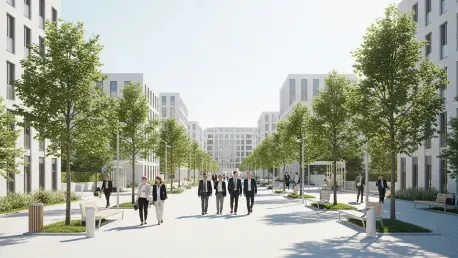
Communal elements are the “connective tissue” that transforms a collection of buildings into a thriving community. By integrating new pedestrian routes and public play areas, we are turning a once-closed campus into a well-connected hub that invites the surrounding Hamilton neighborhood inside. These green spaces act as a natural lung for the area, which significantly bolsters property values by providing a high quality of life that purely residential blocks cannot offer. When a derelict site becomes a scenic, walkable environment, it stabilizes the local market and attracts further investment into the town.
Public-private partnerships and government funding programs are central to delivering these 36 new council homes. What does the collaboration process look like between a major housebuilder and local government, and what financial or regulatory milestones are most critical for keeping a project of this scale on schedule?
The synergy between a top 10 housebuilder and South Lanarkshire Council is a delicate dance of aligning commercial efficiency with public policy goals. A critical milestone for this project was securing joint funding through the Scottish Government’s Affordable Housing Supply Programme, which provided the financial bedrock for the council-owned portion of the site. Regulatory success depends on meeting strict “high-quality home” benchmarks that satisfy both the executive directors of housing and the technical resource teams. Keeping a project of this scale on track requires constant communication to ensure that the delivery of the 36 affordable units coincides perfectly with the broader site infrastructure.
Turning a disused, derelict space into a thriving residential hub represents a major shift for the Hamilton area. Can you walk through the phases of transforming a site from a state of disrepair to a functional community, and what metrics are used to measure the social success of such a transition?
The transformation begins with the transition from a “disused” university asset to a construction-ready site, followed by the intensive phase of installing new infrastructure for 142 units. We measure success by more than just the 35,000-home track record of the developer; we look at the “genuine difference” it brings to the residents’ daily lives. Social success is quantified through the occupancy rates of the diverse housing types and the active use of the new public play areas by local families. When a site that was once a barracks and a derelict college starts buzzing with the activity of a multi-tenure community, the social metric is essentially “mission accomplished.”
What is your forecast for brownfield residential development in the coming decade?
I anticipate that brownfield redevelopment will become the dominant mode of urban expansion, as the pressure to preserve greenbelts forces us to be more creative with sites like the one in Hamilton. We will see an even deeper integration of technology in the remediation phase, allowing us to reclaim increasingly complex derelict spaces for residential use. The “partnership-first” model seen here will likely become the global standard, where government subsidies and private expertise combine to tackle the housing crisis. Ultimately, the next decade will be defined by our ability to see potential in disrepair and turn the relics of our industrial and institutional past into the vibrant, inclusive neighborhoods of our future.