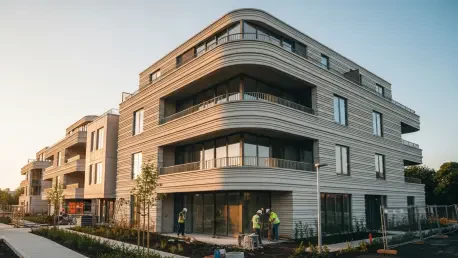

The global housing crisis has reached a critical juncture where traditional construction methods can no longer keep pace with the skyrocketing demand for affordable, high-density urban living spaces. While individual 3D-printed homes have captured public imagination over the last few years, the real challenge lies in whether this technology can scale upward to accommodate multi-family developments. A recent breakthrough in Bezannes, France, has provided a definitive answer with the completion of the ViliaSprint² project, which currently stands as the largest 3D-printed multi-family residential building in Europe. Spanning 800 square meters, this three-story structure houses twelve separate social housing units, effectively shattering the glass ceiling of single-story additive manufacturing. By successfully navigating the complexities of vertical loads and multi-unit integration, this project demonstrates that automated construction is no longer a niche experiment but a viable solution for modern urban planning.
The technical achievements of the ViliaSprint² project reveal a significant shift in how density and architectural form are approached in the digital age. Unlike conventional rectangular blocks, the building utilizes complex curved geometries that were previously too expensive or difficult to execute with standard masonry. By employing a Bod2 printer and specialized synthetic macro-fiber-reinforced concrete, the engineering team managed to eliminate a substantial amount of traditional steel reinforcement while maintaining structural integrity. This transition to a fully load-bearing 3D-printed system allowed for a ten percent reduction in total material usage, which is a massive win for both cost and sustainability. Furthermore, the printing phase was completed in a mere 34 days, remarkably outpacing initial estimates and reducing the overall construction timeline by three full months. This efficiency suggests that as the technology matures through 2027 and 2028, the speed of delivery will become a primary driver for municipal housing authorities.
Scaling Success: From Proof of Concept to Urban Standard
Building on this foundational success, the comparative data gathered from the Bezannes site offers a rare glimpse into the economic reality of automated construction versus traditional craftsmanship. To ensure an objective analysis, a near-identical building was erected nearby using conventional methods, serving as a direct benchmark for performance, waste, and labor costs. The findings were stark; the 3D-printed version saw a fifty percent decrease in on-site waste and significantly lower transportation costs due to on-site material mixing. This reduction in the logistical footprint is particularly crucial for urban environments where space is limited and carbon emissions are strictly regulated. While initial equipment costs remain high, the ability to slash labor requirements and accelerate occupancy schedules provides a compelling financial argument for developers. The success of this twelve-unit structure has already paved the way for an even more ambitious 40-unit residential complex, which will utilize a fleet of synchronized printers to further optimize the workflow.
The path forward for multi-family 3D printing involves moving beyond the “novelty” phase and integrating these tools into the standard architectural toolkit. For developers and city planners, the next logical step is the standardization of 3D-printable building codes and the certification of specialized concrete mixes to ensure long-term durability across different climates. Stakeholders should prioritize the training of a new generation of digital construction managers who can oversee robotic fleets rather than just manual crews. As the industry moves from 2026 toward the end of the decade, the focus must shift to hybridizing 3D printing with other modular technologies, such as prefabricated utility cores and green roofing systems. Investing in localized material supply chains will also be essential to keep costs competitive with traditional masonry. Ultimately, the ViliaSprint² project proved that the technology is ready for the rigors of high-density living, leaving the industry with a clear mandate to scale these innovations into every major metropolitan housing strategy.