
Modern educational paradigms are shifting away from traditional classroom confinement toward immersive, interdisciplinary environments where students address real-world ecological challenges through hands-on application and scientific inquiry. At Norcrest Elementary in Pompano Beach, this shift took the form of the Green Build Lab, a pioneering pilot STEM initiative that recently completed its intensive six-week curriculum. Designed for twenty-five selected students spanning second through fifth grade, the program moved beyond textbook theory to integrate the rigorous principles of landscape architecture with the fluidity of artistic expression. Led by Alexa Simeone of Art Lab, the initiative transformed the school grounds into a living laboratory where young learners explored the complexities of soil science and environmental design. This project was not merely an after-school activity but a comprehensive educational experiment aimed at bridging the gap between abstract scientific concepts and tangible community impact. By engaging with local experts and utilizing professional-grade methodologies, these students transitioned from passive observers of nature to active participants in the construction of their local environment, setting a high standard for future primary education.
Integrating Science and Environmental Stewardship
Bridging the Gap: Art and Engineering
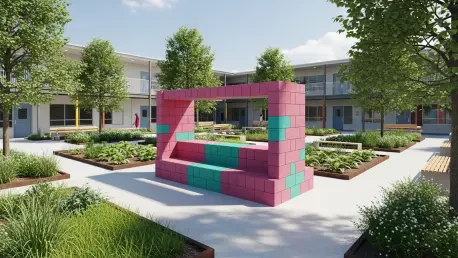
The intersection of creative design and structural integrity served as the foundational pillar for the weekly sessions held during the program’s lifecycle. Students engaged in “maker labs” where they were tasked with repurposing unconventional materials, including marine debris and common kitchen artifacts, into functional pieces of environmental art. This process required a sophisticated understanding of material durability and aesthetic harmony, forcing participants to consider how recycled components could be stabilized for long-term outdoor exposure. The centerpiece of this effort was the creation of a modular bench, designed to evoke the appearance of interlocking blocks and finished in a vibrant palette of teal, pink, and yellow. This construction phase allowed the children to visualize the transition from a conceptual drawing to a three-dimensional structure that must withstand both human use and the elements. Such activities reinforced the idea that engineering is not a dry or purely mathematical field but a creative endeavor that requires a high degree of imagination and resourcefulness to solve modern waste problems.
Furthermore, the curriculum emphasized the scientific necessity of understanding local geology and biology before any physical construction could begin. The participants delved into the intricacies of soil composition, learning how different layers of earth support various types of vegetation and influence drainage patterns within a garden setting. This scientific grounding ensured that the artistic elements of the project were supported by a solid ecological foundation. By investigating the relationship between native plant species and the surrounding soil, the students gained a deeper appreciation for the delicate balance required to maintain a healthy ecosystem. They explored how landscape architecture must respect these natural constraints to create sustainable spaces. The culminating project, which integrated the student-painted bench with the planting of a native tree, demonstrated a sophisticated synthesis of human-made infrastructure and natural growth. This approach taught the children that successful environmental stewardship requires a holistic view where art and science do not exist in isolation but work together to enhance the local landscape.
Cultivating Practical Environmental Literacy
A significant portion of the Green Build Lab was dedicated to the study of native flora and its role in regional biodiversity conservation. The students were introduced to the specific environmental requirements of local plant life, moving beyond general gardening to focus on species that are naturally adapted to the Florida climate. This targeted education helped the children understand why native plants are essential for supporting local pollinators and maintaining soil health without the need for excessive chemical fertilizers or irrigation. By working directly with these species, the young builders learned the practicalities of sustainable landscaping, including the strategic placement of trees for shade and the selection of plants that provide habitats for indigenous wildlife. This hands-on experience translated complex environmental issues into manageable tasks, empowering the students to see themselves as capable environmentalists. The lesson plans were structured to ensure that every scientific fact was accompanied by a physical application, which significantly enhanced the students’ ability to retain and apply their newfound knowledge.
Moreover, the program challenged the traditional educational silos that often separate scientific inquiry from social responsibility and design. The curriculum encouraged students to view the school’s garden as a microcosm of the larger world, where their decisions have immediate and visible consequences. Through the process of designing and building the garden features, they learned the value of long-term planning and the importance of resilience in environmental design. They had to account for variables such as seasonal weather changes and the growth rate of the vegetation they planted, which fostered a sense of foresight rarely developed at such a young age. This practical literacy is vital in an era where environmental challenges are becoming increasingly complex and require a workforce capable of thinking across multiple disciplines. By the end of the six weeks, the students had not only built a physical garden but had also constructed a mental framework for understanding how human intervention can be used to restore and protect the natural world rather than merely consuming its resources for short-term gain.
Building Community Through Educational Synergy
Collaborative Frameworks: A Unified Effort
The success of this pilot program was deeply rooted in the extensive network of community stakeholders who provided the necessary resources and expertise to bring the vision to life. This initiative was characterized by a profound synergy between the Norcrest PTA, the Pompano Beach Rotary Club, and the Pompano Beach Commission, illustrating that effective education requires a village-wide commitment. These organizations did not simply provide financial sponsorship; they offered technical guidance and logistical support that elevated the program’s quality. For instance, professional landscape architects and environmental experts volunteered their time to consult with the students, providing a real-world context for their classroom activities. This collaborative model demonstrated that when local government, civic organizations, and educational institutions align their goals, they can create powerful learning opportunities that far exceed what a single school could achieve alone. The involvement of these diverse groups ensured that the students felt the weight of their responsibility, knowing that their work was supported and valued by the broader community in Pompano Beach.
In addition to high-level coordination, the day-to-day operations of the lab relied on the dedication of local volunteers who managed everything from material procurement to meal preparation for the participants. This grassroots support allowed the lead instructors to focus entirely on the delivery of the curriculum, ensuring that the students received high-quality instruction throughout the six-week duration. The funding provided by the sponsors covered the costs of specialized tools, high-grade recycled materials, and the native plants that now anchor the school’s sustainable garden. This investment in the youth of Norcrest Elementary served as a testament to the community’s belief in the importance of STEM education and environmental literacy. By removing the financial barriers that often hinder such ambitious projects, the partners ensured that the program remained inclusive and accessible to all interested students. This unified effort established a reproducible framework for future initiatives, proving that the most effective way to foster innovation in schools is to leverage the collective assets and passions of the surrounding community.
Fostering Student Ownership and Sustainability
The project concluded with a significant unveiling ceremony on April 8, which served as a public validation of the students’ hard work and creative achievements. Despite inclement weather moving the event indoors, the atmosphere remained celebratory as the young “builders, scientists, and artists” presented their contributions to the school community. Principal Max Castillo emphasized that the most lasting impact of the Green Build Lab is the profound sense of ownership it instilled in the students. Because the children were responsible for every phase of the garden’s development—from the initial sketches of the modular bench to the final planting of the native tree—they developed a personal connection to the space. This psychological investment is a key driver of long-term environmental stewardship; students who build a landscape are far more likely to protect and maintain it over time. The vibrant, student-painted structures now stand as a permanent reminder of what can be accomplished when young minds are given the tools and agency to transform their physical surroundings.
The actionable path forward for educational institutions and community leaders involves the replication of this interdisciplinary model to address local ecological needs while simultaneously meeting STEM learning objectives. Schools should seek to establish standing partnerships with local architectural firms and environmental non-profits to provide students with consistent access to industry-standard mentorship. Stakeholders identified that the integration of “maker spaces” with outdoor ecological labs significantly increased student engagement and retention of scientific principles. Future programs must prioritize the use of upcycled materials to reinforce the circular economy concept, turning waste management into a creative design challenge. By formalizing these community-driven educational tracks, districts can ensure that students develop the practical skills and civic-mindedness required to navigate and mitigate modern environmental pressures. The Green Build Lab served as a successful proof of concept, demonstrating that the fusion of art, science, and community action is a viable strategy for empowering the next generation of environmental leaders.