
Navigating the bustling corridors of Chicago O’Hare International Airport has long been a rite of passage for millions of global travelers who rely on this Midwestern hub as a vital bridge between continents. As air travel demands evolve, the aging infrastructure has faced increasing pressure, leading to the commencement of the $1.45 billion Concourse D expansion. This project represents more than just a local construction endeavor; it is a foundational shift in how one of the world’s busiest hubs facilitates domestic and international movement. This massive undertaking seeks to resolve long-standing bottlenecks while elevating the passenger experience to meet modern standards of efficiency.
The scope of this timeline highlights the transition from conceptual planning to the tangible reality of vertical construction. By examining the milestones of this 580,000-square-foot facility, it becomes clear how Chicago aims to maintain its status as a premier transit leader. This expansion is relevant today as cities worldwide race to modernize transportation networks, ensuring they can accommodate the next generation of aircraft and a growing volume of travelers seeking comfort and streamlined service.
The Evolutionary Path of the Concourse D Expansion
2018: The Authorization of the ORDNext Master Plan
The journey toward a modernized O’Hare began in earnest when city officials and airline partners approved the ORDNext initiative. This $8.5 billion program was designed as a comprehensive overhaul of the airport’s terminal core. The Concourse D expansion was identified early on as a vital component of this strategy, intended to alleviate congestion and provide the necessary footprint for future upgrades, including the eventual replacement of the outdated Terminal 2. This period established the financial and strategic framework required to support a project of such immense scale.
Early 2025: Site Preparation and Foundational Milestones
Before any structures could rise above the airfield, engineers focused on the complex task of subterranean stabilization. By the early months of 2025, the project reached a significant milestone by completing roughly 35 percent of its foundational work. This phase involved the installation of over 90 percent of the caissons, which are deep concrete shafts designed to support the heavy structural loads of the future concourse. This technical progress ensured that the site was ready for the transition from groundwork to visible construction.
August 2025: Formal Groundbreaking and Vertical Commencement
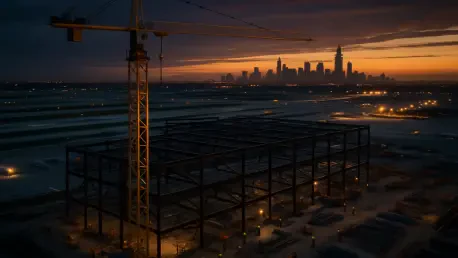
The project entered its most visible phase in August 2025 with the official groundbreaking ceremony. This event signaled the arrival of a massive 195-foot-tall tower crane, a landmark addition to the Chicago skyline that facilitates the assembly of the 73-foot-tall building. This period marked the shift to vertical construction, where the skeletal frame of the 19 new gates began to take shape. The focus during this timeframe also included the development of a central cooling facility, a critical piece of utility infrastructure designed to support the entire ORDNext program’s future cooling needs.
The Near Future: Completion and Operational Integration
As construction continues, the focus will shift toward the interior fit-out and airfield integration. The final stages of the timeline involve the completion of 50,000 square feet of retail, dining, and lounge spaces. Once operational, the facility will undergo rigorous testing to ensure the flexible gate configurations—which allow 18 narrow-body gates to be converted into nine wide-body positions—are ready for active flight schedules. This final phase will conclude with the full integration of Concourse D into the O’Hare terminal map, providing a seamless transition for passengers moving through the airport.
Significant Turning Points and Structural Impacts
The most significant turning point in this expansion is the introduction of gate flexibility. The ability to switch between narrow-body and wide-body configurations allows the Chicago Department of Aviation to react in real-time to shifting industry trends, such as the increased use of larger aircraft for international routes. This versatility is a recurring theme in modern aviation architecture, where static designs are being replaced by adaptable spaces.
Another overarching theme is the integration of utility resilience. The construction of the central cooling facility serves as a backbone for all future projects under the ORDNext banner, highlighting a shift toward centralized, efficient infrastructure rather than piecemeal upgrades. While the progress is substantial, a notable area for future exploration remains the seamless connection between this new concourse and the proposed global terminal, which will be essential for maintaining a unified passenger flow across the airport’s massive footprint.
Regional Competitive Factors and Emerging Innovations
Beyond the airfield, the Concourse D project is part of a larger narrative regarding Chicago’s economic competitiveness. The project is estimated to generate over 3,800 construction jobs, contributing significantly to the regional economy. This investment mirrors other major transit upgrades, such as the $5.7 billion Red Line Extension, suggesting a city-wide effort to synchronize air and rail improvements. Experts suggest that these dual investments were necessary to prevent Chicago from losing its competitive edge to other major metropolitan hubs that are also aggressively modernizing their transit assets.
A common misconception is that this expansion only benefits international travelers; however, the focus on narrow-body aircraft gates indicates a heavy emphasis on improving the domestic short-haul experience. By creating dedicated spaces like the children’s play area and expanded retail zones, the project addressed the “stress points” of modern travel. This methodology focused on the holistic passenger journey, ensuring that the time spent between flights was as productive or relaxing as possible, thereby reinforcing O’Hare’s reputation as a world-class gateway.
The strategic authorization of the ORDNext master plan successfully paved the way for these physical transformations. Officials identified that a unified transit network required both aviation and rail upgrades to function at peak capacity. As Concourse D moved toward completion, attention turned to the next phases of the terminal area plan, specifically the conceptualization of Concourse E and the long-term integration of the Global Terminal. These steps ensured that O’Hare remained a dominant force in the global logistics and travel sectors for decades to come.