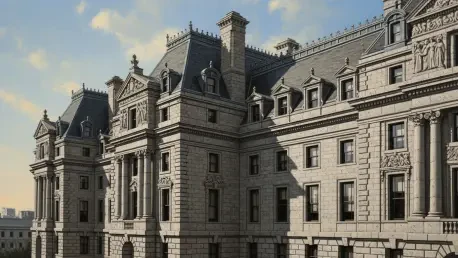

As a leader in the construction and architecture sectors, Luca Calarailli brings a sophisticated understanding of how material science intersects with the preservation of our nation’s most storied landmarks. With an extensive background in structural design and a keen interest in the technological innovations driving the industry forward, he offers a critical perspective on the delicate balance between modern aesthetics and historical integrity. In this discussion, we explore the technical and legal complexities surrounding the controversial proposal to apply mineral silicate coatings to the granite facade of the Eisenhower Executive Office Building. Calarailli breaks down the science of chemical bonding, the irreversible risks of surface abrasion, and the vital importance of federal oversight in protecting the architectural heritage of Washington, D.C.
Mineral silicate paints are typically formulated to bond with stones containing calcium carbonate, such as limestone or marble. Since granite lacks this compound, how does the chemical bonding process fail in this scenario, and what specific mechanical steps, like sanding or etching, would be required to force adhesion?
The fundamental issue is that mineral silicate paints rely on a chemical reaction known as silicification, which requires a substrate rich in calcium carbonate to form a permanent, breathable bond. Because granite is an igneous rock composed primarily of quartz and feldspar, it lacks the necessary chemical “hooks” for this reaction to occur naturally. To force any level of adhesion, contractors would have to aggressively sand, scarify, or etch every single surface of the relatively smooth and non-absorbent granite blocks. This mechanical abrasion creates a profile for the paint to grip, but it also destroys the stone’s natural protective patina. Without such invasive preparation, the paint would likely peel or flake away shortly after application, failing to provide any of the “magic” protective qualities promised.
Applying a permanent coating to historic granite often requires abrasive surface preparation that can permanently alter the stone. Could you walk us through the long-term structural risks of scarifying the face of a building, and what the specific technical challenges are when trying to remove a hazy, filmy residue later?
When you scarify the face of a historic building, you are essentially performing a permanent surgical procedure on the structure’s skin that cannot be undone. This process thins the exterior layer of the 25 specialists’ cited granite, potentially making it more susceptible to environmental weathering and micro-cracking over the coming decades. If a future administration decides to restore the original look, they would face the nightmare of removing a silicate coating that has partially bonded through mechanical means. Removal typically requires harsh chemical stripping or further abrasive blasting, which often leaves behind a stubborn, hazy, and filmy residue that clouds the natural beauty of the gray stone. This cycle of coating and removal can lead to a cumulative loss of detail in the masonry, slowly erasing the building’s architectural character.
Surface coatings are often described as a solution for water penetration, yet moisture usually enters through joints, sealants, or flashing. What are the practical steps for addressing internal flaws and cracks in granite, and how might a white finish actually make iron staining or leaching more visible over time?
True moisture protection comes from maintaining the integrity of the building’s “envelope” systems—specifically the joints, sealants, flashing, and mortar—rather than just painting the face of the stone. A surface coating is merely a cosmetic layer; it does not repair internal structural flaws, bridge active cracks, or enhance the inherent durability of the granite blocks themselves. In fact, applying a white finish to a material like granite can backfire aesthetically because it creates a high-contrast canvas for natural leaching and iron staining. As water moves through the stone and carries minerals to the surface, these discolorations will pass through breathable coatings and appear as vivid orange or brown streaks. On a white background, these inevitable stains become far more glaring than they would be on the original variegated gray facade.
Federal standards usually require public notice and stakeholder consultation before significant work begins on historic landmarks. Why is this collaborative review process vital for preventing irreversible harm, and what are the potential consequences of skipping environmental impact studies when dealing with materials that have unique durability requirements?
The collaborative review process mandated by the National Historic Preservation Act and the National Environmental Policy Act is designed as a “fail-safe” to ensure that impulsive decisions don’t lead to the ruin of national treasures. By engaging stakeholders and preservationists early, agencies can identify whether a proposed material—like this silicate paint—is technically compatible with the substrate before millions of dollars are spent. Skipping these studies ignores the rigorous material science required to maintain high-durability structures like the Eisenhower building. The consequence of bypassing this due diligence is often “irreversible harm,” where a lack of early consideration leads to locked-in technical failures that compromise the building’s lifespan and historical value.
Modern stylistic preferences sometimes favor brighter finishes over original gray stone to better match neighboring architecture. How do you balance these aesthetic goals with the need to preserve authentic materials, and what metrics should be used to determine if a renovation project compromises the historical integrity of a district?
Balancing contemporary taste with preservation requires a “materials-first” approach where the authenticity of the stone’s original character takes precedence over fleeting stylistic trends. While some might argue that “gray is for funerals” and prefer a brighter White House-adjacent aesthetic, the metric for success should always be the retention of the building’s original design intent and material honesty. We evaluate projects based on whether they respect the National Historic Preservation Act’s standards, which generally discourage covering up natural materials with opaque coatings. If a renovation masks the unique textures and colors that define a historic district, it fundamentally compromises the integrity of that district by turning a genuine historic artifact into a mere imitation of its neighbors.
What is your forecast for the future of historic preservation in Washington, D.C.?
I believe we are entering a period of heightened legal and technical scrutiny where the “take care” clause of the Constitution will be increasingly invoked to protect our federal architectural assets. With lawsuits currently surrounding the Eisenhower building, the Kennedy Center, and even HUD headquarters, the future of D.C. preservation will likely be defined by a tug-of-war between executive-led modernization and the established frameworks of environmental and historical law. We will see a shift toward more transparent, data-driven restoration projects where the long-term chemical compatibility of materials is prioritized over immediate visual changes. Ultimately, the preservation community will remain a powerful check against any plans that prioritize “magic” solutions over the proven, time-tested methods of stone masonry and structural conservation.