
Luca Calarailli brings a wealth of experience in heavy construction and architectural design to the conversation regarding one of the nation’s most vital rail arteries. With a career dedicated to the intersection of traditional engineering and innovative technology, he understands the high stakes involved when repairing century-old infrastructure that serves millions of commuters. In this discussion, we explore the complexities of the $1.6 billion East River Tunnel project, examining the logistical shifts in tunnel restoration, the hidden technical hurdles found beneath the surface, and the strategic decision to prioritize long-term structural integrity over short-term scheduling conveniences.
When managing a project of this magnitude, why is opting for a continuous, contractor-controlled outage often prioritized over traditional night and weekend work windows?
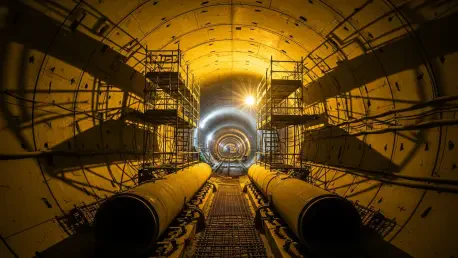
Making the call to fully shut down a tube like Line 2 is never easy, but it is fundamentally the most cost-effective and safest way to handle a $1.6 billion rehabilitation. When you rely on those small night or weekend windows, you lose an incredible amount of time just installing and then tearing down temporary railroad systems so the morning commuters can pass through. By securing a continuous outage, our teams have uninterrupted access to rebuild complex drainage systems and repair the tunnel liner without the constant friction of clearing the site every few hours. This strategy not only prevents the schedule from ballooning but also allows for a much more efficient workflow where the contractor is in total control of the environment. For Line 1, we are looking at a 13-month outage precisely because this method has proven to be the only way to tackle deep-seated structural issues effectively.
Once the demolition of the century-old bench walls began, what kind of unforeseen challenges did the team encounter beneath the surface?
The reality of working on a structure that has seen a century of use is that you never truly know what you’re dealing with until you start the heavy demolition. Once those bench walls were removed, the team discovered a grim scene: collapsed cable conduits with almost no spare capacity and drainage systems that were so clogged they were essentially useless. It became clear very quickly that surface-level repairs wouldn’t cut it and that a comprehensive rebuild was the only path forward for the long-term health of the tunnel. We found that by removing that old material, we could finally address the hydrostatic pressure on the tunnel liner, which is the root cause of the water intrusion. These discoveries were a real turning point for the project, proving that the decision to undergo a full outage was the only way to actually fix the underlying decay rather than just masking it for a few more years.
Technical hurdles such as ceiling voids often disrupt even the most meticulous schedules; how did these discoveries influence the engineering approach for the catenary installation?
During the catenary installation phase, we hit a significant snag when we found that more than half of the 203 ceiling locations we inspected contained voids. This wasn’t just a minor technicality; it required immediate engineering changes before any support hardware could be safely mounted to the ceiling to ensure the power lines remain stable. Even though the tunnel remains structurally safe, you cannot simply ignore gaps in a century-old liner when you are installing high-tension hardware that needs to last for decades. We had to pivot our sequence of work, which is why the reopening of Line 2 shifted to August, roughly a month later than we initially hoped. This experience has been a vital lesson that we are carrying into the Line 1 reconstruction this fall, as it allows us to anticipate these “hidden” voids and resequence our engineering response much earlier in the timeline.
As the project transitions from the first tube to the next, how is the team applying the hard-earned lessons from Line 2 to ensure the 2027 completion goal remains realistic?
Every inch of progress on Line 2 has provided a blueprint for how we will handle the 13-month outage for Line 1 starting this fall. We are currently refreshing the track work schedule to ensure all “infrastructure hardening” is completed before the main closure begins, which helps mitigate the risk of mid-project delays. One of the major takeaways is the need to address drainage and water leaks much earlier in the process to “chase” fewer leaks during the final stages of construction when time is tightest. We are taking the data from those 203 ceiling locations and the bench wall demolition to refine our expectations for what lies behind the concrete in the next tube. While the $1.6 billion project is a massive undertaking, the knowledge we’ve gained about reducing hydrostatic pressure and managing contractor-controlled outages keeps us firmly on pace for a 2027 finish.
What is your forecast for the long-term resilience of the Northeast Corridor’s transit tunnels?
My forecast is that we are entering a “century of renewal” where we will finally see these vital links hardened against the type of extreme weather events, like Hurricane Sandy, that have plagued them in the past. By investing $1.6 billion now to address the root causes of deterioration—like clogged drainage and liner pressure—we are effectively resetting the clock for the next 100 years of service. We will see a much more reliable Northeast Corridor because we are choosing to do the hard, deep work of a full rebuild rather than just patching holes and hoping for the best. The transition to continuous outages marks a shift in how we approach urban infrastructure; we are prioritizing the long-term integrity of the rail line over the temporary inconvenience of a closure. Ultimately, this means that by 2027, the millions of passengers who rely on this link will have a safer, drier, and more robust piece of engineering beneath the East River.