
Luca Calaraili stands at the forefront of the modern construction landscape, blending a deep mastery of architectural design with a keen eye for the technological shifts reshaping our built environment. With a career dedicated to navigating the complexities of large-scale infrastructure and industrial innovation, he has become a leading voice on how global firms balance massive growth opportunities against the inherent risks of a volatile market. In this conversation, we explore the current surge in private sector investment, the strategic pivot toward more secure contract structures, and the evolving dynamics of public-sector infrastructure funding. We also delve into the lessons learned from high-stakes projects where productivity challenges can lead to significant financial adjustments, providing a comprehensive look at the state of the industry today.
With the private sector accelerating its footprint, particularly in the digital infrastructure space, how do you see the current landscape for data center development evolving compared to previous cycles?
The current cycle is defined by an incredibly healthy funding environment that sets it apart from anything we have seen in recent decades. We are seeing a sustained runway for the data center boom, primarily driven by hyperscalers who are ramping up their investments to meet the insatiable global demand for processing power. This has transformed data center work into one of the fastest-growing segments of the business, characterized by deep, expanding relationships with these massive private-sector clients. Unlike past booms that felt speculative, the current momentum is backed by concrete expansion plans and a clear strategic need for infrastructure. It creates a very strong tailwind that allows for more aggressive long-term planning, as the outlook remains robust and fast-growing despite broader economic fluctuations.
Beyond the digital sphere, public infrastructure and military facilities are seeing a significant uptick in activity. What is driving the expansion in these specialized sectors?
The growth we are seeing in water infrastructure and the Department of War pipeline is quite remarkable, with both sectors expanding by about 30% in the most recent quarter. This surge is largely due to increased facility requirements, where being a leading provider for the Army and the Navy provides a stable and consistent project flow. At the same time, state and local clients are rolling out multiyear plans for critical infrastructure like highways, bridges, transit, and rail. There is also a lot of anticipation surrounding the House’s initial $580 billion proposal for surface transportation, which signals a continued bipartisan commitment to investment. Even though the original $1.2 trillion Infrastructure Investment and Jobs Act is set to expire on September 30, the underlying demand for modernizing these essential systems keeps the pipeline incredibly active.
Every major firm eventually faces a project that tests their resilience and risk management. How do you interpret the impact of unexpected subcontractor productivity shifts on massive modernization programs?
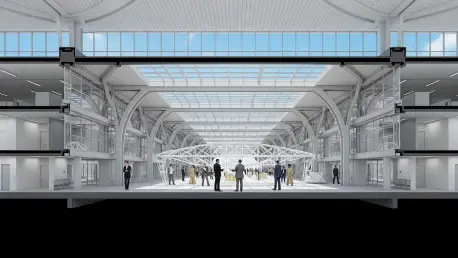
Managing large-scale modernization, such as the ongoing work at JFK Airport, requires a constant recalibration of expectations when subcontractor productivity doesn’t meet the initial benchmarks. We recently saw a situation where a $337 million charge was taken because the expected completion date for a project bid back in 2019 had to be pushed further into the future. It is a sobering reminder that even with 80% of a project finished, the final 20% can be the most challenging to navigate. The project is now slated to reach completion by the end of the fiscal second quarter in 2027, rather than the start of that year. This type of delay is exactly why we have tightened risk controls and changed leadership structures to ensure that legacy bids do not derail current financial stability.
There is a noticeable shift away from traditional design-build P3 models in construction management. Why is moving toward guaranteed maximum price contracts becoming the new standard for managing risk?
The industry is moving away from design-build P3 work because the risk profile is often too lopsided for the contractor to bear in an unpredictable economy. By focusing predominantly on guaranteed maximum price contracts, firms can ensure that designs and subcontractor costs are much further developed before they assume any additional financial risk. In fact, many organizations have reached a point where traditional P3 projects would no longer even qualify for approval under their current commercial structures. This shift is a strategic move to protect the bottom line, and it seems to be working, as evidenced by a record backlog that recently reached $27.82 billion. This 13% increase in backlog from the previous year shows that you can grow a business while simultaneously becoming more selective about the risks you take.
Despite the recent financial adjustments and the dip in quarterly revenue, what do the current backlog numbers suggest about the industry’s long-term health?
Even with a reported net loss of $86.71 million this quarter and a 14% year-over-year drop in revenue to $3.59 billion, the record-breaking backlog paints a picture of long-term resilience. The $337 million project charge certainly impacted the immediate profitability, but it shouldn’t overshadow the strong long-term awards that were secured during the same period. Investors and analysts are looking closely at the cash burn rates and the magnitude of these charges, yet the underlying demand across core markets remains undeniable. The sheer volume of work waiting to be executed suggests that the industry is successfully pivotting toward higher-quality, more stable contracts. It is a period of transition where clearing out legacy issues is paving the way for a more disciplined and profitable future.
What is your forecast for the construction industry’s evolution over the next three years?
I expect to see a period of intense specialization where the gap widens between firms that can handle the technical demands of hyperscale data centers and those that cannot. We will likely see a full transition where the $580 billion in proposed infrastructure funding begins to hit the ground, providing a safety net for the industry as the $1.2 trillion IIJA expires. Risk mitigation will remain the top priority, with guaranteed maximum price contracts becoming the absolute norm for any project exceeding a certain complexity threshold. Ultimately, the industry will be defined by its ability to integrate advanced technology into the construction process to solve the productivity issues that have plagued large transit and infrastructure projects in the past. This will lead to a more predictable, data-driven sector that can weather localized financial charges while maintaining a record-high global backlog.