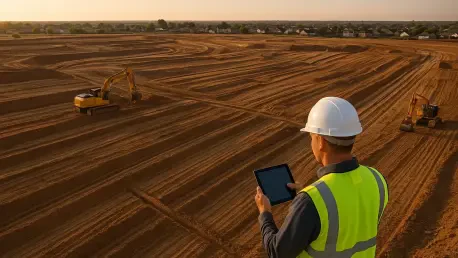

Construction sites often bustle with heavy machinery, yet without precise data, it is difficult to determine if that activity translates into actual progress. The residential construction industry is currently undergoing a fundamental paradigm shift as builders transition their focus from vertical construction excellence to horizontal precision. For decades, optimization efforts centered on the visible structure of the home, while the process of transforming raw land into build-ready lots remained relatively opaque. However, as economic conditions tighten and traditional profit margins face pressure, the industry is pivoting toward site intelligence and data-driven management to modernize the grading, utility installation, and infrastructure phases. This evolution is not merely about adopting new gadgets but involves a complete overhaul of how project managers view the earthwork phase of development. By integrating sophisticated software with traditional site management, companies are now able to track progress with the same granular detail that was once reserved for interior finishes. The goal is to eliminate the guesswork that has long plagued the early stages of community development, ensuring that every shovel in the ground contributes directly to the bottom line.
Navigating Economic Pressures and Market Volatility
The Financial Necessity: Mastering Horizontal Control
In previous years, rapid home price appreciation provided a financial cushion that allowed builders to absorb operational inefficiencies and unexpected costs. Today, with builder confidence often sitting below break-even thresholds and construction timelines stretching significantly longer than they did a decade ago, that cushion has evaporated. Builders now operate in a high-pressure environment where capital is tied up in land for extended periods, making the ability to predict and control the land development phase a critical requirement for financial survival. The margin for error has shrunk to the point where a single week of delay in site stabilization can negate the cost-saving benefits of an entire pre-fabricated framing package.
This shift toward horizontal control is particularly evident as interest rates remain a dominant factor in project feasibility. When land sits idle or moves through the development phase at a glacial pace, the interest on acquisition and development loans compounds, eating into the eventual profit of every home sold in that community. By focusing on horizontal efficiency, organizations are treating land not just as a canvas for architecture, but as a dynamic financial asset that must be moved through the production pipeline as quickly as possible. This necessitates a more aggressive approach to schedule management and a refusal to accept traditional “dirt work” delays as an inevitable part of the business.
Addressing the Challenge: The High Cost of Uncertainty
The lack of visibility in horizontal construction carries a staggering price tag, particularly when accounting for carrying costs and the ongoing skilled labor shortage. When land development stalls due to unforeseen soil conditions or topographical challenges, the interest on loans and site overhead continue to accumulate without progress. A minor cost overrun in the horizontal phase can instantly evaporate hundreds of thousands of dollars in profit, turning what should have been a lucrative project into a financial burden. This uncertainty is compounded by the fact that subsurface conditions are often only partially understood until the first dozers begin their work, leading to reactive management rather than proactive planning.
Furthermore, the labor market for heavy equipment operators and underground utility specialists has become increasingly competitive, meaning that every hour of downtime is a wasted premium. If a crew is waiting for clarification on a grading plan or a utility conflict, the builder is essentially paying for stagnant potential. Modern site intelligence aims to mitigate these risks by providing a digital twin of the land that can be analyzed before the first bucket of earth is moved. By quantifying the risks associated with rock outcroppings or high water tables, builders can budget more accurately and avoid the mid-project “surprises” that historically derailed seasonal delivery targets and quarterly financial projections.
Bridging the Gap Between Vertical and Horizontal Processes
Overcoming Inefficiency: Inside the Black Box
Vertical construction has long benefited from standardization, utilizing repeatable floor plans and predictable workflows that mirror an assembly line. In contrast, horizontal construction has traditionally been treated as an unpredictable “black box” because every piece of land presents unique soil, drainage, and regulatory hurdles. This lack of standardization has historically prevented builders from applying the same rigorous performance metrics to land development that they use for the actual building of the house. While a superintendent can easily tell if a house is behind on plumbing rough-ins, determining if a detention pond is sixty percent or seventy-five percent complete is much more difficult without specialized tools.
To bridge this gap, builders are beginning to apply manufacturing principles to the very earth they build upon. This involves breaking down the development process into discrete, measurable milestones that can be tracked across different geographic regions and soil types. By normalizing the “units” of land development, such as the time required to clear an acre or install a hundred linear feet of storm drain, companies can finally compare the performance of different site contractors. This transparency removes the shroud of mystery from the horizontal phase and forces a level of accountability that was previously impossible to maintain in the chaotic environment of a raw job site.
Measuring Success: Activity versus Actual Progress
One of the most persistent challenges in managing land development is the psychological trap of equating machine activity with project progress. A site may appear busy with heavy equipment, yet without precise data, it is difficult to determine if that work is actually moving the project toward the “lot release” stage. Modern site intelligence aims to replace subjective observations with hard data regarding cubic yards of earth moved and linear feet of utilities installed to ensure every hour of labor contributes to the final goal. This distinction is vital because moving the same pile of dirt three times looks like work, but it represents a massive failure in site logistics and planning.
The implementation of telematics and real-time reporting has allowed for a move away from “windshield management,” where a project manager’s only insight comes from a brief daily visit. Instead, digital dashboards now provide a constant stream of information regarding how much fuel is being burned and how much grade has been achieved. If the data shows that a grader has been active for eight hours but the elevation has only changed by a fraction of what was expected, the system flags an immediate inefficiency. This allows for rapid intervention, ensuring that the heavy equipment on site is actually creating buildable lots rather than just burning expensive diesel and creating a false sense of productivity.
The Evolution of Land Development Systems
Production Logic: Implementing Cycle Time Benchmarks
A significant trend in the industry is the application of “production system” logic to the earthwork phase, specifically through the concept of horizontal cycle time. By normalizing variables such as acreage and lot count, builders can create benchmarks to identify which contractors are most efficient and which regions consistently face delays. This shift does not remove the natural variability of the land, but it allows builders to manage that variability through data-driven forecasting rather than optimistic guesswork. These benchmarks provide a baseline that helps in selecting the right partners for high-stakes projects where timing is the most critical variable for success.
Implementing these benchmarks also facilitates a more sophisticated approach to scheduling the vertical teams. When a builder knows with high statistical confidence that a specific site will be ready for foundation pours by a certain date, they can lock in subcontractors further in advance. This reduces the “gap time” between lot completion and home starts, which is one of the most significant leaks in construction profitability. By treating land development as the first stage of the assembly line rather than a separate pre-construction task, the entire organization moves in a more synchronized fashion, reducing the friction that often occurs during the hand-off between site crews and home builders.
Technological Integration: AI and Geospatial Intelligence
The transition toward measurable development is being powered by advanced technologies, including drone-captured aerial data and geospatial intelligence. When high-resolution site views are integrated with artificial intelligence, builders gain the ability to spot potential bottlenecks—such as utility installation lagging behind grading—before they become expensive delays. These tools empower human project managers to focus on strategic problem-solving rather than manual progress verification. AI can process thousands of images to identify when a silt fence is failing or when a stockpile of gravel is being depleted faster than it is being replaced, providing a layer of oversight that a single human could never achieve.
Geospatial intelligence also plays a crucial role in long-term planning and environmental compliance. By overlaying topographical data with local regulatory maps, builders can automatically identify areas of concern regarding wetland boundaries or slope stability. This proactive identification of constraints allows for design adjustments earlier in the process, preventing the costly redesigns that often occur when horizontal crews encounter regulatory “no-go” zones. As these technologies become more accessible, the ability to “see” through the complexities of a site has become a competitive advantage, allowing firms to take on more challenging terrain with a level of confidence that was once reserved for flat, easy-to-develop parcels.
Optimizing Capital and Future Growth
Strategic Finance: Prioritizing Capital Efficiency
At its core, the push for horizontal visibility is driven by the need for extreme capital efficiency in an environment of high interest rates. Because land development is front-loaded with massive expenditures, the longer the gap between infrastructure work and the start of home construction, the lower the overall return on investment. Improving horizontal cycle times allows for faster lot delivery, which accelerates revenue generation and reduces the risk of exposure to sudden market downturns. In the current 2026 to 2028 window, the speed of capital rotation has become a more important metric for many large-scale developers than the gross margin per individual unit sold.
Focusing on capital efficiency also means making smarter decisions about when to start specific phases of a multi-stage development. By using predictive analytics, builders can determine the optimal “just-in-time” delivery for lots, ensuring they do not have millions of dollars sitting in finished roads and sewers that will not be utilized for another year. This strategic timing preserves liquidity and allows the company to pivot if market conditions shift unexpectedly. The goal is to create a seamless flow of capital from raw land acquisition through to the final closing, minimizing the time the builder’s money is “stuck in the mud” without a clear path to liquidation.
Future Frameworks: A New Era of Site Visibility
The homebuilding industry reached a consensus that the next leap in efficiency would come from preparing the land smarter rather than simply building the structure faster. By treating the land beneath the home as a primary focus for operational improvement, builders transformed a historically chaotic process into a precise production framework. Those who successfully adopted these intelligence technologies positioned themselves to protect their margins and navigate the complexities of a volatile housing market. They established a baseline where every cubic yard of dirt moved was accounted for, and every hour of machine time was justified by a measurable increase in site readiness.
Strategic leaders recognized that the integration of digital tracking and site intelligence was no longer an optional luxury but a fundamental requirement for large-scale operations. They moved toward a model where project data was shared instantly between the field and the back office, allowing for a level of transparency that ended the era of the “unpredictable” horizontal phase. This shift allowed for more accurate financial forecasting and a significant reduction in the insurance premiums associated with site-work risks. Ultimately, the industry learned that the foundation of a profitable home was not just the concrete slab, but the data-driven efficiency of the earth on which it stood.