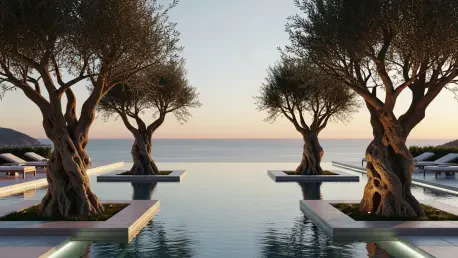

High above the shimmering waters of Cap-d’Ail, where the rocky coastline meets the crystalline Mediterranean, Villa Monaco stands as a defiant architectural statement against the fleeting trends of contemporary luxury development. The property, originally an expansive olive plantation with gnarled trees that have witnessed more than two hundred years of history, effectively bridges the generational gap between the refined legacy of the Belle Époque and the demands of modern high-design living. Instead of appearing as a cold, static gallery meant for public display, the villa radiates a lived-in sensibility that evokes the effortless charm of legendary landmarks like the Chateau Marmont in Los Angeles. It operates as a living testament to the cultural evolution of the French Riviera, prioritizing a narrative of permanence and multi-generational ease over the ephemeral nature of passing fashions. This approach creates a sanctuary where the past is not merely preserved but is actively engaged with, allowing residents to inhabit a space that feels deeply rooted in its geographic and historical context while offering every modern convenience expected in a world-class residence today.
The Philosophy of Lived Design: Beyond Staged Luxury
At the core of the estate’s identity is a fundamental distinction between “staged” environments often found in high-end real estate and a “lived” design philosophy where interiors develop their own organic rhythm. Secluded behind towering hedges that shield the grounds from public view, the villa offers a gradual reveal that emphasizes discretion and architectural continuity rather than immediate visual impact. This deliberate pacing of the arrival experience ensures that the home remains a private retreat, integrated into the daily rituals of its inhabitants rather than serving as a billboard for wealth. The design favors inherited sensibilities, utilizing a neutral and calm palette that serves as a backdrop for a lifetime of collected memories. By avoiding the pitfalls of over-styled minimalism, the estate fosters a sense of long-term belonging, where the architecture and its diverse contents feel like a natural extension of the rugged landscape that defines this specific coastal region.
Maintaining this sense of continuity requires a sophisticated understanding of how light and space interact with the natural surroundings throughout the changing seasons. The designers opted for materials that age gracefully, ensuring that the property’s aesthetic value only increases as the surfaces develop a unique patina over time. This focus on material integrity allows the villa to stand as a resilient monument to quality, where the transition from indoor to outdoor living is handled with a seamless elegance. Large apertures frame the Mediterranean horizon, effectively turning the scenery into a dynamic element of the interior decor. Consequently, the boundary between the built environment and the lush vegetation of the former plantation becomes blurred, creating a meditative atmosphere that encourages a slower pace of life. Such a configuration highlights the importance of creating homes that are not just structures to be looked at, but environments to be experienced through every sense.
Architectural Fluidity: The Art of Borderless Living
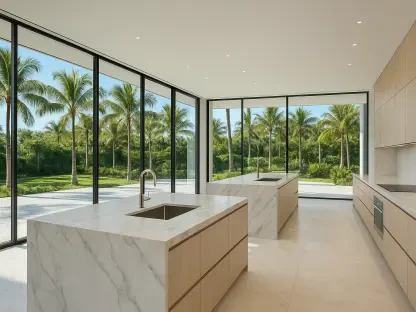
Inside the main villa, the ground floor layout is defined by a “living space without borders,” where traditional partitions between the dining and lounging areas have been removed to favor a cohesive and uninterrupted flow. At the geometric center of this expansive open plan lies a massive, custom-made marble table designed to comfortably seat fourteen guests, serving as the primary social anchor of the home. Surrounding this centerpiece is an eclectic yet disciplined collection of vintage designer seating that showcases a deep appreciation for the history of industrial design. This curated assembly includes Italian postmodern Regia chairs and Luisa chairs by Marcello Cuneo, positioned alongside the early modernist Purkersdorf armchairs originally designed by Josef Hoffmann and Koloman Moser. The juxtaposition of these varied styles encourages social interaction while maintaining a rigorous aesthetic standard that respects both physical comfort and the historical significance of each piece within the overall composition.
The living area is anchored by a large, handcrafted firestone fireplace that functions as an essential atmospheric regulator for the entire floor, providing both physical warmth and a visual focal point. During the daylight hours, the fireplace offers a sense of architectural clarity and weight, while at night, it casts a warm, intimate glow across a sophisticated seating arrangement that prioritizes relaxation. This central space features the sculptural Togo sofas by Michel Ducaroy, known for their plush comfort and distinctive pleated silhouette, which sit in conversation with the geometric rigor of the Kubus sofa by Hoffmann. These elements are further complemented by Art Deco armchairs and a travertine-and-glass coffee table, representing a complex dialogue between different design eras. By balancing the softness of contemporary French luxury with the structured discipline of early 20th-century modernism, the interior achieves a rare harmony that feels both curated and comfortable, proving that high design does not have to sacrifice livability.
A Pan-European Dialogue: Mixing Traditions and Heritage
Villa Monaco effectively serves as a vessel for a diverse pan-European aesthetic conversation, intentionally mixing national traditions to create a unified interior narrative that transcends borders. French influence is prominently visible through the inclusion of Jacques Adnet-associated works and ornate Christofle silver chandeliers, which provide a nod to the region’s aristocratic past. In contrast, Italian contributions, such as a rare 19th-century Murano glass mirror and the Alanda coffee table, introduce a sculptural and expressive rhythm to the various rooms. Austrian geometric precision from the Vienna Secession era meets German functionalism in the form of award-winning tubular lighting systems, creating a home where diverse histories dissolve into a singular, cohesive atmosphere. This blend of origins results in a residence that feels like a global collection rather than a regional cliché, demonstrating how material integrity and thoughtful curation can bridge the gap between disparate design movements.
The connection between the villa and its Mediterranean setting is reinforced through a constant exchange with nature, where every room is carefully oriented to frame breathtaking views of the sea. This relationship becomes most tactile in the “objects that carry time,” such as the vintage silver cutlery once used in the grand hotels of the Riviera, which links the present day to a bygone era of ceremony and service. These small details ensure that even the most mundane daily activities, like dining, are elevated to a ritualistic experience. Outside, the infinity pool is designed to dissolve the boundary between the built environment and the horizon, creating a visual continuum that draws the eye toward the infinite blue of the Mediterranean. Ultimately, the estate proves that true design strength lies in the balance of diverse histories and the careful selection of artifacts that possess both beauty and utility. It remains a hidden gem of the coast, where every object tells a compelling story of its past.
Future Considerations: Preserving the Legacy of Riviera Design
The development of Villa Monaco established a clear blueprint for how historical properties could be modernized without losing their cultural soul or architectural integrity. Designers successfully navigated the challenge of integrating cutting-edge technology while maintaining the estate’s heritage, offering a lesson in the importance of restraint and material honesty. Looking forward, the preservation of such spaces will depend on a continued commitment to sourcing artisanal pieces that offer longevity over fast-fashion trends. Property owners and interior architects found that investing in “living” design—where every piece of furniture and every architectural detail serves a functional purpose—created more value than simple ornamental luxury. The project demonstrated that the key to a successful renovation lay in the deep research of local history and the willingness to blend international influences into a cohesive whole. As the industry evolved from 2026 onwards, the emphasis shifted toward creating environments that prioritize sensory experience.