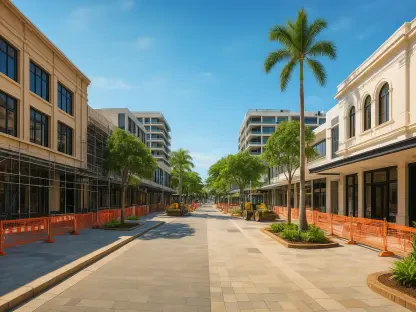

European construction firms like Besix and Comsa Corp are finding steady growth in rail modernization and urban congestion-reduction projects across the continent. This momentum reflects a broader trend where the global construction sector has hit a monumental financial milestone, seeing international revenue for the top 250 firms jump to an impressive $550.6 billion. This nearly 10% increase serves as a testament to the industry’s resilience during a period that has been characterized by shifting geopolitical landscapes and evolving economic pressures. While the global economy remains sensitive to external shocks, the ability of major contractors to navigate these complexities suggests a newfound maturity in operational execution. This surge is not merely a byproduct of inflation or rising material costs; rather, it indicates a fundamental expansion in the scale of international infrastructure needs and the capacity of firms to fulfill them. Most importantly, this growth is widely distributed, with over half of the industry reporting robust project pipelines that extend well into the coming years. As domestic markets face varying degrees of saturation, the international stage has become the primary arena for firms looking to secure long-term stability and diversify their financial foundations through massive cross-border initiatives. The current climate demonstrates that the industry’s ability to capture value and maintain operational momentum remains incredibly strong despite the rising complexity of modern engineering.
Prioritizing Stability: The Shift Toward Project Certainty
Industry leaders are increasingly prioritizing project certainty to navigate modern hurdles like fluctuating material costs and lingering supply chain delays. In an environment where a single late shipment of specialized components can derail a multi-year timeline, the ability of a contractor to guarantee delivery and cost-predictability has become a primary competitive advantage. Clients are no longer just looking for the lowest bidder; they are seeking partners who can offer stability and transparency from the earliest stages of a project’s lifecycle. To achieve this, contractors are moving away from traditional, reactive models toward proactive risk mitigation and pre-construction planning. This involves engaging with customers long before any physical work begins to influence design choices and procurement strategies that favor availability and reliability. By securing long-term agreements with suppliers and utilizing advanced logistics tracking, these firms are effectively insulating themselves and their clients from the volatility that previously plagued the sector. This shift toward predictability has fundamentally changed how contracts are negotiated, placing a premium on the contractor’s track record for on-time and on-budget delivery in uncertain environments.
The transformation of delivery models has further solidified this trend toward certainty, with a notable shift toward collaborative frameworks such as public-private partnerships and integrated project delivery. These models align the financial and operational interests of the contractor and the client, ensuring that both parties are invested in the long-term success and efficiency of the asset. Unlike traditional adversarial relationships that often lead to litigation and delays, collaborative delivery fosters an environment of open communication and shared problem-solving. This approach has proven particularly effective for complex infrastructure projects that require a high degree of technical expertise and flexibility. By involving contractors in the financing and design phases, clients can leverage industry knowledge to optimize costs and minimize the likelihood of expensive change orders during the construction phase. Furthermore, these partnerships allow for a more equitable distribution of risk, which is essential for attracting investment in large-scale projects. As these collaborative models become the standard for international work, the industry is seeing a marked improvement in overall project performance and a reduction in the friction that typically characterizes major construction efforts.
Technical Convergence: High-Tech and Environmental Markets
A clear trend has emerged regarding the convergence of technical requirements across data center development, life sciences, and advanced manufacturing. These “hyperscale” projects require specialized capabilities that were once considered niche but are now central to the portfolios of top-tier international firms. Because these industries share similar infrastructure needs—such as high-redundancy power systems, advanced climate control, and complex piping—contractors can leverage their expertise across multiple high-demand sectors simultaneously. This allows them to deploy their most skilled resources where profit margins are highest and demand is most consistent. The rapid expansion of artificial intelligence and biotechnology has created a backlog of projects that require rapid execution and extreme precision, favoring firms that have invested in specialized engineering talent. These high-tech facilities are often built on aggressive timelines, requiring contractors to utilize modular construction and off-site manufacturing to meet the needs of global tech giants. This shift into advanced manufacturing and data infrastructure is not just a temporary boom; it represents a fundamental change in the global economy’s physical requirements, placing contractors at the heart of the digital and biological revolutions.
Beyond the surge in high-tech facilities, the hazardous waste and remediation sector has recorded the highest percentage increase in revenue within the industry. This growth is driven by massive environmental cleanup efforts and soil remediation projects as global standards for land restoration and pollution control become significantly more stringent. Firms specializing in these complex environmental solutions are seeing a significant boost in their international portfolios as governments and private entities prioritize the reclamation of industrial sites for urban redevelopment. The technical difficulty of removing contaminants from soil and water requires a level of engineering sophistication that only a handful of global players possess. This work is often tied to long-term government contracts, providing a stable revenue stream that is less susceptible to the cyclical nature of commercial real estate. As the focus on environmental, social, and governance (ESG) criteria intensifies, the demand for remediation services is expected to continue its upward trajectory. Contractors who have developed proprietary technologies for waste treatment and site stabilization are now finding themselves in a dominant market position, as their services are essential for unlocking the value of contaminated land and meeting international environmental mandates.
Regional Dynamics: The Middle Eastern Engine and New Models
Geographically, the Middle East has emerged as the most dynamic region for international contractors, fueled largely by massive infrastructure and energy projects in Saudi Arabia. The region saw a revenue spike of nearly 25% over the past year, highlighting its role as the primary engine for global construction activity. While other regions like Africa and the Caribbean also showed double-digit growth, the Middle East remains the focal point for rapid execution and large-scale investment. The scale of the “Giga-projects” currently underway is unprecedented, requiring an enormous influx of international labor, machinery, and technical expertise. This has created a gold rush for contractors who can manage the logistical nightmare of building entirely new cities in remote desert environments. However, the competition is fierce, and firms must demonstrate a commitment to local development and sustainable practices to secure a piece of the pie. The sheer volume of work in this region is acting as a stabilizer for the global industry, offsetting slower growth in more mature markets where high interest rates have tempered private investment. As these projects move from the planning phase to peak construction, the Middle East will likely continue to dominate the international revenue charts for the foreseeable future.
Many top-ranked firms are fundamentally altering their business models to include long-term operations and maintenance as a core part of their service offering. By moving into financing and facility management, contractors are diversifying their portfolios and creating more predictable, recurring revenue streams that last long after the physical construction is complete. This “de-risking” strategy allows companies to move beyond the high-risk, low-margin nature of one-off construction contracts and establish a permanent presence in the markets they serve. Managing an asset for twenty or thirty years provides a level of financial stability that is highly attractive to shareholders and lenders alike. This transition also encourages better design and construction quality, as the contractor is responsible for the long-term upkeep and performance of the building or infrastructure. Clients are increasingly favoring these “end-to-end” solutions, where a single entity takes responsibility for the entire lifecycle of the project. This evolution from a pure builder to a service provider and asset manager is a defining characteristic of the modern international contractor, reflecting a broader shift toward vertical integration in the global construction marketplace.
Resource Management: Addressing the Labor and Digital Gaps
A critical shortage of specialized labor remains a major bottleneck for the industry, specifically regarding electrical engineers and commissioning specialists who are vital for high-tech projects. To combat this persistent challenge, many firms are shifting toward internal capability building by establishing their own accredited training institutes and vocational programs. By developing talent from within and focusing on employee retention through competitive benefits and career development paths, contractors are reducing their reliance on an increasingly constrained external labor market. This internal focus also ensures that the workforce is trained on the specific technologies and safety protocols unique to the firm’s operations, leading to higher efficiency and fewer errors on site. The labor crisis has forced a realization that the traditional model of hiring for a project and letting go after completion is no longer sustainable. Instead, firms are treating human capital as a long-term asset that requires continuous investment and nurturing. This approach not only solves the immediate staffing problem but also creates a more loyal and skilled workforce capable of tackling the increasingly complex engineering challenges of the next decade.
Digital transformation is also playing a vital role in maintaining project margins in a high-inflation environment where every efficiency gain counts. Contractors are doubling down on tools like Building Information Modeling (BIM) and integrated planning systems to manage the increasing complexity of megaprojects from a single source of truth. These technologies are no longer viewed as optional luxuries; they are essential for identifying design clashes early, optimizing material usage, and ensuring that every stage of construction is handled with maximum precision. The integration of artificial intelligence into these planning systems allows for real-time adjustments to schedules based on weather patterns, supply chain delays, or labor availability. By creating a “digital twin” of a project, contractors can simulate various scenarios and choose the most efficient path forward, significantly reducing the risk of costly rework. This digital maturity is a key differentiator in the international market, as clients prioritize firms that can demonstrate a data-driven approach to project management. As these tools become more sophisticated, the gap between digitally advanced firms and those relying on legacy systems will only widen, further consolidating the market in favor of the tech-enabled leaders.
Future Resilience: Managing Climate and Political Risks
Climate change is forcing contractors to treat extreme weather as a standard operational risk that must be managed through strict health and safety protocols and adaptive engineering. New assessments are being integrated into project schedules to protect workers from severe heat and storms, ensuring that environmental factors do not lead to unexpected delays or accidents. This adaptation is becoming a standard operating procedure for firms working in both tropical and high-latitude environments, where the frequency of extreme events is rising. Beyond worker safety, firms are also incorporating climate-resilient designs that ensure infrastructure can withstand the increased stresses of a changing world. This involves using more durable materials, improving drainage systems, and elevating critical components to avoid flood damage. This focus on resilience is not just about disaster prevention; it is also a response to the demands of insurance companies and investors who require a clear plan for climate risk mitigation. Contractors who can offer these “future-proof” solutions are finding themselves in higher demand as the global community prepares for the long-term impacts of environmental shifts.
Geopolitical instability in various regions highlighted the vital importance of deep local partnerships as a primary strategy for business continuity. Building trust with local communities and stakeholders was increasingly viewed as an insurance policy against regional political upheaval and social unrest. By emphasizing the employment of local talent and maintaining strong ties with regional suppliers, international contractors ensured they remained an integral part of the local economy rather than an external entity. This approach allowed firms to navigate complex regulatory environments and cultural nuances that often stymied less integrated competitors. Moving forward, the most successful companies implemented strategies that prioritized local content and knowledge transfer, creating a more sustainable and resilient international footprint. They realized that long-term success depended on their ability to adapt to local conditions and provide tangible benefits to the regions where they operated. By fostering these relationships, contractors not only mitigated risks but also gained a competitive edge in securing future projects within those markets. The industry proved that while financial strength and technical expertise were necessary, local integration was the key to maintaining stability in a volatile global landscape.