
The increasing frequency of high-intensity wildfires across diverse geographical regions has forced a fundamental shift in how residential properties are designed and managed to ensure long-term survival. In this context, “firescaping” has emerged not merely as a trend in landscaping, but as a critical safety protocol designed to mitigate the risks posed by embers and radiant heat. The core philosophy behind this approach involves creating a landscape that starves a fire of fuel rather than feeding its progression toward the main structure. By prioritizing low-growing, moisture-rich vegetation and implementing smart spatial design, property owners can significantly reduce the likelihood of ignition. This paradigm shift requires a deep understanding of how fire interacts with various types of organic and inorganic materials. Modern homeowners are now viewing their yards as the first line of defense, where every plant choice and structural placement serves a functional purpose in a broader security strategy. This evolution in property management emphasizes that safety and beauty can coexist, provided that the underlying design is grounded in ecological resilience and scientific mitigation principles. As the environment continues to present more volatile conditions, the adoption of these strategies represents a proactive commitment to safeguarding both the immediate home environment and the surrounding ecosystem.
Functional Principles of Fire-Safe Garden Design
The foundation of a fire-smart garden rests on the critical distinction between fire-retardant and fire-resistant botanical species. Fire-retardant plants are those that actively work to deprive a fire of the fuel it needs to sustain itself, often due to high soap or salt content in their tissues. On the other hand, fire-resistant varieties are characterized by their inherent difficulty to ignite, even when exposed to intense heat or direct flames. High-moisture vegetation is particularly effective in this regard because it functions as a natural radiant heat screen, absorbing significant amounts of thermal energy from an approaching fire without immediately catching flame. These plants act as biological barriers that can slow the advance of a fire front, providing a crucial window of time for emergency response or for the fire to lose momentum. By selecting plants that store water in their leaves and stems, homeowners create a damp microclimate that is naturally less hospitable to sparks and blowing embers.
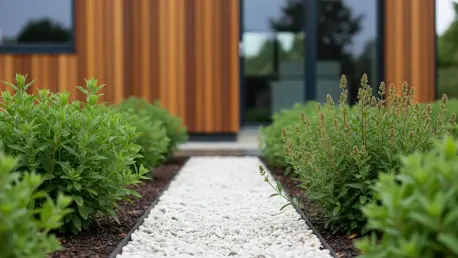
Beyond the specific chemical and biological properties of the plants themselves, the physical layout of the landscape is a decisive factor in fire mitigation. Strategic spacing between individual shrubs and trees is essential to prevent the creation of a “fuel bridge” that allows fire to jump effortlessly from one plant to another. Integrating non-flammable materials into the design, such as decorative gravel, sand paths, or river rocks, helps create distinct “islands” of greenery that are separated by effective firebreaks. These breaks interrupt the horizontal path of a fire, making it much harder for flames to sweep across a yard. Furthermore, the use of inorganic mulch near the home foundation prevents the common scenario where dry wood chips or organic debris ignite and carry fire directly to the siding or vents. By thinking of the yard as a series of disconnected fuel sources rather than a continuous carpet of vegetation, property owners can effectively disrupt the physics of fire spread before it reaches the dwelling.
Botanical Selections for Enhanced Structural Protection
Ecological experts consistently advocate for the use of native species because these plants are naturally adapted to the local climate and require significantly less supplemental water to remain healthy. A well-hydrated, healthy plant is inherently much more resistant to ignition than one that is stressed, parched, or dormant. Native varieties also possess the advantage of recovering more quickly after an environmental crisis, which helps to restore the local ecosystem and prevent the secondary threat of soil erosion following a fire event. Among the premier choices for fire-wise designs is Rock Soapwort, which forms a dense, low-growing mat that effectively prevents fire from climbing into higher vegetation layers. Similarly, the silvery foliage of White Sage and Snow-In-Summer contains high internal water levels and low volatile oil content. These hardy perennials excel in sun-baked conditions, acting as natural deterrents to the spread of airborne sparks while maintaining an aesthetically pleasing appearance throughout the growing season.
In addition to ground covers, larger architectural plants like Yucca and Lamb’s Ears serve as powerhouses in a fire-resistant landscape. As a succulent, the Yucca stores immense amounts of water within its thick, fibrous leaves and possesses very little woody growth that could serve as fuel. Lamb’s Ears is another resilient perennial with fuzzy, moisture-packed leaves that naturally resist ignition, making it an excellent candidate for filling gaps in the garden and ensuring that no dry, combustible debris accumulates in open spaces. For those seeking vibrant color without compromising safety, Blanket Flower and Daylilies offer a combination of drought tolerance and compact growth. These plants tend to grow in dense, succulent clumps that do not easily carry fire. When integrated into isolated planting groups surrounded by rock or sand, they provide a visual pop while ensuring that there is no continuous path for a fire to travel. This strategic selection of species ensures that the landscape remains lush and green even during the driest months of the year.
Strategic Maintenance and Zonal Defensive Planning
A successful fire-smart yard is the result of both intentional plant choices and disciplined, ongoing maintenance routines. Even the most drought-tolerant and fire-resistant plants must be kept in peak health through proper hydration, as a stressed or dying plant quickly becomes a dangerous source of fuel. Regular upkeep involves more than just watering; it requires the consistent removal of dead branches, dried leaves, and accumulated pine needles that act as tinder. Pruning is another vital task, as it helps to eliminate “ladder fuels”—lower branches that allow a ground fire to climb into the canopy of a tree. By maintaining a clear gap between the ground and the lowest tree limbs, homeowners can prevent a manageable surface fire from escalating into a far more destructive crown fire. This level of maintenance ensures that the landscape remains a protective buffer rather than a liability during the peak of the wildfire season.
Effective zonal planning involves implementing the “defensible space” concept, which categorizes the area around a home into distinct management zones. In the immediate vicinity of the house, often referred to as Zone Zero, the focus is on completely non-combustible materials and very low-profile, high-moisture plants. As one moves further from the structure, taller native shrubs and trees are permitted, but they must be managed with strict vertical and horizontal spacing to prevent any continuous fuel paths. This graduated approach to landscaping ensures that the most fire-resistant elements are positioned closest to the home, where they can provide the greatest protection against heat and embers. By managing both the volume and the arrangement of vegetation across these zones, property owners create a beautiful sanctuary that is fundamentally designed to survive an emergency. This systematic layout not only protects the individual property but also contributes to the overall resilience of the neighborhood by slowing the progress of a fire.
Evolution of Modern Property Safety Standards
The transition toward fire-resistant landscaping was completed through the integration of scientific observation and practical horticultural application. Homeowners who adopted these strategies found that the combination of moisture-rich succulents and strategically placed firebreaks provided a robust defense that previous traditional gardens lacked. This shift in perspective encouraged the removal of highly flammable invasive species, which were replaced with native perennials that offered both ecological value and physical security. The implementation of zonal planning allowed for a more organized approach to yard work, where maintenance efforts were focused on the areas that offered the highest return on safety. This evolution in gardening culture demonstrated that a well-designed yard was not just a luxury, but a functional component of home engineering that worked in tandem with fire-resistant building materials to create a comprehensive safety envelope.
Looking back at the implementation of these protocols, the most successful designs were those that prioritized the health of the soil and the hydration of the plants. Property owners utilized smart irrigation systems to ensure that moisture levels remained optimal without wasting water, creating a landscape that remained resilient even during periods of extreme heat. The use of non-organic mulches and stone pathways proved to be a decisive factor in stopping the crawl of surface fires across large properties. These actions resulted in a significant reduction in property loss and provided a blueprint for future residential development in vulnerable areas. By focusing on the inherent properties of fire-resistant vegetation and the physics of fire movement, a new standard for suburban and rural living was established. This proactive approach turned the landscape into a living shield, proving that thoughtful design was the most effective tool for mitigating environmental risks.