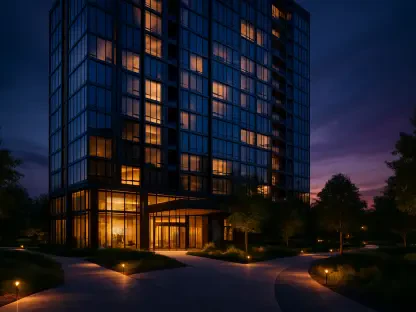

Current green building certifications frequently reward designs for efficiency while ignoring the structural integrity needed to withstand intensifying climate disasters. This fundamental disconnect between high-performance ratings and real-world durability has led to a landscape where award-winning glass towers may shatter under the pressure of escalating wind speeds or succumb to rising floodwaters. For years, the industry has prioritized green metrics such as energy-efficient HVAC systems, but these features offer little solace when a structure requires a total reconstruction following a catastrophic weather event. The environmental cost of replacing a building entirely—demolishing debris and manufacturing new concrete—dwarfs any carbon savings achieved during its brief period of operation. This oversight represents a significant vulnerability in sustainability standards, as it encourages a disposable approach to architecture. By failing to account for physical resilience, the sector risks creating a cycle of waste that contradicts its own goals.
The Flaw in Static Assessments: Why Current Models Fail
Modern environmental accounting relies heavily on Life Cycle Assessments (LCAs), which are designed to track the carbon footprint of a building from its initial construction through its eventual demolition. However, these models operate under a dangerously optimistic assumption: that the building will exist in a stable, predictable climate for its entire sixty-year lifespan. This static view of time fails to incorporate the increasing frequency of external shocks, such as 100-year floods occurring every few seasons or wildfires encroaching on suburban boundaries. When an LCA assumes zero interruptions, it ignores the massive carbon spike associated with emergency repairs and the disposal of ruined interior finishes. In reality, a building that is not designed to withstand these pressures is a ticking environmental debt. The industry has largely ignored the probability of failure, treating climate disasters as rare outliers rather than statistical certainties that must be integrated into every calculation.
Furthermore, current industry standards focus almost exclusively on embodied carbon—the energy consumed during the extraction and manufacture of materials—without considering the re-embodied carbon required for reconstruction. When a flash flood necessitates the replacement of every drywall sheet and flooring plank in a high-rise, the carbon savings promised by the original green certification are effectively erased. This systemic risk is particularly acute in the commercial sector, where high-value assets are frequently gut-renovated after water damage or electrical failure. The resources required to mobilize emergency services, power temporary climate control systems, and manufacture replacement components add an uncounted chapter to the environmental narrative. Without a metric that penalizes fragility, developers are incentivized to use the cheapest compliant materials rather than the most durable ones. This focus on day-one compliance neglects the reality that the greenest building is the one that never needs to be rebuilt.
Quantifying the Resilience Debt: The Cost of Fragility
Research into various environmental threats reveals a consistent omission of two vital components in rating systems: upfront resilience costs and post-disaster debt. Most existing frameworks do not quantify the environmental benefit of over-engineering a structure for safety, such as using thicker glass, reinforced foundations, or redundant power systems that utilize microgrids. While these features may increase the initial carbon footprint of a project by a small margin, they act as a form of environmental insurance. By preventing the total loss of the structure, these investments eliminate the need for the massive influx of new materials that a disaster would otherwise demand. Currently, a building that uses extra concrete to prevent flood damage might even be penalized in a standard rating system for having higher embodied carbon, despite the fact that it is far more sustainable over a thirty-year horizon. This irony highlights the need for a shift in how we value material density and structural robustness.
Beyond the immediate structural damage, the environmental toll of bringing a building back into service involves a complex web of secondary emissions that are rarely tracked. This includes the fuel consumed by specialized emergency recovery equipment, the chemicals used in large-scale mold remediation, and the manufacturing of temporary protective structures. When a coastal property fails, the debris often ends up in landfills, where it decomposes and releases methane, further exacerbating the climate crisis. These post-disaster emissions represent a significant debt that current green certifications simply ignore. By isolating the building’s operational performance from its survival probability, rating agencies have inadvertently encouraged the development of high-tech but fragile assets. The absence of a resilience metric means that a building can be labeled platinum even if it sits in a high-risk flood zone with no specialized waterproofing. This gap creates a false sense of security for investors.
The Path Forward: Integrating Durability into New Frameworks
To address these discrepancies, a new framework emerged that treated resilience as a quantifiable environmental benefit rather than just a safety or insurance feature. This model compared the initial environmental cost of building for longevity against the long-term carbon savings of avoiding a total loss. Architects and engineers began to prove that a resilient building avoided the necessity for temporary housing and the resource-intensive transport of debris. By remaining operational during a crisis, a structure served as a community anchor, reducing the overall carbon footprint of the surrounding neighborhood during recovery phases. This shift allowed the industry to recognize that durability was, by its very nature, the most sustainable design strategy available. Developers started to prioritize passive survivability, ensuring that buildings could maintain habitable temperatures and basic functions even when the power grid failed. These efforts transitioned the focus to the core structural integrity of a truly sustainable asset.
The industry finally realized that a building’s environmental narrative did not end at the ribbon-cutting ceremony; it was an ongoing story that included every repair avoided and every storm survived. Moving forward, the adoption of Resilience Credits within international standards provided a necessary mechanism to validate durable design. These tools required professionals to conduct rigorous stress tests against local climate projections for the next twenty years, starting from the current cycle in 2026 through 2046. Actionable next steps for the sector included the mandatory integration of site-specific hazard assessments into every Life Cycle Analysis. Building owners should also consider decoupling their sustainability goals from mere energy efficiency, moving instead toward a Total Recovery metric that accounted for the potential cost of failure. By embracing these data-driven approaches, the construction industry ensured that the next generation of infrastructure was not only efficient but truly permanent.