
Luca Calaraili has spent years at the intersection of architectural design and industrial innovation, witnessing firsthand how traditional building methods often fail to keep pace with modern societal needs. As an expert in construction technology, he advocates for a radical shift in how we conceive and execute large-scale residential projects. With the UK currently grappling with a severe housing deficit—delivering only 196,500 homes between April 2024 and March 2025 against a 300,000-unit annual ambition—the necessity for a manufactured approach has never been more pressing. This discussion explores the integration of factory precision with onsite agility, the financial frameworks required to unlock institutional capital, and the strategic deployment of “flying factories” to deliver one million affordable homes while adhering to the most stringent net-zero carbon standards.
The following conversation examines the logistical and structural changes needed to bridge the gap between national housing targets and actual delivery rates. We delve into the complexities of building integrated communities that include schools and renewable energy, the implications of recent financial reforms on the London Stock Exchange, and the potential for designating major housing projects as nationally significant infrastructure to bypass traditional planning bottlenecks.
Traditional construction methods often struggle with labor shortages and planning delays. How does a system combining factory manufacturing with onsite assembly specifically bypass these constraints, and what technical steps are taken to ensure these homes meet both national space standards and net-zero carbon requirements?
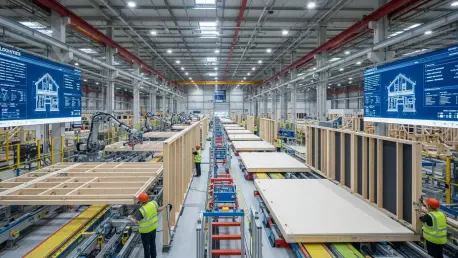
The failure to meet our national housing goals is a systemic issue, evidenced by the fact that we are currently nearly 100,000 homes short of the annual 300,000-unit target. By utilizing an offsite/onsite construction system, we can decouple the production of high-precision components from the unpredictable variables of a traditional building site. This manufacturing-led approach allows us to maintain strict compliance with the Nationally Described Space Standards and Part M of the Building Regulations in a controlled environment. Every unit is engineered to align with the Future Homes Standard and the UK Net Zero Carbon Building Standard, ensuring that sustainability is baked into the design rather than added as an afterthought. This method effectively bypasses local labor shortages because the technical “heavy lifting” is done in a factory setting, leaving the onsite assembly to be a highly coordinated, rapid process.
Planning for large-scale communities requires more than just residential units; it involves schools, energy systems, and transport links. How do you incorporate these complex infrastructure needs into a modular manufacturing process, and what metrics determine the long-term viability of these integrated developments?
When we talk about delivering one million homes, we aren’t just discussing individual buildings; we are planning between 75 and 100 new large-scale communities that function as self-sustaining ecosystems. Our manufacturing process is designed to produce the structural components for schools, employment hubs, and renewable energy centers with the same efficiency as our residential units. The long-term viability is measured through the net economic benefit, which is estimated to reach £51.2 billion over 30 years if we can successfully manage a high volume of social and affordable housing. By integrating transport infrastructure and public open spaces into the initial master plan, we ensure these communities are not isolated pods but vibrant, connected extensions of the existing urban fabric.
National housing delivery is currently falling short of its annual targets by significant margins. If major housing developments were designated as nationally significant projects to streamline decision-making, what specific procedural changes would be necessary, and how would this shift impact the overall speed of delivery?
Designating major housing as nationally significant would represent a fundamental structural change in how we approve and build homes. Currently, the gap between the 1.5 million-home ambition and the actual delivery rate is widening, largely due to a fragmented and slow-moving planning system. By moving these projects into a central planning process, we can bypass many of the localized delays that prevent large-scale developments from breaking ground. This shift would allow for a more unified approach to infrastructure, enabling us to roll out 100 to 200 smaller urban extensions with the same speed as a single industrial project. Speed is the critical metric here; without this procedural leap, we will continue to miss our targets by nearly half every single year.
Securing capital at scale is a major hurdle for large-scale infrastructure and manufacturing. How have recent shifts in financial listing rules influenced the strategy for attracting long-term institutional investment, and what specific milestones must be met to ensure the financial viability of a million-home initiative?
To build at this scale, we need capital that matches our ambition, and a full listing on the London Stock Exchange is the primary vehicle for unlocking that investment. The recent reforms introduced by the Financial Conduct Authority have made the UK listing environment much more accessible for growth-oriented companies like ours. We are currently engaging with IPO sponsors and institutional partners to ensure we have the financial runway to support a nationwide delivery strategy. The viability of a million-home project depends on meeting milestones related to factory output and the successful deployment of capital into the manufacturing systems that underpin the entire model. Transitioning from a private entity to a public one provides the transparency and scale required to attract the long-term partners needed to address the housing crisis head-on.
With over a million households on waiting lists, the demand for affordable housing is urgent. How do “flying assembly factories” function during a nationwide rollout, and what are the logistical steps required to manage hundreds of these sites operating concurrently across different regions?
The “flying assembly factory” concept is our solution to the logistical nightmare of managing a nationwide rollout across 1,000 concurrent sites. These are essentially mobile, high-tech assembly hubs that can be positioned close to the development sites, reducing the carbon footprint of transporting materials and allowing for hyper-local job creation. With 1.3 million households on council waiting lists and another 350,000 in temporary accommodation, we cannot afford the luxury of slow, centralized production. Each factory acts as a node in a massive, coordinated network, ensuring that the components manufactured in a central facility are assembled with precision on the ground. Managing this requires a sophisticated digital twin of the entire supply chain, allowing us to track every beam and panel from the moment it is cast to the moment a family moves in.
Creating nearly 100 new large-scale communities involves significant coordination between the private sector and local authorities. Can you describe the process of engaging with multiple stakeholders to align housing goals, and what specific benefits does a manufacturing-led approach offer to local employment and infrastructure?
We have already seen strong momentum with approximately 180 organizations expressing support for this initiative, ranging from construction firms to financial institutions. The process of engagement is about aligning the public sector’s need for affordable housing with the private sector’s capability for rapid delivery. A manufacturing-led approach offers a predictable timeline for local authorities, which is a massive advantage when planning local infrastructure like schools and clinics. Furthermore, it creates a new class of stable, high-tech manufacturing jobs within the local community, rather than the transient labor patterns associated with traditional construction. This alignment ensures that we are not just dropping houses into a landscape, but are instead building a sustainable economic engine for the region.
What is your forecast for the UK housing market?
The UK housing market is at a crossroads where the old ways of building are no longer compatible with the scale of the crisis. I forecast a significant pivot toward offsite manufacturing as the primary driver for affordable housing, simply because the traditional sector lacks the labor and speed to bridge the 100,000-home annual deficit. As we see more institutional capital flow into the sector via the London Stock Exchange, the distinction between “construction” and “manufacturing” will blur, leading to a more stable and predictable market. If we can successfully implement the million-home strategy, we will not only see a reduction in council waiting lists but also a massive economic stimulus, generating over £50 billion in net benefits for the national economy. The future of the market isn’t just about bricks and mortar; it’s about a tech-driven, low-carbon industrial revolution that finally puts delivery ahead of ambition.