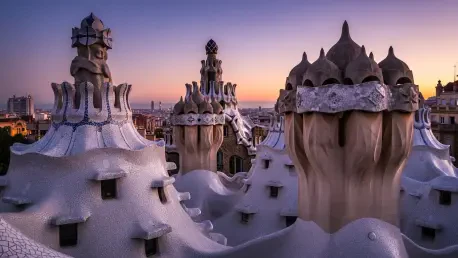

Walking down the Passeig de Gràcia in Barcelona, one is immediately struck by a building that appears to breathe, its stone facade undulating like a slow-moving wave against the urban skyline. This architectural marvel, known as Casa Milà, represents the zenith of Antoni Gaudí’s secular work and serves as a testament to a period when the boundaries of structural engineering were pushed to their absolute limits. By the time construction began in the early twentieth century, Gaudí had already established himself as a revolutionary, yet this particular project would become his most daring residential statement before he turned his full attention to the Sagrada Família. Today, the building is not merely a relic of a bygone era but a vibrant center for culture that continues to challenge contemporary perceptions of how living spaces should interact with the natural world and the people who inhabit them.
Historical Evolution and Controversial Beginnings
The Origins of a Prestigious Commission
The inception of this ambitious project was rooted in the social and economic aspirations of Pedro Milá y Camps and his wife, Rosario Segimon, who sought to cement their status within Barcelona’s high society. As a wealthy developer and a prominent figure in the city’s burgeoning industrial landscape, Milá recognized the Passeig de Gràcia as the ultimate stage for architectural display, commissioning Gaudí to design a building that would serve as both a family home and a source of rental income. The couple envisioned a structure that would dominate the corner of the boulevard, reflecting the opulence of the Modernisme movement while providing modern amenities that were virtually unheard of at the time. This commission gave Gaudí the financial freedom and the physical space to experiment with radical concepts, such as an open floor plan and an integrated garage, which would eventually transform the way urban residences were conceived and built in the Mediterranean region.
Building on this foundation of luxury and ambition, Gaudí approached the design with a holistic philosophy that integrated every aspect of the residents’ daily lives into the very fabric of the building. The plan was meticulously organized to ensure that the Milá family occupied the entire main floor, a sprawling space that allowed for grand entertaining and private comfort, while the upper floors were divided into high-end apartments for the city’s elite tenants. This dual-purpose strategy was intended to create a micro-community within the walls of the estate, where the architectural grandeur would be shared by multiple families. However, the complexity of the design and the sheer scale of the unconventional masonry required a level of craftsmanship that pushed the project’s budget and timeline far beyond the original estimates. This tension between the architect’s uncompromising artistic vision and the practical concerns of the patrons defined the early years of the building’s existence, setting the stage for its legendary status.
Public Skepticism and the “Quarry” Moniker
Despite the architectural brilliance we recognize today, the initial reception of the building by the citizens of Barcelona was marked by a mixture of confusion, mockery, and genuine concern for the neighborhood’s aesthetic integrity. The heavy, rough-hewn stone exterior, devoid of the colorful tiles and delicate ornaments common in other contemporary works, led critics and neighbors to compare the structure to a pile of rubble or a massive cavern. This collective skepticism gave rise to the nickname “La Pedrera,” or “The Quarry,” a term originally intended as a sharp insult to imply that the building was unfinished or lacked the refinement expected of a prestigious residence. Local satirists frequently featured the building in cartoons, depicting it as a garage for zeppelins or a monstrous intrusion into the orderly grid of the Eixample district, reflecting a broader societal resistance to the radical departure from traditional geometric norms.
This atmosphere of hostility was further exacerbated by legal battles between Gaudí and the local municipal authorities, who claimed the building exceeded height and volume regulations. The controversy reached such heights that the owners were nearly forced to demolish parts of the facade, a fate only avoided after the building was declared a monument of artistic merit by the city. Over time, however, the very features that once drew ire began to be seen as strokes of genius, as the public started to appreciate the way the light played across the curved surfaces and the rhythmic quality of the stone. What began as a symbol of architectural eccentricity gradually evolved into a source of civic pride, proving that true innovation often requires a period of social digestion before it can be fully embraced. This shift in perception eventually paved the way for its designation as a UNESCO World Heritage Site, securing its place as an indispensable treasure of global modernism.
Architectural Innovation and Structural Design
Organic Forms and Natural Inspiration
The visual language of the building is defined by Gaudí’s profound rejection of the straight line, which he famously argued did not exist in the natural world. Instead, he utilized the principle of organic growth to dictate the flow of the facade, creating a limestone skin that seems to pulse with an internal energy, much like the cliffs of a rugged coastline or the movement of the sea. Each stone was meticulously cut and fitted to maintain the continuity of the curves, a feat of engineering that required the development of a self-supporting stone facade that did not rely on internal load-bearing walls. This innovation allowed for the inclusion of massive windows and an abundance of negative space, which Gaudí punctuated with intricate wrought iron balconies. These metalwork elements, designed by Josep Maria Jujol under Gaudí’s supervision, resemble tangled masses of seaweed or wild vines, further blurring the distinction between man-made construction and biological growth.
Furthermore, the structural integrity of the building was achieved through a revolutionary system of pillars and girders, which liberated the interior spaces from the constraints of traditional masonry. This “free plan” meant that the internal walls could be moved or removed without compromising the stability of the entire complex, a concept that was decades ahead of its time and would later become a staple of modern architecture. By treating the building as a living organism rather than a static box, Gaudí was able to synchronize the aesthetic experience with the structural requirements of the site. The result is a harmonious blend where the heavy weight of the stone is balanced by the light, airy quality of the iron and the rhythmic openings of the windows. This approach ensured that the building was not just a facade but a fully realized three-dimensional sculpture that interacted with the light and shadows of the Mediterranean sun throughout the day.
Functional Layout and Interior Light
Inside the massive stone shell, the architectural focus shifts toward the optimization of light and air, two elements that Gaudí believed were essential for the health and well-being of the inhabitants. The design is centered around two large internal courtyards—one circular and one oval—which act as light wells, drawing sunshine deep into the heart of the nine-story structure. These courtyards are decorated with vibrant murals and delicate floral motifs, creating a serene environment that contrasts with the ruggedness of the exterior. By arranging the apartments around these central voids, Gaudí ensured that every room had access to natural ventilation and illumination, a significant departure from the dark, cramped interiors common in many urban buildings of the early 1900s. The vertical layout was equally thoughtful, including a basement for carriages and early automobiles, which represented one of the first implementations of an underground parking garage in a residential setting.
This commitment to functional excellence extended to the specialized attic space, which is characterized by a series of 270 catenary arches made of brick. These arches support the weight of the roof terrace while creating a cavernous, rib-like interior that serves as a natural insulating layer, protecting the living quarters below from extreme temperatures. The attic was originally used as a laundry and storage area, but its sophisticated thermal regulation and structural beauty demonstrate that Gaudí viewed even the most utilitarian spaces as opportunities for innovation. The seamless transition between the grand reception rooms of the main floor and the highly efficient rental units above showcases a mastery of space management that catered to both the social hierarchy and the practical needs of the era. This internal logic ensures that the building remains remarkably livable even by current standards, as the fluid layout accommodates the evolving requirements of its modern-day occupants and visitors.
The Rooftop Garden and Cultural Legacy
The Surrealist “Garden of Warriors”
Ascending to the roof of the building reveals a surrealist landscape that feels entirely disconnected from the bustling streets below, a place where functional chimneys and ventilation shafts are transformed into silent, watchful guardians. This space, often referred to as the “Garden of Warriors,” features a collection of sculptural elements adorned with marble, glass, and ceramic fragments through the trencadis technique. The chimneys, with their helmet-like tops and twisted bodies, seem to stand in formation, protecting the building and its inhabitants from the elements. Gaudí’s decision to treat these mechanical necessities as high art was a revolutionary move, as it challenged the prevailing notion that utility and beauty were mutually exclusive. The undulating floor of the terrace follows the curves of the attic arches below, creating a dreamlike terrain of peaks and valleys that offers breathtaking views of the city while maintaining its own internal logic.
The artistic impact of this rooftop extends beyond its visual appeal, as it serves as a masterclass in the creative reuse of materials and the integration of symbolic meaning into architecture. Each sculpture is unique, yet they all contribute to a cohesive narrative of protection and resilience, reflecting Gaudí’s belief that the “hat” of a building was just as important as its foundation. By using broken pieces of tile and recycled glass to create vibrant mosaics, he not only achieved a stunning aesthetic effect but also demonstrated a precocious commitment to sustainable artistic practices. This rooftop has since become an icon of the Barcelona skyline, inspiring generations of artists and architects to look beyond the surface of a structure and find the hidden potential in its most basic components. It remains a place of contemplation and wonder, where the boundaries between the terrestrial and the celestial appear to vanish amidst the stone and sky.
A Living Museum of Gaudí’s Philosophy
In the current era, the building has transitioned from a private residence into a sophisticated cultural institution that provides a comprehensive look into the mind of its creator. The Espai Gaudí, located within the magnificent brick arches of the attic, utilizes modern multimedia tools and detailed scale models to deconstruct the architect’s complex theories on geometry and nature. This educational center allows visitors to see how Gaudí used weighted strings to calculate his signature catenary curves and how he drew inspiration from skeletons, honeycombs, and trees to solve structural problems. By grounding his artistic whimsy in rigorous scientific observation, the museum dispels the myth of Gaudí as a mere dreamer and instead presents him as a highly disciplined engineer. This deep dive into his methodology provides essential context for understanding not just this building, but his entire body of work across Catalonia.
Moving from the theoretical to the practical, the Pis d’Epoca provides a tangible connection to the past by showcasing a fully restored apartment as it would have appeared in the early twentieth century. This space highlights the attention to detail that defined Gaudí’s interiors, from the ergonomic door handles that fit perfectly in the palm of the hand to the specialized moldings that play with the shadows in the hallways. Today, under the careful management of the Fundació Catalunya La Pedrera, the site serves as a blueprint for the future of heritage preservation, balancing the needs of a world-class tourist destination with the ongoing mission of research and education. The building stands as a powerful reminder that architecture should not be a static monument but a living, breathing entity that evolves with the society it serves. As urban environments continue to densify, the lessons found within these walls—regarding light, air, and the human scale—remain more relevant than ever for those seeking to create sustainable and inspiring spaces for future generations.