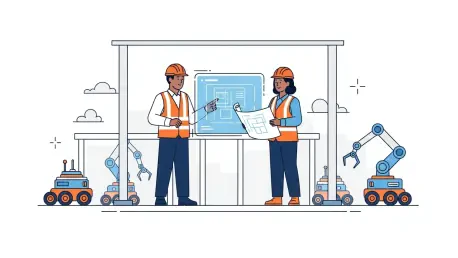

The construction industry is poised on the brink of a technological transformation, yet the promise of widespread robotic automation has been slow to materialize on job sites. This significant gap between potential and reality is not due to a failure of technology, but rather a profound lack of preparedness within the human workforce. A groundbreaking new competency framework now aims to resolve this issue by systematically defining the precise knowledge, skills, and abilities that workers need to collaborate safely and effectively with robotic systems. This pioneering effort moves the industry beyond abstract discussions about the future of work and provides a concrete, actionable blueprint for developing a robot-ready construction workforce, setting the stage for a new era of human-robot collaboration. Full automation remains a distant goal for the unstructured and dynamic construction environment; therefore, this hybrid model, which augments human intelligence with robotic precision, represents the most viable path to enhanced productivity and safety.
Charting a New Course for Workforce Development
A landmark study conducted by a research team from Virginia Tech and the University of Illinois Urbana-Champaign has produced the first-ever expert-informed competency framework specifically for human-robot collaboration (HRC) in construction. To ensure its practical relevance and industry-wide acceptance, the researchers employed a rigorous, multi-stage methodology. The process began with an exhaustive literature review and content analysis to compile a preliminary list of 42 potential competencies, which were then systematically categorized into 20 knowledge areas, 10 skills, and 12 abilities. This foundational list was subsequently subjected to a structured, two-round Delphi survey, a sophisticated method designed to achieve consensus among a panel of carefully selected industry experts. This expert-driven validation process was critical, as it ensures the final framework is not merely an academic exercise but is deeply rooted in the practical realities, immediate needs, and future challenges of the global construction sector.
The framework’s first core domain, Essential Knowledge, outlines the foundational information a worker must possess to function effectively in a technologically advanced construction environment. The expert panel placed the highest priority on a deep, functional understanding of robotic anatomy, operational specifications, and inherent performance limitations. This includes knowing the specific applications of various construction robots, from automated bricklayers to drone-based surveyors, to ensure they are deployed in the most effective manner. Crucially, this domain also encompasses a firm grasp of the principles behind advanced sensing and perception technologies, such as LiDAR and computer vision, which serve as the eyes and ears of autonomous systems. Furthermore, workers must be proficient with the functionality of human-robot interfaces for clear communication and control, understand the mechanics of robotic control systems, and, most critically, possess a thorough knowledge of all relevant safety standards and protocols to prevent accidents and mitigate risks in a shared human-robot workspace.
The Anatomy of a Robot-Ready Builder
Beyond foundational knowledge, the framework meticulously details the Critical Skills required, focusing on the practical, trainable capabilities workers must be able to perform. The study emphasizes the skill of sophisticated task planning, which involves the complex process of breaking down large construction jobs into discrete sub-tasks that are suitable for robotic execution while integrating them seamlessly with human-led activities. A high degree of technical proficiency in operating, calibrating, and performing routine maintenance on diverse robotic systems was also identified as an essential hands-on skill. The framework highlights the growing importance of programming—not necessarily the ability to build complex systems from the ground up, but the practical skill of modifying and adapting pre-existing robot routines to suit the unique and often unpredictable conditions of a specific site. Other vital skills include proactive safety management, the ability to communicate effectively with robotic systems through their designated interfaces, and the capacity to apply principles of data analytics to interpret the vast amounts of information generated by robots, thereby optimizing performance and enabling predictive maintenance.
The final category of the framework outlines Fundamental Abilities, which encompass the inherent cognitive and behavioral attributes that enable a worker to thrive in a dynamic, technology-infused environment. The panel of experts unanimously identified unwavering safety awareness as the single most important ability, forming the bedrock upon which all human-robot interaction must be built. The capacity for continuous learning was also deemed paramount, as robotic technology is in a constant state of evolution, requiring workers to regularly update their skills and knowledge. Strong, agile problem-solving skills and a high degree of adaptability are essential for troubleshooting unexpected issues in the field, where conditions can change rapidly. Furthermore, the ability to apply critical thinking to assess complex situations and make sound judgments in real-time, alongside enhanced spatial awareness to safely navigate and manage a three-dimensional workspace shared with powerful autonomous machines, were identified as indispensable personal attributes for the modern construction professional.
A Strategic Roadmap for Industry Advancement
The establishment of this comprehensive competency framework provided a strategic roadmap that guided multiple stakeholders toward a unified vision for the future of construction labor. For educational institutions, it offered a clear and validated foundation for developing innovative curricula and modernizing existing engineering and construction management programs, which in turn produced graduates who were immediately prepared for the modern job site. For industry leaders and employers, it served as a targeted guide for creating effective reskilling and upskilling initiatives that successfully prepared the current workforce for this significant technological shift, thereby strengthening both operational efficiency and site safety. For policymakers, the framework informed the establishment of standardized qualifications and certification programs, ensuring a consistent and high level of competence across the industry. The research ultimately stressed that technology alone was insufficient; the success of this new era hinged on a deliberate and sustained investment in a resilient, robot-ready workforce capable of supervising, communicating, and adapting alongside their robotic counterparts.