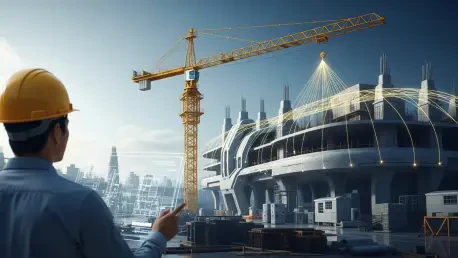

The staggering complexity of modern industrial facilities and high-rise developments has fundamentally transformed the requirements for oversight, rendering traditional manual management techniques obsolete in the current building environment. As project sizes expand, the margin for error shrinks, necessitating a fundamental shift from reactive troubleshooting to a proactive, technology-driven strategy for risk avoidance and management. Building Information Modeling automation serves as the cornerstone of this evolution, integrating algorithmic scripts and artificial intelligence to allow project managers to oversee complex data streams that were previously entirely unmanageable. This technological transition addresses the primary challenges of fragmented stakeholder communication and the sheer volume of information generated throughout a project’s lifecycle. By leveraging rule-based validation to handle repetitive tasks, automation ensures that the groundwork is laid with digital precision, allowing teams to prioritize strategic execution over manual input.
Strategic Defense Against Project Vulnerabilities
Categorizing Major Construction Hazards: The Primary Risks
Large-scale projects are naturally susceptible to a variety of primary risks that can derail their success if not identified and mitigated during the earliest stages of planning and design. Design inconsistencies between disparate engineering disciplines often manifest as physical “clashes” that, if left undetected until construction begins, require expensive field modifications and extensive rework. These spatial conflicts, such as ductwork intersecting with structural steel, represent a significant portion of the hidden costs inherent in massive developments. Furthermore, the manual reconciliation of these designs across thousands of pages of documentation is a process ripe for fatigue-driven oversights. When architects and mechanical engineers work in silos without a unified automated checking system, the likelihood of these errors surviving until the groundbreaking phase increases exponentially. This vulnerability creates a ripple effect, where a single missed intersection causes a cascade of delays across the entire site.
Beyond the physical constraints of the design, financial volatility and schedule delays frequently stem from manual errors during the initial estimation and planning phases of the project. In the current economic climate of 2026, where material prices and labor availability fluctuate rapidly, the inability to accurately forecast requirements can lead to catastrophic budget overruns. On-site safety hazards and evolving regulatory requirements also pose significant legal and physical threats that must be managed with extreme care. Identifying these vulnerabilities is the first step in understanding how automated workflows act as a comprehensive defense mechanism for the developer. These hazards are not merely inconveniences; they are existential threats to the project’s viability, requiring a system that can process thousands of variables simultaneously. By categorizing these risks early, teams can implement automated triggers that flag deviations before they manifest as physical problems on the job site.
Enhancing Precision and Minimizing Human Error: Parametric Protocols
The construction industry widely recognizes human error as a primary driver of project risk, making the achievement of consistency a vital goal for any major contractor or developer. Automation introduces sophisticated parametric protocols where a change in one part of a model automatically updates all related components throughout the entire database. For instance, moving a structural beam by just a few inches instantly adjusts the connected joints, plumbing runs, and architectural finishes across the entire project file without human intervention. This synchronization prevents the dreaded “orphaned” errors, where a modification in one set of documents fails to appear in another, leading to massive confusion during the fabrication phase. By removing the need for manual cross-referencing, the system ensures that every drawing and data point remains in a state of perpetual harmony, regardless of how many revisions occur during the design development process.
This level of digital rigor significantly reduces the need for rework and limits the potential for scope creep, which often occurs when small errors accumulate into large-scale design changes. In the period from 2026 to 2028, the adoption of these automated parametric tools is expected to become the standard requirement for securing insurance and financing for large-scale infrastructure. The software acts as a tireless auditor, checking every connection and dimension against a set of predefined rules that represent the project’s technical requirements. This allows highly skilled engineers to move away from the tedious task of double-checking basic measurements and instead focus on optimizing the performance and sustainability of the building. Consequently, the precision of the initial digital twin directly correlates to the efficiency of the physical construction, creating a reliable bridge between the conceptual design and the final, built reality of the structure.
Optimizing Workflows and Financial Control
Pre-emptive Conflict Resolution: The Power of Clash Detection
Coordination between mechanical, electrical, and plumbing systems is incredibly dense in major infrastructure projects, often involving miles of conduit and piping within confined spaces. Automated clash detection allows these various systems to be run against each other in real-time within the digital environment, rather than forcing teams to wait for weekly coordination meetings to find problems. The software categorizes these conflicts by severity and discipline, enabling project managers to resolve critical structural issues before moving on to minor cosmetic overlaps. This hierarchy of resolution ensures that the most impactful errors are addressed immediately, preventing a backlog of design changes that could paralyze the project. By fostering a “clash-free” environment in the virtual world, firms can guarantee that when components arrive at the physical construction site, the assembly process will be seamless and rapid.
The elimination of on-site downtime caused by parts that do not fit is perhaps the most immediate return on investment for automation technologies in the building sector. When a prefab module arrives on-site and fits perfectly into its designated slot because the digital model was validated automatically, the project maintains its momentum and avoids the high costs of idling labor. Furthermore, this pre-emptive resolution reduces the volume of Requests for Information that typically plague the transition from design to construction. Instead of field crews stopping work to ask for clarification on a pipe hitting a beam, the solution is already baked into the approved construction documents. This streamlined workflow allows for a more aggressive and predictable schedule, as the uncertainty of field adjustments is removed from the equation. Ultimately, automated clash detection transforms the job site from a place of problem-solving into a place of efficient assembly and execution.
Data-Driven Financial Stability: Precision in Procurement
Modern construction thrives on accurate data, which automation distills into actionable visual dashboards that allow stakeholders to monitor project health in real-time. By utilizing automated quantity takeoffs, companies can generate precise material counts directly from the model, allowing for more effective budgeting and reducing the “buffer” costs used to hide manual counting errors. In traditional workflows, estimators would often add a ten percent contingency just to cover the uncertainty of manual measurements, but automation brings that margin down to nearly zero. This precision allows for leaner procurement strategies, where materials are ordered exactly as needed, reducing on-site storage requirements and minimizing waste. When every ton of steel and cubic yard of concrete is accounted for in the digital twin, the financial predictability of the project increases, making it far more attractive to investors.
Additionally, sophisticated simulation tools let stakeholders test the financial impact of design changes or material substitutions before any physical work starts on the project. If a client considers switching from one cladding material to another, the automated system can instantly calculate the change in cost, lead time, and even the long-term energy performance of the building. This ensures that every expenditure is backed by empirical data rather than mere intuition or guesswork, providing a clear audit trail for financial decisions. The integration of cost data directly into the BIM environment creates a living budget that responds to every design iteration, ensuring that the project remains within its financial boundaries. By grounding every decision in hard data, firms can avoid the sudden fiscal shocks that often occur at the end of large-scale projects, leading to more stable and profitable outcomes for all involved.
Safety, Scheduling, and Long-Term Value
Integrated Scheduling and 4D BIM: The Temporal Dimension
The integration of time into the digital model, known as 4D BIM, is a critical advancement in risk mitigation that allows for the visualization of the entire construction sequence. Automation links the project schedule directly to the 3D elements, meaning any design change or delay in material delivery automatically updates the construction sequence across the board. This visual simulation allows teams to identify potential bottlenecks months before they occur on-site, such as two subcontractors needing to occupy the same small area at the same time. By identifying these spatial-temporal conflicts early, project managers can resequence tasks to ensure a continuous flow of work without the expensive “hurry-up-and-wait” scenarios. This foresight is especially valuable in urban environments where staging area is limited and every delivery must be timed with surgical precision to avoid local traffic disruptions.
By optimizing the use of labor and equipment through these automated simulations, firms can achieve a level of operational efficiency that was previously impossible. The 4D model acts as a rehearsal for the actual construction, allowing the team to test different logistics strategies until they find the one that minimizes risk and maximizes speed. If a particular crane location is found to be inefficient through the simulation, it can be moved in the digital environment at no cost, rather than discovering the error after the equipment is already on-site. This data-driven approach to scheduling also improves communication with stakeholders, as they can watch a time-lapse animation of the future construction to understand the project’s progress. Consequently, the schedule becomes a dynamic tool for management rather than a static document that is out of date the moment it is printed, leading to higher accountability and performance.
Maintaining Safety and Regulatory Compliance: Digital Oversight
While safety is often seen as a field issue handled by site supervisors, automation brings it into the earliest design phases by simulating worker pathways and equipment zones. Rule-based checking acts as a “digital inspector,” ensuring that every part of the design follows local building codes, fire safety standards, and occupational health regulations automatically. For example, the software can automatically check that every hallway meets the required width for emergency egress or that railings are placed at the correct heights throughout the structure. This proactive oversight catches non-compliance issues that the human eye might miss during a manual review, helping the firm avoid the legal liabilities and fines associated with failed inspections. By embedding safety into the digital DNA of the building, the project team creates a safer environment for the workers who will eventually bring the design to life.
Furthermore, the automation of safety planning includes the simulation of high-risk activities, such as heavy lifts or excavations near existing utilities, to identify potential hazards before they occur. These simulations allow safety officers to develop specific mitigation plans and train the field crews using the visual data from the model, ensuring that everyone is aware of the risks involved in a particular task. This preventative approach significantly reduces the rate of on-site accidents and the associated work stoppages that can derail a project’s timeline. In the period from 2026 to 2030, the integration of automated safety checking is expected to drastically lower insurance premiums for contractors who can demonstrate a tech-enabled approach to risk management. Ultimately, the use of automation for compliance and safety transforms these requirements from administrative burdens into strategic advantages that protect both the workforce and the project’s bottom line.
Unified Collaboration and Operational Handover: The Data Legacy
One of the greatest benefits of automation is the creation of a “single source of truth” for all project participants, from the lead architect to the smallest subcontractor. In an environment with dozens of stakeholders, automation ensures everyone works from the same updated model, with instant notifications sent whenever a change occurs in a related discipline. This unified approach eliminates the miscommunications that typically lead to errors, as every team member has access to the most current data at all times. The system tracks who made what change and when, providing a transparent history of the design’s evolution that can be invaluable for resolving disputes or understanding the rationale behind specific decisions. This collaborative environment fosters a sense of shared responsibility and alignment, ensuring that the entire team is moving toward the same goals.
This accuracy persisted even after construction was complete, providing the owner with an “as-built” digital record that served as a foundation for the building’s entire lifecycle. The automated model included maintenance schedules, equipment details, and warranty information, turning the transition from construction to operation into a smooth, data-driven exchange. Facility managers were able to use this data to predict equipment failures and optimize energy consumption from day one, rather than spending months manualizing paper files. This long-term value was a direct result of the rigorous data collection and validation that occurred throughout the automated design and construction process. By delivering a comprehensive digital asset along with the physical building, the project team provided the owner with a tool for ongoing risk mitigation and operational excellence that lasted for decades.
The implementation of BIM automation across large-scale projects successfully moved the needle from reactive management to a sophisticated, predictive framework. This transition allowed developers to navigate the increasing complexities of the modern built environment with unprecedented confidence and precision. By the time the final structures were commissioned, the integration of algorithmic checking and real-time data synchronization had already saved thousands of hours in rework and millions of dollars in unallocated contingency. The industry realized that technology was not merely a supplement to human expertise but an essential multiplier that enabled teams to tackle projects of previously impossible scale. As a result, the focus shifted toward refining these automated workflows to ensure that every future development began with a robust, de-risked digital foundation.