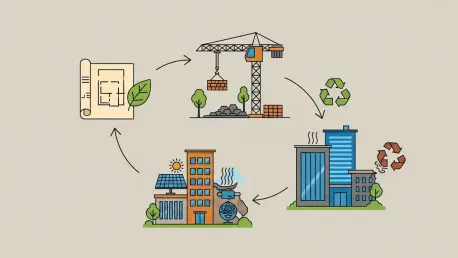

A newly published comprehensive analysis details a powerful methodology for architects and engineers to forecast and drastically reduce a building’s entire environmental footprint before a single shovel breaks ground. The study, appearing in the latest issue of Energy & Environment Nexus, centers on integrating Building Information Modeling (BIM) with life cycle assessment principles to create a “digital twin” of a structure. This data-driven framework allows for precise identification of carbon emission hotspots throughout every stage, from material manufacturing to eventual demolition. Given that the global building sector is responsible for roughly a third of all energy consumption and carbon dioxide emissions, and with construction-related emissions continuing to rise, this innovative approach provides a critical, proactive tool. It equips stakeholders with the foresight needed to make informed design decisions that can lead to substantial, long-term decarbonization and support national and international climate goals.
A New Framework for Sustainable Design
At the core of the research is an integrated Carbon Emission Estimation for Buildings (CEEB) framework, which was rigorously tested using an office building in northern China as a detailed case study. This advanced model synthesizes the granular geometric, material, and operational data inherent in a BIM model with the holistic, cradle-to-grave perspective of a life cycle assessment. This fusion directly addresses a persistent challenge in sustainable construction: the difficulty of comprehensively quantifying emissions across all stages and linking them directly back to specific design choices. By establishing this clear connection, the CEEB framework moves carbon assessment from a reactive, post-construction audit to a proactive, integrated part of the initial design process. It provides a transparent and verifiable method for evaluating the long-term environmental consequences of every decision, from structural system selection to window specifications, long before they are locked in.
The application of this framework involved a meticulous analysis of the building’s entire life span. Researchers focused on major construction materials, including concrete, steel reinforcement, cement, sand, and masonry blocks, calculating the embodied carbon associated with their production and transport. Simultaneously, the BIM model was used to simulate the building’s operational energy consumption for heating, cooling, lighting, and hot water, tailored to the region’s specific climatic conditions. Through the use of standardized calculation methods and a series of scenario-based sensitivity analyses, the study generated a highly detailed and granular map of the building’s carbon footprint. This comprehensive approach ensures that no significant emission source is overlooked, providing a complete picture that encompasses both the upfront embodied carbon and the long-term operational carbon, which together define a building’s true climate impact.
Deconstructing the Carbon Footprint
The investigation yielded several critical findings by dissecting the various phases of the building’s life cycle, revealing distinct emission hotspots in the material production and transportation phase. The analysis identified steel production as the dominant source of embodied carbon, responsible for 270.87 metric tons of CO₂ equivalent, which constitutes a staggering 46% of all production-related emissions. It was followed by concrete at 29% and cement at 21%, underscoring that any serious effort to decarbonize the material supply chain must prioritize technological innovations in the steel and cement manufacturing sectors. In a contrasting discovery, emissions from transportation were driven not by heavy industrial materials but by logistics. Sand, despite having a negligible production footprint, contributed 40% of all transport-related emissions due to the sheer volume and logistics involved, revealing that supply chain management is a critical but often overlooked leverage point for mitigation.
However, the most significant discovery of the study relates to the operational phase of the building, which was found to overwhelmingly dominate the structure’s total carbon footprint over its lifetime. The detailed, BIM-based energy simulations revealed that operational emissions, particularly those generated from heating systems, are the primary driver of the building’s long-term environmental impact. In the specific case study, the reliance on a conventional coal-based heating system proved to be the single largest factor. The use of bituminous coal alone accounted for nearly 45% of all operational emissions, while heating-related activities in total were responsible for almost two-thirds of the operational carbon output. This powerful finding emphasizes that the energy systems and efficiency measures chosen during the initial design phase have a far greater and more enduring impact on a building’s carbon legacy than the embodied emissions generated during its construction.
Targeting High-Impact Decarbonization Strategies
To quantify the potential for meaningful carbon reduction, the researchers conducted a comparative scenario analysis of alternative heating technologies, and the results were stark. The study demonstrated that replacing the conventional coal-fired heating system with a modern ground-source heat pump could cut heating-related emissions by over 50%. This single design modification would translate to a reduction of nearly 19% in the building’s total life-cycle emissions, showcasing the immense power of making strategic technological choices early in the design process. This high-performance system significantly outpaced other common alternatives, such as natural gas and air-source heat pumps, particularly within the cold climate of northern China. This highlights the critical importance of selecting decarbonization technologies that are not only advanced but also appropriately suited to the local environmental and climatic context to achieve maximum effectiveness.
Ultimately, by integrating all stages into a full life cycle assessment, the research confirmed that the operation and maintenance phase is the largest contributor to a building’s carbon footprint, accounting for a staggering 94.62% of total emissions. In comparison, material production and transportation contributed a much smaller fraction, while the emissions from the on-site construction and end-of-life demolition phases were found to be negligible. This overarching consensus reinforced that to achieve deep and meaningful decarbonization in the building sector, the primary focus must shift decisively toward minimizing operational energy consumption. The findings collectively advocated for a new paradigm in building design, one that moves away from a narrow focus on construction materials and toward a holistic, life-cycle-oriented approach. By embedding carbon estimation directly into the BIM process, designers and developers could proactively implement the most impactful strategies from day one.