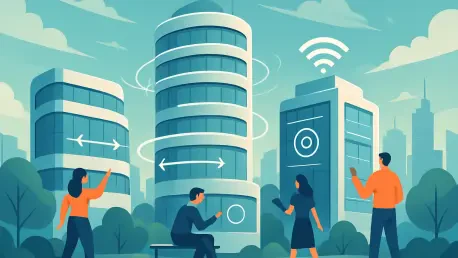

The buildings we inhabit daily, from sprawling corporate campuses to towering urban high-rises, have struggled to keep pace with the rapid evolution of human work and life patterns, creating a significant disconnect between our dynamic needs and the static nature of our built environment. Commercial real estate now stands at a critical juncture, pressured by a confluence of rising operational costs, volatile energy prices, and an urgent mandate for greater sustainability. In this new landscape, buildings can no longer function as passive structures of concrete and steel; they must transform into living, breathing ecosystems that anticipate human requirements and adapt seamlessly to perpetual change. At the core of this revolution lies a new generation of human-centric, autonomous buildings—intelligent spaces designed to think, learn, and evolve in service of both their occupants and the planet. This shift represents more than an incremental upgrade over earlier “smart” technologies; it is a fundamental reimagining of how buildings are designed, operated, and ultimately valued throughout their entire lifecycle.
1. The Transition from Smart to Autonomous
The evolution from smart to autonomous buildings marks a pivotal change in how technology is integrated into our physical spaces, moving beyond isolated efficiency gains to create a truly holistic and responsive system. While smart buildings have long utilized sensors and automation for tasks like lighting and climate control, their functions often operate in silos, requiring significant human oversight to manage and optimize. Autonomous buildings, in contrast, are defined by their ability to sense, analyze, and act without constant human intervention. They leverage a network of interconnected systems to gather vast amounts of real-time data, process it through advanced analytics, and make predictive decisions that enhance the environment. This autonomous action can manifest in myriad ways, from preemptively adjusting HVAC systems based on occupancy forecasts to identifying potential equipment failures before they occur. The ultimate goal is to create an environment that continuously learns and refines its operations, thereby reducing waste, improving occupant comfort, extending asset value, and ensuring the highest levels of operational flexibility for any use case.
The imperative driving this transition is rooted in the growing unsustainability of traditional building management models, which are proving inadequate in the face of modern economic and environmental pressures. The sharp increase in energy costs, persistent labor shortages in facility management, and increasingly stringent Environmental, Social, and Governance (ESG) requirements have created a perfect storm for commercial real estate owners. Buildings that fail to adapt to these new realities risk becoming obsolete, or “stranded assets,” unable to attract tenants or investment in a competitive market. Autonomy has thus emerged not as a technological novelty but as a strategic necessity for survival and growth. By embracing this evolution, property owners can transform their assets into resilient, flexible, and future-proof environments that not only meet regulatory demands but also deliver superior experiences, securing their long-term competitiveness and value in a rapidly changing world.
2. Orchestrating the Technology for Execution
The realization of autonomous buildings is not dependent on a single breakthrough technology but rather on the sophisticated orchestration of multiple interconnected systems working in concert. At the heart of this digital nervous system are technologies like digital twins, which create virtual replicas of physical assets for simulation and analysis, and AI-driven analytics engines that can process immense data streams from thousands of sensors. Connected Internet of Things (IoT) devices provide the real-time data—from occupancy levels and air quality to equipment performance—that fuels these systems. This information is processed using a combination of cloud and edge computing, allowing for both large-scale analysis and rapid, localized decision-making. Together, these elements enable advanced capabilities such as predictive maintenance, which can forecast equipment failures and schedule repairs with minimal disruption, and AI-enabled HVAC optimization, which intelligently balances indoor air quality with energy efficiency based on live conditions rather than static schedules.
What truly differentiates an autonomous building from a conventional smart one is its capacity to close the loop from insight to execution, moving beyond simply identifying issues to resolving them autonomously within predefined parameters. This journey often begins with a phased implementation strategy, starting with targeted use cases that deliver a rapid and measurable return on investment, such as energy optimization or automated fault detection. Once these initial projects demonstrate value and build trust in the system, owners can progressively scale the integration across other building systems and portfolios. This creates a unified operational layer that enables continuous, data-driven optimization rather than relying on one-off improvements or manual interventions. The result is a system that not only flags an inefficient chiller but can also automatically adjust its setpoints or dispatch a work order, transforming building management from a reactive, often chaotic process into a proactive and highly efficient operation.
3. Redefining the Human Role in Building Management
Contrary to the common fear that automation will render human roles obsolete, the rise of autonomous buildings actually elevates the function of property managers and facility teams, enabling a strategic shift from reactive troubleshooting to high-value optimization. This new operational paradigm is often described as a “human-in-the-loop” model, where artificial intelligence acts as a co-pilot, handling the torrent of routine decisions and mundane tasks that currently consume a significant portion of a facility manager’s day. For example, the system can automatically adjust lighting levels room by room, manage thermal comfort based on real-time occupancy, and generate routine performance reports. This frees up human experts to focus on more complex, strategic challenges that require nuanced judgment and creative problem-solving. When the AI encounters an issue that falls outside its defined parameters or involves a high-impact decision, it escalates the situation to a person with the appropriate expertise, providing all the necessary data and context to make an informed choice.
This collaborative relationship between humans and AI creates a powerful virtuous cycle that enhances both operational performance and the occupant experience, leading to improved tenant retention and greater asset resilience. By offloading the burden of constant monitoring and manual adjustments, autonomous systems empower smaller facility teams to manage larger and more complex portfolios without sacrificing performance or control. These teams can then dedicate their time to initiatives that directly impact business goals, such as developing long-term capital improvement plans, engaging with tenants to better understand their needs, and fine-tuning the building’s performance to align with corporate sustainability targets. Ultimately, this model does not replace human oversight; it refines it, ensuring that human intelligence is applied where it matters most. The result is a more efficient, responsive, and strategically managed built environment that delivers superior outcomes for owners, operators, and occupants alike.
4. An Unwavering Focus on the Human Experience
The concept of human-centric buildings has rapidly gained urgency as employers and investors increasingly recognize the direct link between occupant wellbeing, productivity, and long-term value creation. In an era where companies are competing fiercely for talent, the quality of the workplace environment has become a critical differentiator. Research consistently shows that spaces designed with intentional focus on elements like natural light, acoustic comfort, superior air quality, and user control significantly outperform conventional offices in both occupancy rates and rental premiums. When employees feel comfortable, healthy, and empowered in their surroundings, they are more engaged, innovative, and productive. This realization is fueling a fundamental shift in the real estate industry, where the focus is moving away from simply providing square footage to delivering a comprehensive and curated “experience as a service”—a holistic offering that supports the physical, mental, and social health of the people inside.
Autonomous buildings make it possible to deliver this human-centric experience at scale by moving beyond the static assumptions made during the design phase and instead learning from real, dynamic usage patterns. Traditional building systems are often programmed based on standardized schedules and generalized assumptions about how a space will be used, leading to environments that are frequently too hot, too cold, or poorly lit. In contrast, an autonomous building uses a dense network of sensors to understand how people actually move through and interact with the space throughout the day. Its digital systems can then dynamically adjust temperature, lighting, and airflow around human behavior in real time, ensuring that comfort is not just an abstract goal but a measurable and consistently delivered outcome. For real estate decision-makers, this capability represents a powerful tool to create highly desirable, marketable environments that can adapt to the evolving needs of tenants in competitive urban markets.
5. A Deliberate Path Forward
The journey toward a future of autonomous, human-centric buildings required a collective and concerted effort across the entire industry ecosystem, fundamentally altering how different stakeholders approached their roles. Investors learned to adopt longer-term perspectives on digital upgrades, recognizing that the goals of decarbonization and digitalization were not separate but mutually reinforcing investments that built lasting asset value. Similarly, developers and designers began to plan for data integration from the very outset of a project, ensuring that new constructions were “born connected” with the digital infrastructure necessary for future autonomy. This foresight prevented the costly and disruptive retrofitting of legacy systems down the line. Perhaps most importantly, the industry acknowledged that technology was not the end goal but rather the enabler of spaces that were more adaptive, inclusive, and sustainable for the people who used them every day.
This evolution also necessitated a significant transformation in the workforce, as success became dependent on upskilling facility teams to collaborate effectively with intelligent systems. As AI became the co-pilot of building operations, team members were trained to interpret complex data insights, validate automated decisions, and shift their focus from routine, manual interventions to high-impact strategic actions. For many organizations, the most effective path forward was an evolutionary one that began with implementing high-impact use cases to build trust in data and AI outputs. From there, they progressively expanded autonomy across systems, sites, and eventually entire portfolios. This deliberate, phased approach ensured that human-centric, autonomous buildings delivered on their promise of measurable outcomes, ultimately transforming commercial real estate from a collection of cost centers into a network of intelligent, self-optimizing assets that created new frontiers of value.