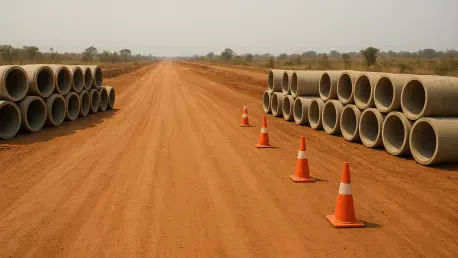

Major Chinese contractors such as Sinohydro and China Harbour Engineering Company currently manage CFAF 306 billion in road projects that are failing to progress as scheduled. This substantial financial commitment represents approximately 66 percent of the total road infrastructure portfolio for Northern Cameroon, a region encompassing the Adamawa and Far North provinces. While these firms have successfully secured a lion’s share of the market, the physical reality on the ground tells a much different story of missed deadlines and stagnant machinery. The Ministry of Public Works has expressed increasing concern over the fact that out of sixteen major regional road projects, ten are under the control of Chinese entities, yet the anticipated economic corridor improvements remain largely theoretical. This disparity between contract volume and results has sparked a national debate regarding the capacity of these global giants.
Structural Monopoly: The Chinese Footprint in Northern Cameroon
The current landscape of infrastructure development in the northern regions is characterized by a heavy reliance on subsidiaries of the China Communications Construction Company, including China First Highway Engineering and China Harbour Engineering. Together, these specific entities oversee contracts valued at nearly CFAF 88 billion, focusing on critical arteries like the Mora-Kousseri corridor. Alongside them, the Sinohydro and Stecol consortium, as well as the CGCOC Group, have established a formidable presence that often leaves little room for smaller competitors. These projects are not merely local initiatives; they are backed by significant international capital from the World Bank and the African Development Bank. Despite this robust financial backing and the technical pedigree associated with these firms, the integration of local labor has remained minimal, leading to a centralized management style that may be contributing to the systemic inertia across multiple job sites.
Financing Dynamics: International Capital and Global Contractors
In contrast to the dominant Chinese presence, other international players like the Chadian company Sotcocog and various consortia from Turkey maintain a significantly smaller footprint. The most striking observation within recent Ministry reports is the near-total absence of local Cameroonian firms as lead contractors on these high-value projects. This lack of domestic leadership in the construction sector limits the development of internal expertise and keeps the nation dependent on foreign entities that may prioritize global portfolio management over local deadlines. While the government has sought to diversify its partnerships, the sheer scale of Chinese financing and logistical reach continues to tip the scales in their favor during procurement. As the 2026 to 2028 development cycle progresses, the pressure to demonstrate actual paved kilometers is mounting, forcing a reevaluation of how these massive infrastructure contracts are awarded and held to account by the state.
Performance Gaps: Assessing Progress on Critical Corridors
The most glaring execution failures were found along the Ngaoundéré-Garoua road, where sections showed less than five percent completion a year into the project. To address these systemic delays, the Cameroonian authorities began implementing stricter oversight mechanisms that required contractors to provide real-time updates on equipment mobilization. The government moved toward a policy of diversifying contractor nationalities to foster a more competitive environment, while simultaneously incentivizing joint ventures between international giants and local firms. This shift was intended to ensure that technical knowledge was transferred to the domestic workforce, reducing the long-term dependency on foreign management. Decision-makers also prioritized the enforcement of penalty clauses for non-performance, signaling that the era of indefinite extensions had come to an end. These proactive measures were designed to transform the infrastructure sector into an accountable engine.