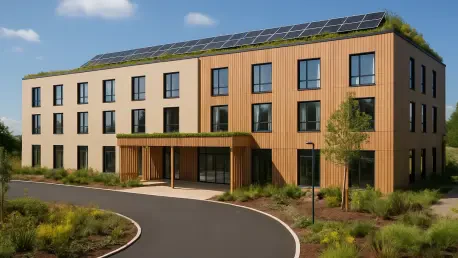

The hospitality industry has reached a transformative juncture where sustainable luxury is no longer a niche preference but a fundamental requirement for modern infrastructure development. This shift is most clearly evidenced by the voco Zeal Exeter Science Park, which recently achieved a historic milestone by securing a BREEAM Outstanding rating at its final assessment stage. As the first hotel in Western Europe to receive this prestigious classification, the 142-room property serves as a definitive global benchmark for the sector. Operating as the inaugural branded net-zero carbon hotel under the IHG umbrella, it represents a departure from traditional building methods toward a more ecologically integrated model. The project has already earned significant recognition from industry experts, including high-profile honors such as the Best New Construction or Commercial Project at the BREEAM Awards and the Green Building Project of the Year at the edie Net Zero Awards. By prioritizing environmental integrity from the initial design phase, the facility demonstrates that large-scale commercial success is compatible with rigorous carbon reduction. This achievement signals a broader trend in the market where asset value is increasingly tied to verifiable sustainability metrics and the ability to meet stringent international environmental criteria.
Engineering a Net-Zero Architectural Standard
The technical foundation of this development relied on a sophisticated collaboration between Zeal Hotels and RED Construction Group, focusing on the industry’s net-zero objectives for the coming decades. Engineered as a 100% electric facility, the structure adheres to the demanding Passivhaus standards, which emphasize airtightness and thermal performance to drastically reduce energy demand. One of the most innovative features is the implementation of Solarlab vertical photovoltaic panels, marking the first time such a comprehensive rainscreen cladding system has been utilized in the United Kingdom. These panels do not merely provide aesthetic appeal but act as a continuous source of renewable energy, feeding the building’s internal systems directly. To maintain optimal temperatures without the heavy carbon footprint of traditional HVAC systems, the design incorporates adiabatic cooling and reversible heat pumps. These technologies work in tandem to ensure that guest comfort remains uncompromised while the operational energy consumption remains at a fraction of standard levels. This synthesis of advanced building fabrics and renewable tech proves that the physical envelope of a hotel can function as an active participant in energy generation rather than just a passive consumer of resources.
Strategic Pathways for Sustainable Hotel Operations
The successful certification of the Exeter project provided a clear roadmap for developers seeking to align commercial hospitality with planetary boundaries through transparent third-party validation. Stakeholders recognized that the path forward necessitated a move away from self-reported sustainability claims toward rigorous, data-driven assessments like BREEAM. Industry leaders observed that the integration of ultra-low carbon construction early in the lifecycle allowed for a scalable model that could be replicated across diverse geographic markets. To achieve similar results, future projects prioritized the use of vertical solar integration and advanced thermal systems to mitigate the environmental impact of 24-hour operations. This transition required a fundamental shift in how investment was allocated, moving capital toward high-efficiency materials that offered long-term operational savings and resilience against fluctuating energy costs. By demonstrating that environmental responsibility enhanced guest experiences, the project encouraged a broader adoption of net-zero strategies across the global portfolio. Professionals in the field analyzed these outcomes to refine their own carbon reduction targets, ensuring that new developments contributed positively to the built environment while maintaining the high standards expected by a climate-conscious public.