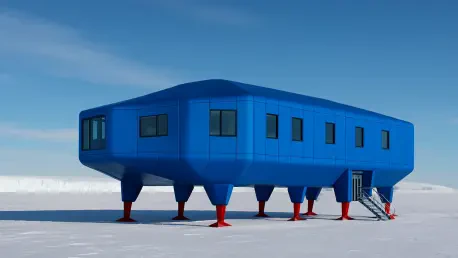

Standing as a vibrant beacon of sapphire blue against the blinding white expanse of the Adelaide Island ice shelf, the Discovery Building represents a radical departure from the makeshift structures that have traditionally housed polar explorers. This architectural marvel at the Rothera Research Station is the first facility in the Antarctic to earn an “Outstanding” BREEAM accreditation, a prestigious sustainability rating usually reserved for the most elite skyscrapers in London or New York. By achieving this benchmark in one of the most volatile climates on the planet, the British Antarctic Survey has demonstrated that the technical limitations of net-zero construction are largely a thing of the past.
The stakes for this modernization project could not be higher, as the very scientists tasked with monitoring the melting of the polar ice caps have historically been forced to rely on carbon-intensive energy sources to survive. For decades, the Rothera station consisted of scattered, aging buildings that bled heat into the atmosphere, requiring an exhaustive supply chain of marine gas oil to keep the lights on. This logistical burden created a paradoxical cycle where the study of climate change contributed to the problem, making the transition to a high-efficiency consolidated hub a critical requirement for the integrity of future global research efforts.
A New Standard for Sustainability in the Deep Freeze
The successful completion of this facility places it within the top 1% of the world’s most sustainable buildings, proving that geography is no longer an excuse for environmental negligence. Reaching such a high accreditation required an unprecedented collaboration between architects, engineers, and environmental consultants who had to account for wind speeds that can shred traditional building materials. The project serves as a proof of concept for the international scientific community, illustrating that if a building can maintain an “Outstanding” rating in a place with no power grid and months of total darkness, urban centers have no excuse for lagging behind.
By reimagining how infrastructure functions in sub-zero temperatures, the British Antarctic Survey is setting a precedent for every other nation operating on the frozen continent. This building is not merely a place to sleep and work; it is a sophisticated instrument designed to minimize the human footprint on a pristine ecosystem. The shift toward such high-performance hubs ensures that the station can continue its mission of protecting marine biodiversity and stabilizing global climate models without becoming a source of pollution itself.
The High Stakes of Polar Infrastructure Modernization
The modernization of the Rothera station is part of a broader commitment to ensure that British polar science remains at the forefront of global discovery through the end of the decade. As international pressure mounts to stabilize the world’s ice sheets, the logistical inefficiency of old polar bases has become a significant liability. The Discovery Building addresses this by consolidating multiple functions—from science labs and medical facilities to workshops—into a single footprint, which drastically simplifies the complex supply chains required to move fuel and equipment across the Southern Ocean.
Maintaining the integrity of polar research requires a base that can withstand the physical toll of the environment while offering a stable platform for sensitive instrumentation. Historically, the energy demand of polar bases was so high that it limited the budget available for actual scientific inquiry. By streamlining operations into a modernized, low-emission facility, the organization can redirect resources toward the actual study of the Antarctic Peninsula, ensuring that the data collected remains as clean and untainted as possible.
Engineering Efficiency Through Integrated Design and Automation
At the core of the building’s ability to slash carbon emissions by 25% is a meticulously engineered ecosystem that prioritizes resource conservation at every turn. A sophisticated building management system serves as the central nervous system of the facility, utilizing a network of sensors to monitor occupancy and light levels in real time. This automation ensures that energy is never wasted on heating or illuminating empty laboratories or storage rooms. Furthermore, a combined heat and power system captures the thermal energy typically lost by generators, recycling it to provide consistent warmth for the inhabitants.
To bolster the station’s energy independence, a bank of over 80 solar panels was installed to harvest the intense radiation of the Antarctic summer sun. While the winter months rely on traditional power generation, these renewable inputs provide a significant boost during the peak of the field season. This integrated approach to energy management creates a feedback loop where waste is minimized and every kilowatt is tracked, allowing the station to operate with a level of precision that was previously unimaginable in such a remote location.
Architectural Innovation Shaped by the Antarctic Elements
The physical structure of the Discovery Building was dictated by the brutal physics of the Antarctic Peninsula, featuring a 90-meter central corridor that acts as a thermal spine for the station. This “building within a building” design allows researchers to move between different departments without ever exposing the interior to the sub-zero air outside. By reducing the number of external door openings, the facility minimizes the energy spikes that typically occur when heat escapes into the wind, effectively creating a massive buffer against the cold.
Beyond its thermal envelope, the building’s exterior features a unique curved wind-deflector designed to manage the massive snowdrifts that often bury polar facilities. By using the wind to sweep snow away from the structure, the station avoids the fuel-intensive labor previously required for mechanical snow removal. The interior design also reflects a deep understanding of human psychology, using intentional color palettes and flexible social spaces to support the mental well-being of a crew that must endure long periods of total isolation and physical confinement.
Strategies for Implementing Low-Impact Construction in Extreme Environments
The success of the Discovery Building offers a clear framework for future construction projects in remote or environmentally sensitive areas. The first step in this model is the centralization of operations, which reduces the total surface area vulnerable to heat loss and makes life-support systems far easier to maintain. Additionally, the project highlights the importance of “passive” design—shaping a building to work with, rather than against, the local climate—to reduce the baseline energy demand before active heating systems are even engaged.
By integrating waste-stream recovery and smart automation from the earliest planning stages, the project proved that self-sustaining environments could thrive despite extreme logistical constraints. The lessons learned at Rothera provided a roadmap for sustainable development in other fragile regions, such as the High Arctic or high-altitude mountain ranges. Ultimately, the project moved the needle on what is possible for remote infrastructure, ensuring that the next generation of researchers can work in a facility that lived up to the environmental standards they were there to defend.