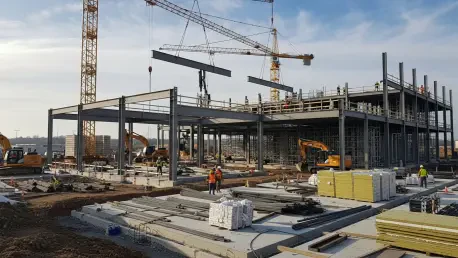

Demand for data centers is rising steadily, driven by cloud adoption, artificial intelligence workloads, and broader digital transformation across industries.
For construction firms, this shift translates into a growing pipeline of complex, high-value projects.
Still, capturing that opportunity requires both technical capability and a comprehensive understanding of what makes data center builds different from standard commercial construction.
This article outlines the key characteristics of data center construction, which risks can derail even well-resourced projects, and the project management priorities that determine whether these builds succeed.
What Data Center Construction Actually Involves
Data centers are specialized facilities designed to house IT equipment and the infrastructure that keeps it running continuously. Their main operational requirement is 24/7 uptime, which shapes every aspect of how they are built.
Several characteristics of data center construction set it apart from standard commercial builds, starting with highly complex and costly core systems and infrastructure.
The mechanical, electrical, and plumbing (MEP) systems alone can account for up to 60% of total project costs, while power systems typically include dual utility feeds from separate substations, uninterruptible power supply (UPS) units, and backup generators.
Cooling infrastructure evolved significantly to sustain increased computing demands, with many facilities moving away from traditional air conditioning units toward more efficient approaches. This includes hot-aisle/cold-aisle containment and, increasingly, liquid cooling for high-density deployments.
Security design is equally layered. Multi-factor access controls, perimeter barriers, and dedicated secure zones have become the standard expectations.
Project timelines reflect this complexity, with a typical data center build spanning 18 to 24 months from groundbreaking to commissioning, although modular construction techniques can reduce that window further.
According to DC Deployed, individual campus projects frequently exceed $1 billion in total investment. Construction costs typically range from $7 to $12 million per megawatt of IT capacity, depending on location, design specifications, and tier requirements.
For contractors used to commercial or industrial builds, the scale and specificity of these requirements can take some adjusting.
Key Challenges Contractors Are Facing
Data center construction presents several challenges that are particularly significant for firms entering or expanding in this space.
The first is supply chain exposure. Specialized electrical and mechanical equipment, such as transformers, switchgear, and UPS systems, carries long lead times that can stretch months beyond standard commercial procurement cycles.
What’s more, a delay in a single critical component can push commissioning back significantly, with downstream effects on staffing, cost assumptions, and contract obligations. Since these items often cannot be substituted or expedited, project teams that wait until construction is underway to initiate equipment orders will face delays that were entirely foreseeable.
Regulatory and compliance requirements add another set of challenges. Data centers are subject to multiple overlapping standards, and the requirements vary depending on the end client.
The Uptime Institute’s Tier Classification System is the most widely recognized benchmark for reliability, with Tier III and Tier IV designs offering increasing levels of redundancy. Facilities serving healthcare clients must comply with HIPAA, while financial services data centers are typically subject to SOC 2 and PCI DSS standards.
Achieving formal tier certification extends project timelines but provides third-party validation that many clients mandate from the start.
Next up is operational complexity. As previously established, data centers must perform without interruption once they go live, which means construction quality standards are considerably higher than on standard commercial builds. Concrete pours for raised floor systems require precise tolerances, electrical installations demand meticulous grounding and bonding, and mechanical systems must be carefully balanced for proper airflow.
Simply validating whether all systems perform to specification before the facility accepts its first IT load can span several months. Every phase feeds into the next, leaving limited margin for rework.
Finally, community opposition is an emerging challenge that construction firms can’t afford to ignore. The main concerns surrounding data center projects are environmental impact and the strain these facilities place on local power grids, particularly in areas where infrastructure has not kept pace with demand.
The opposition can take multiple forms, from permit appeals and zoning challenges to protests, lawsuits and temporary construction moratoriums. According to a June 2026 report in Construction Dive, at least 75 data center projects worth roughly $130 billion hit delays or outright construction blocks during just the first quarter of 2026. This nearly matches the total number of disrupted projects across all of 2025.
As noted by Mark Carter, partner at law firm Buchalter: “The biggest contractor risk isn’t necessarily that the project gets canceled. It’s that the project gets delayed long enough that all the assumptions underlying the contractor’s price and schedule become obsolete.”
Taken together, these challenges illustrate the complexity of managing data center projects while also indicating where contractors need to place their focus.
Project Management Priorities for Data Center Builds
Given the complexity and risk profile of these projects, disciplined project management is a baseline requirement. Several practices are increasingly standard among firms that execute these builds successfully.
Integrated delivery from the start. Many developers are adopting integrated project delivery (IPD) models that bring owners, designers, and contractors together from project inception. Early contractor involvement improves coordination, reduces the likelihood of costly change orders, and supports more accurate scheduling across long lead-time procurement cycles.
Technology-enabled coordination. Building Information Modeling (BIM) has become standard practice on data center projects. It enables 3D clash detection, trade coordination, and pre-construction visualization that reduces errors during the build phase. Drone surveys and IoT-based monitoring tools are also being used to track real-time site progress, and are becoming a mainstay for firms competing in this segment.
Contractual risk allocation, especially surrounding community opposition. Because contractors have limited ability to prevent community pushback, the most effective protection comes before a contract is signed. Viktor Pregel, an attorney at Greenstein DeLorme & Luchs, advises that force majeure clauses should be drafted to explicitly include community-led injunctions, citizen-initiated zoning lawsuits, public protests, and municipal construction moratoriums. This shifts the risk to the project owner rather than the contractor.
Contractors should also verify the project’s approval status before mobilizing.
Are environmental reviews complete?
Are there pending appeals?
Has the utility commitment been secured?
Answering these questions early reduces the chance of mobilizing for a project that stalls.
Documentation discipline matters too. If a project is interrupted, the only way to support cost recovery claims are detailed records of completed work and ongoing costs, such as trailer and crane rentals, site security, demobilization, and personnel retention. Negotiating reimbursement rights for these costs upfront is increasingly common practice on data center contracts.
Contingency planning for disruption. When delays do occur, contractors face difficult staffing decisions. Key site personnel may be reassigned, and restarting a project means remobilizing resources that have moved on. Some owners are now willing to contribute to personnel retention costs during a pause in order to preserve schedule continuity when work resumes. Establishing these terms in advance, rather than negotiating them mid-disruption, puts contractors in a stronger position.
What Sets Successful Contractors Apart
Data center construction is a substantial and growing opportunity for firms with the capability to execute on complex, high-specification builds. But it rewards preparation more than speed.
The contractors best positioned to perform in this environment are those who treat entitlement risk, supply chain exposure, and community opposition as foreseeable project variables, rather than remote contingencies.
That principle applies regardless of project scale. Whether a firm is managing a hyperscale campus or a smaller edge facility, the fundamentals are the same: understand the regulatory environment, build contractual protections before work begins, invest in coordination technology, and plan for the delays that are increasingly part of this market.