
In the densely packed neighborhoods of Toronto, the traditional semi-detached house often presents a unique set of architectural challenges that require innovative solutions to overcome cramped layouts and poor light penetration. For many residents in areas like Davisville, the desire for a modern, functional home frequently clashes with the rigid boundaries of century-old structures characterized by narrow footprints and disconnected rooms. This project, led by Kate Dickson of The Dickson Design Group, serves as a masterclass in how strategic intervention can breathe new life into these restrictive urban environments. By prioritizing a sense of airy openness over the contemporary trend toward compartmentalized living, the design team successfully reimagined a 1,500-square-foot dwelling that had served its owners for over a decade. The transformation focused on erasing the psychological weight of a gloomy interior, replacing it with a cohesive atmosphere that fosters connectivity among family members while maximizing every square inch of available space.
Structural Realignment and Spatial Growth
The cornerstone of this renovation was the removal of an outdated rear solarium, a structure that had become more of a liability than an asset for the growing family of five. In its place, a robust three-story addition was constructed, which fundamentally altered the home’s vertical and horizontal dimensions by adding approximately 600 square feet of usable area. This expansion was not merely about increasing raw square footage but about correcting systemic functional deficits that had plagued the household for years. On the upper level, the addition provided the necessary space for a dedicated primary ensuite, effectively ending the logistical strain of a single shared bathroom. Meanwhile, the main level gained a generous family room that seamlessly integrated with the existing kitchen and dining zones. The basement also benefited from this growth, transforming from a cluttered storage area for sports equipment into a purposeful utility and living space. This structural shift allowed the home to reach a comfortable 2,100 square feet, providing the essential breathing room required for modern urban life.
Beyond the physical expansion, the architectural philosophy behind the renovation centered on the concept of “de-walling” to combat the inherent darkness of a semi-detached floor plan. In many traditional Toronto homes, internal partitions act as barriers to natural light, leaving the center of the house in perpetual shadow regardless of the time of day. By removing these barriers on the main floor, the design team enabled sunlight to flow unobstructed from the front street-facing windows through to the newly expanded rear garden entrance. This strategic openness directly challenged the recent movement toward darker, more enclosed interior themes, proving that for narrow dwellings, light remains the most valuable commodity. The elimination of these visual and physical obstructions created a sense of continuity that makes the interior feel much larger than its actual footprint. It turned a series of isolated, disconnected rooms into a unified living experience where family members can remain connected even while occupying different zones, thereby enhancing the overall social dynamic within the household during daily activities.
Strategic Zoning: Defining Purpose in Open Areas
Successfully executing an open-concept layout requires more than just removing walls; it necessitates a sophisticated approach to zoning to prevent the space from feeling like a cavernous hall. To avoid the common pitfall where furniture seems to float aimlessly, the designer utilized purposeful dividers that establish clear boundaries without the need for ceiling-height partitions. A prime example is the custom bistro-style banquette situated near the front entrance, which creates a dedicated dining zone while maintaining sightlines throughout the main level. This seating arrangement, finished in a rich brick-brown faux leather, adds a layer of sophisticated warmth and texture that grounds the surrounding area. Furthermore, the placement of the kitchen sink within a peninsula facing the front window serves a dual purpose. It fulfills the homeowner’s desire for community connection while performing daily chores and acts as a subtle transition point between the active kitchen and the more formal entry sequence, ensuring that each area retains its specific identity within the larger whole.
Transitioning from the high-traffic kitchen to the more relaxed lounging areas required a nuanced architectural touch to signal a shift in atmosphere. A low half-wall was integrated into the design to separate the transitional coffee bar area from the new family room at the rear of the house. This element provides a psychological boundary that distinguishes the work-oriented kitchen from the rest-oriented living space, allowing multiple activities to occur simultaneously without conflict. In the family room itself, the focus shifted toward intimacy and closeness, anchored by a streamlined sectional with slim arms that maximizes seating capacity without overwhelming the room’s proportions. Built-in bookcases and a minimalist fireplace provide a central focal point that encourages relaxation and quiet reflection. These design choices illustrate how a well-considered floor plan can accommodate the diverse needs of a large family by providing specific environments for both social interaction and private retreat, all within a singular, cohesive architectural framework that prioritizes flow and accessibility.
Aesthetic Cohesion and Material Intelligence
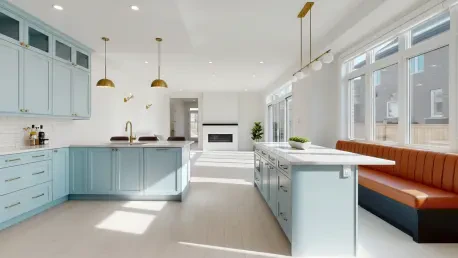
The aesthetic identity of the home was driven by a desire for a modern, fresh, and calm atmosphere, often referred to by the design team as a hint of pretty. This vision was brought to life through a carefully curated palette dominated by soft blues and light neutrals, creating a serene backdrop for family life. The kitchen serves as the visual anchor of the home, featuring shaker-style cabinetry finished in a light sky-blue hue that evokes a sense of clarity and openness. To complement these tones, white-oak flooring was installed throughout the main level, providing a warm, organic foundation that ties the various zones together. The inclusion of glitzy gold hardware, including faucet fixtures, cabinet pulls, and pendant lighting, provides a sophisticated contrast to the crisp quartz countertops and the white hexagon-tile backsplash. This blend of feminine elegance and contemporary clean lines ensures that the space feels approachable and lived-in rather than overly formal, reflecting the personality of the homeowners while maintaining a high standard of modern design.
Beyond the color palette, the selection of materials played a critical role in enhancing the home’s functionality and longevity. Quartz was chosen for the countertops and the family room’s coffee table because of its extreme durability and resistance to the daily wear and tear inherent in a household with three children. The use of fluted paneling along the staircase served both a decorative and a functional purpose, adding a contemporary vertical texture that draws the eye upward while simultaneously acting as a sound-dampening element. This attention to detail extends to the choice of faux leather for the banquette, which offers the luxurious look of high-end upholstery with the practical benefit of being easy to clean. By balancing aesthetic appeal with material intelligence, the design team created an environment that is both beautiful and resilient. This approach acknowledges that a family home must be able to withstand the rigors of everyday use without sacrificing its visual integrity, resulting in a space that remains as vibrant and functional years after the renovation as it was on the day of completion.
Technical Solutions: Managing Noise and Atmosphere
One of the most persistent challenges in open-concept living is the management of acoustics, as the lack of internal walls can often lead to sound traveling unchecked between different levels. To mitigate this issue, the designer moved away from traditional open pickets on the central staircase, opting instead for solid fluted paneling. This architectural choice serves as a significant acoustic buffer, absorbing ambient noise from the busy main floor and preventing it from disrupting the quieter sleeping quarters above. This focus on sound management is particularly important for a family of five, where different schedules and activities often overlap. Furthermore, the integration of high-efficiency lighting and the strategic placement of windows ensure that the atmosphere of the home can be easily adjusted to suit the time of day or the specific needs of the occupants. By addressing these technical aspects alongside the aesthetic ones, the renovation creates a multi-sensory environment that supports the well-being of the residents, proving that a successful design must consider the invisible elements of a space just as much as the visible ones.
The successful outcome of this project provided a clear roadmap for urban homeowners looking to modernize traditional semi-detached structures without losing their inherent character. Future renovations prioritized structural expansions that addressed specific lifestyle bottlenecks, such as the need for additional bathrooms or dedicated family zones. Homeowners were encouraged to embrace the concept of strategic openness, using subtle dividers and thoughtful material choices to define spaces while maintaining a sense of volume and light. The professional evolution of the homeowner, who eventually joined the design firm as a business manager, underscored the profound impact that a well-executed renovation had on the family’s daily lived experience. This project demonstrated that through a combination of bold architectural moves and a personalized aesthetic, it was possible to transform a cramped, gloomy house into a vibrant and functional sanctuary. The transition from a dysfunctional layout to a light-filled, cohesive home offered immediate solutions to the family’s space constraints while setting a high standard for future residential developments.