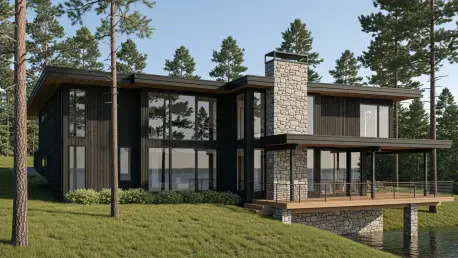

For more than three decades, from a studio nestled within the serene landscape of the Adirondack Mountains, architect Andrew Chary has been meticulously crafting a new definition of luxury in residential design. Through his firm, Andrew Chary Architect, PLLC, he has championed a philosophy that moves beyond the conventional metrics of scale and opulence, proposing instead that the ultimate measure of a home’s value lies in its capacity to foster a profound sense of belonging. His portfolio of exquisite residences, boathouses, and private structures argues that true luxury is not a display of wealth, but an accumulation of emotional and historical weight. This approach transforms architecture from a mere collection of spaces into a dynamic vessel for legacy, a repository for memory, and a catalyst for enduring human connection. His work serves as a powerful counter-narrative to the ephemeral trends of modern design, suggesting that the most sought-after amenity is a home that holds a family’s story and secures its future.
The Philosophy of Belonging
From Historic Great Camps to Modern Legacies
At the core of Chary’s architectural practice lies a deeply human-centered philosophy, one that positions him not merely as a designer but as a thoughtful interpreter of his clients’ deepest aspirations. His primary role, as he sees it, is to “translate someone’s wish list into emotions and then translate those emotions into a buildable reality.” A significant wellspring of his inspiration is the region’s historic Great Camps, the sprawling, rustic family compounds that once served as seasonal retreats for industrialist families like the Vanderbilts and Rockefellers. These were not just homes; they were self-contained worlds built for communal living, recreation, and a deep immersion in nature. Chary studies their masterful use of native materials, their intelligent site planning, and their ability to house multiple generations under a series of interconnected roofs. This historical reverence provides a foundational language for his own projects, grounding them in a tradition of enduring craftsmanship and a sophisticated understanding of place.
However, Chary’s work is far from a simple replication of a bygone era; it is a thoughtful and creative evolution of it. He endeavors to “take the historic Great Camp concept and bring it into our current age in a meaningful way,” carefully adapting its core principles to the needs and values of a new generation. Where the original Great Camps were often built to project power and social standing, Chary’s designs prioritize intimacy, comfort, and the seamless flow of modern family life. He deconstructs the formality of the past, creating spaces that encourage spontaneous interaction and quiet reflection in equal measure. This process involves a delicate balance of preserving the rustic, handcrafted soul of the Adirondack style while integrating the technological advancements, open-plan living, and emphasis on personal wellness that define contemporary living. The result is a home that feels both timeless and perfectly suited to the present moment, a heritage reimagined for today’s families.
Building a Generational Inheritance
The focus on multigenerational living that permeates Chary’s portfolio is not a concession to a fleeting market trend but a deeply held belief in what he calls a fundamental “return to roots.” This philosophy is increasingly resonant in a society grappling with disconnection and change. His vision aligns with a significant demographic shift, as underscored by a 2024 report from the National Association of Realtors, which revealed that a record 17 percent of U.S. homebuyers were actively seeking properties designed to accommodate multiple generations. For Chary, this statistic is not just data; it is a validation of his mission to create venues where families can gather, grow, and intimately understand the “nuances of who came before you.” His clients are often looking beyond immediate needs, seeking to commission a home that will long outlive them, becoming a cherished heirloom and a physical anchor for their lineage.
This forward-thinking approach has given rise to a powerful concept Chary’s work embodies: “architecture as emotional equity.” This idea reframes the value of a property, suggesting its true worth is not solely captured in its market price but in the intangible inheritance it provides. This form of equity is accrued not in dollars, but in shared experiences—the annual family gatherings, the quiet morning rituals passed down, the holidays celebrated within its walls. It is the cumulative wealth of memories, stories, and a tangible sense of belonging that enriches the lives of each successive generation. In this context, the home becomes more than an asset; it is a repository of a family’s cultural and emotional identity, a constant in a changing world. Chary’s firm has thus positioned itself within a resilient and growing niche of bespoke design focused on creating this profound and lasting sense of continuity.
The Art of Creation
A Process Rooted in Empathy and Spirit
Chary’s creative methodology is a distinctive fusion of meticulous observation, keen intuition, and a profound sense of spirituality that he openly describes as a “God-given gift.” He has found that embracing this aspect of his identity has been instrumental in forging a deeper connection and an unwavering level of trust with his clients. This spiritual underpinning infuses his work with an almost tangible warmth, resulting in spaces that are consistently characterized as nurturing, protective, and deeply comforting. The sentiment is perhaps best captured by a client who remarked, “People have told me my buildings feel like a comforting hug.” This emotional resonance is not accidental; it is the direct outcome of a design process that prioritizes the human experience above all else. His approach is built on a foundation of genuine empathy, aiming to create environments that not only meet functional needs but also soothe the soul and elevate the spirit.
The practical application of this philosophy begins long before any drawings are made, with a period of deep, intimate observation of a family’s daily life. Chary invests time in understanding the subtle rhythms of their existence, from their morning routines and the way they gather for meals to the simple, often overlooked act of doing laundry. These mundane details provide invaluable insights that inform a design conceived to foster harmony between the inhabitants’ lifestyle and the unique natural setting of their land. He strategically orchestrates a delicate balance between shared and private experiences, often designing kitchens to serve as vibrant social hubs and creating great rooms that open seamlessly to the outdoors. Simultaneously, personal spaces like bedrooms and studies are crafted as serene, restorative sanctuaries, offering a peaceful retreat from the communal energy of the home. This meticulous attention to the nuances of daily living ensures the final structure feels less like a building and more like a natural extension of the family it shelters.
Synthesizing Global Influences
While Andrew Chary’s architecture is profoundly rooted in the rugged beauty of the Adirondack landscape, his design sensibility is anything but provincial. His work is informed by a remarkably diverse and sophisticated palette of global influences, which he masterfully synthesizes to create a unique architectural language. He draws inspiration from the flowing, organic forms of Spanish architect Antoni Gaudí, the stately Beaux-Arts elegance of American pioneer Julia Morgan, and the dynamic, expressive modernism of the late Zaha Hadid. This eclectic range of inspirations allows him to move beyond the confines of a single style, borrowing concepts of movement, structure, and ornamentation from different traditions. He is able to see the universal principles at play in their work—a shared commitment to craft, a bold use of materials, and a deep understanding of spatial experience—and translate them into his own context.
This ability to weave disparate ideas into a cohesive whole allows Chary to infuse his projects with a cosmopolitan subtlety that complements, rather than clashes with, their distinct local character. For instance, the biomorphic curves of Gaudí might inform the gentle sweep of a roofline that mimics the surrounding hills, while the disciplined classicism of Morgan could be reflected in the balanced proportions and graceful detailing of an interior space. This thoughtful integration results in an architecture that feels simultaneously grounded and transcendent. It speaks a universal language of high craft and artistic vision while remaining authentically and unapologetically true to its sense of place. His buildings do not simply sit upon the land; they engage in a rich and layered conversation with their environment, their history, and the broader world of architectural thought, creating a truly unique and enduring presence.
Crafting with Conscience and Care
In Andrew Chary’s practice, sustainability is not an appended policy or a checklist of modern requirements; it is an intrinsic and inseparable part of his craft. He demonstrates a deep-seated reverence for the materials he uses, prioritizing what he calls “noble materials” such as reclaimed timber, natural stone, and other regionally sourced elements. This choice is deliberate, as these materials not only reduce the environmental footprint of a project but also carry their own inherent history and, as he suggests, their own “vibration.” A beam salvaged from a historic barn or a stone hewn from a local quarry brings a story and a sense of timelessness into the new structure. This practice aligns with the projected growth of the global green construction market, yet Chary’s motivation feels more personal and philosophical than merely commercial. It is a commitment to building with integrity and creating structures that are in harmony with their natural surroundings.
This approach is driven by a desire to imbue his buildings with the “mark of humanity,” a tangible sense of artistry and intention that stands in stark contrast to the impersonality of mass-produced construction. The goal is to create structures that feel as though they were “assembled with love by human hands,” where every joint, every surface, and every detail resonates with a sense of care and continuity. This human touch is the critical ingredient that transforms a house into a home, a building into a sanctuary. It ensures that his work will not only endure physically for generations but will also carry forward an emotional legacy. The very fabric of the building becomes a testament to craftsmanship, a celebration of natural beauty, and a reflection of the values of both the architect and the family for whom it was created, solidifying its place as a lasting contribution to the architectural landscape.
A Legacy of Whimsy and Connection
In the final analysis, Andrew Chary’s architectural practice was built on a philosophy that consistently prioritized emotional and cultural value over material ostentation. His work stood as a direct response to a growing desire among discerning families for real estate that could serve as a cultural anchor and a vessel for their most cherished values. By forging tangible connections between generations, seamlessly integrating homes into their natural landscapes, and designing with a rare degree of empathy and love, he created more than just buildings; he crafted what could only be described as “vessels of belonging.” His ultimate goal was to be remembered as someone who brought “whimsy and play into the mundane,” transforming conventional structures into extraordinary spaces that connected people to nature and, most importantly, to each other. His architecture became a testament to the idea that the most enduring form of luxury was not found in grandeur, but in the simple grace of a home that held love, history, and life itself.