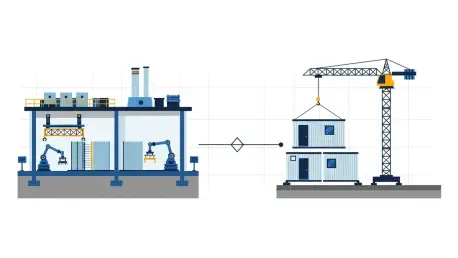

As Australia grapples with persistent housing challenges, a significant push is underway to modernize the very foundations of its construction industry by dismantling the regulatory roadblocks impeding the widespread adoption of prefabricated and modular building methods. The Housing Industry Association (HIA) is at the forefront of this effort, leading a comprehensive project under the Pre-fab Innovation Hub to address the systemic failures of a framework built for a bygone era. Current regulations, designed around traditional on-site construction, create a landscape of ambiguity and inefficiency that stifles innovation and prevents the nation from realizing the immense productivity benefits offered by off-site manufacturing. This initiative seeks to create a clear, supportive pathway for these advanced construction techniques, aiming to unlock a new chapter of efficiency, quality, and speed in residential building, ultimately benefiting builders, suppliers, and consumers alike. The project’s findings and recommendations represent a critical step toward aligning Australia’s building codes with the technological realities of the 21st century.
A Framework Unfit for Modern Methods
The fundamental problem lies within an entire regulatory ecosystem—spanning the National Construction Code (NCC), Australian Standards, and local building approval systems—that is inherently biased toward conventional on-site practices. This foundational mismatch creates significant friction for prefabricated projects, which are often subjected to review processes that do not recognize their unique manufacturing and assembly methods. The consequences are tangible and severe, manifesting as excessively time-consuming approval cycles, inflated costs due to uncertainty, and inconsistent outcomes across different jurisdictions. This unpredictability has a chilling effect on the market, as manufacturers and suppliers become hesitant to invest in developing and introducing innovative, efficient building systems to Australia. The result is a self-perpetuating cycle where the lack of a clear regulatory pathway prevents the industry from maturing, denying governments and consumers the substantial productivity gains, such as accelerated construction timelines and improved quality control, that a robust prefabricated building sector is poised to deliver.
To systematically dismantle these barriers, the HIA initiated a meticulously structured project, with research and development conducted by Swinburne University of Technology. The endeavor was organized into two distinct phases to ensure a thorough and collaborative approach. Phase one served as a crucial consultation stage, beginning with the circulation of a briefing paper that outlined the key regulatory issues. This document was disseminated to a wide range of industry stakeholders, whose feedback was collected through in-depth interviews and targeted surveys. This initial period of outreach was designed to identify and meticulously examine the specific hurdles encountered by professionals in the field, moving beyond theoretical problems to capture real-world challenges. While this formal consultation period has concluded, the project has maintained an open channel for ongoing input, ensuring that the research remains grounded in the practical experiences of those working directly with prefabricated and modular systems every day.
Identifying the Critical Roadblocks
A central finding of the investigation is that pervasive regulatory ambiguity is the root cause of the uncertainty plaguing all parties involved in a modular construction project, from designers and manufacturers to certifiers and homeowners. One of the most significant practical barriers identified is the challenge of quality assurance and certification. Traditional building inspections, which occur sequentially on a construction site, are fundamentally incompatible with complex, factory-finished modules that arrive on-site with many critical components already enclosed. This inability to fully verify the quality of internal elements post-delivery creates a significant confidence gap among building practitioners and regulatory authorities. The project underscores the urgent need for a robust, nationally recognized system for the certification of factory outputs. Such a system would provide the necessary assurance that components meet all required standards before they even leave the manufacturing facility, thereby increasing trust and streamlining the final approval process.
The investigation also revealed that formidable barriers exist long before any physical construction begins. These pre-construction hurdles often make the adoption of prefabrication economically unviable or logistically impossible. Restrictive design rules, originally written without modular systems in mind, can severely limit architectural possibilities or require costly custom modifications. Furthermore, project proponents must navigate convoluted and protracted approvals processes that are ill-equipped to handle the nuances of off-site construction. Securing financing also presents a unique challenge, particularly within the residential housing market, where lenders may be unfamiliar or uncomfortable with the payment schedules and risk profiles associated with factory-built homes. To contextualize these domestic issues, the research benchmarked Australia against international counterparts where prefabrication has gained significant traction, such as Japan and Sweden, as well as those where the sector is still developing, including Canada, the United Kingdom, and the United States, highlighting the clear benefits of a supportive regulatory environment.
A Blueprint for the Future of Construction
The project culminated in a series of clear recommendations designed to forge a new regulatory pathway for Australia’s construction industry. The central technical proposal advocated for the creation of a new, dedicated section within the National Construction Code, or alternatively, the development of a separate protocol or standard that could be officially recognized by the NCC. This addition was conceived to explicitly clarify the technical requirements for off-site construction, resolving the deep-seated ambiguities that arise when modern methods are judged against standards written for traditional building. These recommendations were developed as a key component of the broader Pre-fab Innovation Hub, a strategic initiative aimed at bolstering Australia’s manufacturing and construction industries by fostering collaboration and promoting new technologies. The findings underscored the urgency of this reform, noting that a vast number of construction projects were expected to transition to off-site and modular methods over the next two decades, making it critical to establish a supportive framework that could unlock the sector’s transformative potential.