
In a city-state renowned for its futuristic skyline and meticulous urban planning, a quieter revolution is taking place on the ground, one that seeks to weave the delicate threads of nature back into the fabric of daily life. At the forefront of this movement is Cathy Hang, a lead designer at Henning Larsen and the recipient of the 2025 Young Landscape Architect of the Year award from the Singapore Institute of Landscape Architects. Since her arrival from Hong Kong in 2015, Hang has been instrumental in designing public spaces that do more than just add greenery; they foster a profound sense of connection, balance, and community, challenging conventional ideas of what an urban park can be. Her work is a testament to a design philosophy rooted not in grand gestures but in a deep-seated humility, a commitment to collaboration, and an unwavering respect for the intricate dance between humanity and the natural world.
A Philosophy in Practice
The Spirit of Collaboration
A defining characteristic of Cathy Hang’s professional ethos is a deep-seated humility that consistently deflects individual acclaim in favor of collective achievement. This was never more apparent than upon her acceptance of the Young Landscape Architect of the Year award, where her immediate response was to credit the network of mentors and colleagues who shaped her career. She articulated this sentiment with a powerful metaphor, stating, “I am who I am because I’ve met many people who put a lot of ‘fertiliser’ into me.” This perspective frames her professional journey not as a solitary ascent but as a cultivation nurtured by the contributions of many. By specifically acknowledging the lasting influence of mentors like Ryan Shubin and Melle van Dijk, she reinforces that her successes are built on a foundation of shared knowledge and collaborative spirit. This principle is not merely a professional courtesy but the very cornerstone of her methodology, influencing how she approaches every project and engages with every team member.
This collaborative approach extends beyond her immediate team to include a wide array of specialists and even on-site contractors, viewing them as integral partners in the creative process. For Hang, landscape architecture is a discipline that thrives on interdisciplinary dialogue, integrating insights from ecologists, engineers, architects, and the community itself. She believes that the most resilient and meaningful spaces emerge from a synthesis of diverse perspectives, where every voice contributes to a more holistic outcome. This belief in collective intelligence challenges the traditional notion of a singular design visionary, instead promoting a model where leadership involves listening, facilitating, and weaving together different threads of expertise. Her work demonstrates that the richest designs are not imposed upon a site but are co-created, emerging from a dynamic exchange of ideas that respects the complexities of both the natural environment and the human experience within it.
Case Study The Jurong Lake Gardens Transformation
The Jurong Lake Gardens project stands as a monumental case study in Hang’s career, representing the first major development she guided from its nascent conceptual stages to its celebrated completion. The sheer scale of the undertaking was immense, involving the radical transformation of a conventional neighborhood park and a former golf club into Singapore’s third national garden. This was far more than a simple beautification project; it was a complex act of ecological restoration and cultural placemaking. At the heart of this transformation was the meticulous and scientifically-grounded restoration of a 53-hectare freshwater swamp. This ecosystem, once a natural feature of the region’s landscape before being erased by decades of industrialization, was painstakingly brought back to life, serving as both a biodiversity haven and a living lesson in environmental history for a new generation of Singaporeans.
The project’s ambition required a design philosophy that could navigate the intricate demands of large-scale ecological engineering while remaining sensitive to the human experience. Hang’s involvement was deep and multifaceted, touching every aspect of the garden’s creation. She was a pivotal figure in developing sophisticated planting designs tailored to a variety of newly created habitats, ensuring that the botanical choices would support a thriving and resilient ecosystem. Her role also encompassed the critical task of orchestrating the protection and integration of existing mature trees, preserving the site’s natural heritage amidst widespread construction. Furthermore, she was instrumental in designing key landscape structures that would guide and enhance the visitor’s journey, and she played a central role in coordinating the complex choreography of the construction process. This hands-on, comprehensive involvement underscores her holistic approach, where every element, from the smallest plant to the largest structure, is considered part of an interconnected whole.
An Integrated Design Approach
Cathy Hang’s philosophy on landscape architecture is perhaps best understood through her emphasis on creating a cohesive and immersive experience. For her, the design process at Jurong Lake Gardens was not a series of isolated tasks but a holistic endeavor aimed at unifying disparate elements into a singular, resonant whole. She speaks of the work as “marrying everything, like the ground, the surfaces and how we positioned all the different elements.” This statement reveals a meticulous attention to detail that goes far beyond mere aesthetics or botanical arrangement. It is about thoughtfully orchestrating the visitor’s sensory journey through the space, shaping their perceptions and interactions at every turn. The texture of a path underfoot, the way light filters through a canopy of trees, and the carefully framed view that opens up around a bend are all deliberately crafted to evoke a specific mood and foster a deeper connection with the environment.
This integrated approach is fundamentally about storytelling—using the landscape as a medium to communicate ideas about ecology, history, and community. By carefully considering how different components of the design relate to one another, Hang and her team were able to create a narrative that unfolds as visitors explore the gardens. The transition from a manicured lawn to a restored wetland, for instance, is not just a change in scenery but a journey through the region’s ecological past and future. This method requires a deep understanding of not only horticulture and construction but also human psychology and perception. The goal is to create spaces that are not just looked at but are felt and experienced, leaving a lasting impression that encourages repeat visits and a sense of personal ownership among the public. This thoughtful curation of experience is what elevates a project from a simple park to a cherished public realm.
The Grasslands A Synthesis of Nature and Art
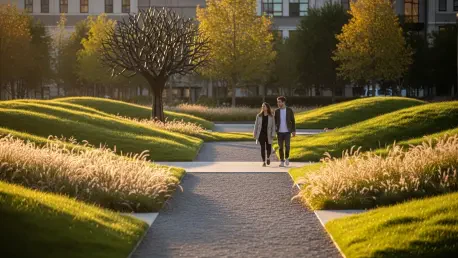
Within the sprawling expanse of Jurong Lake Gardens, the three-hectare area known as the Grasslands holds a special place in Hang’s portfolio and serves as a powerful embodiment of her design principles. This section was conceived to mimic the open, airy feel of a savanna, a landscape type not commonly recreated in Singapore’s tropical urban environment. The design is both bold and subtle, featuring a striking, perfectly straight gravel path that cuts decisively through undulating hillocks of native Chinese fountain grass and mission grass. This strong linear element provides a dramatic contrast to the soft, flowing textures of the grasses, creating a powerful visual dynamic under a vast, open sky. The habitat-led design has proven to be a remarkable success, attracting a diverse array of wildlife, including flocks of munias and majestic storks, which now frequent the area, adding a layer of dynamic, natural life to the carefully crafted landscape.
At the heart of the Grasslands lies a unique sculptural piece that serves as a focal point and an anchor for the entire composition. Resembling the gnarled, skeletal form of a leafless tree, the sculpture possesses a raw, elemental power that complements the wild aesthetic of the surrounding grasses. In a testament to Hang’s collaborative and resourceful approach, she reveals that this striking work of art was not a high-budget commission from a famous artist. Instead, it was crafted on-site by a contractor supervisor named Lao Gao, who used his ingenuity and skill to translate the design team’s vision into a physical form. He creatively repurposed steel rebar salvaged from demolished structures within the park, bending and welding the metal into an organic shape inspired directly by his daily proximity to nature. This story of creation adds a profound layer of meaning to the sculpture, transforming it from a mere object into a symbol of on-site collaboration and sustainable creativity.
A Story of Community and Connection
Beyond the successful ecological outcomes and the aesthetic appeal of the Grasslands, what Hang finds most rewarding is the unforeseen social impact the space has had on the community. Since its opening, the area has spontaneously evolved into a cherished backdrop for some of the most significant milestones in people’s lives. It has become a popular, almost iconic, location for graduation and wedding photoshoots, with its dramatic landscapes providing a memorable setting for these joyous occasions. More intimately, it has also been the site of heartfelt marriage proposals, where the natural beauty of the environment enhances the personal significance of the moment. This organic adoption of the space by the public, for moments both personal and celebratory, represents the pinnacle of success for a landscape architect. It is a powerful affirmation that the design has resonated on a deep emotional level, transforming a public park into a meaningful part of people’s personal histories.
This phenomenon underscores a key tenet of Hang’s philosophy: that the ultimate measure of a landscape’s success is not its critical acclaim or its design awards, but its ability to become a beloved and integral part of the community it serves. When a space is embraced so fully that it becomes intertwined with the personal narratives of its users, it transcends its function as a mere recreational area and becomes a living repository of memories and emotions. For Hang, seeing the Grasslands used in these deeply personal ways is the most profound validation of her work. It signifies that the design has successfully created more than just a beautiful place; it has created a setting where life can unfold, where memories are made, and where a genuine connection between people and place is forged. This human-centered outcome, often unplanned and unscripted, is the truest indicator of a project that has truly come to life.
A Career of Growth and Advocacy
The Guiding Principle of Balance
The concept of “balance” is the central and unwavering tenet of Cathy Hang’s approach to landscape architecture. She defines this not as a static compromise but as a “stable state where different parts can keep thriving together.” This principle is a holistic one, encompassing the delicate relationships between the built and natural environments, the symbiotic coexistence of people and wildlife, and the harmonious interactions between people themselves. This philosophy is vividly illustrated in the design of Alstonia Island, a specially created habitat nestled within the restored freshwater swamp at Jurong Lake Gardens. The island was meticulously designed as a sensitive land-water interface, where a carefully placed lookout point allows visitors to observe fauna like monitor lizards and herons from a distance. This thoughtful separation ensures that human presence does not intrude upon the island, allowing the wildlife to remain undisturbed in its sanctuary while still providing an educational and engaging experience for the public.
This commitment to ecological balance extended to the very engineering of the swamp itself, which was designed to be a self-sustaining system. A particularly innovative technique was used for the reintroduction of native, wet-tolerant trees like the Alstonia. To ensure their survival and adaptation, the saplings were subjected to a unique acclimatization process where they were gradually exposed to increasing water depths. This method was intended to “remind them of their own heritage,” effectively awakening their innate genetic resilience to waterlogged conditions. Hang’s pursuit of balance also required making difficult design choices that prioritized community sentiment and natural heritage. In one notable instance, a decision was made to divert the planned course of a stream to preserve a particular mango tree that was deeply cherished by local residents, demonstrating that a truly balanced design respects both ecological integrity and the emotional connections people form with their environment.
From Early Passion to Professional Excellence
Cathy Hang’s career path was seeded early on by a fusion of a creative impulse and a deep-seated love for the natural world, cultivated during her youth in the dense urban landscape of Hong Kong. Her decision to study landscape architecture at the University of Hong Kong was driven by a desire for a profession that offered both freedom of expression and intellectual challenge—a field with “no absolute answers.” Her professional journey in Singapore began serendipitously when a professor, recognizing her potential, recommended her for a position at the acclaimed firm Atelier Dreiseitl. She has remained with the same company for over a decade, navigating its evolution through its eventual integration with the global firm Henning Larsen in 2022. This remarkable long tenure is a testament to the dynamic and nurturing environment she found herself in, an environment that has provided a continuous stream of inspiration and energy.
She attributes her sustained passion and growth to the collaborative culture fostered by her mentors and teammates, as well as the sheer diversity of the projects she has been able to engage with. This variety has allowed her to constantly explore new ideas, tackle different challenges, and push the boundaries of her own expertise. Over the years, her understanding of the discipline has matured significantly. She has evolved from focusing purely on design aesthetics to appreciating the profound necessity of interdisciplinary collaboration. She now sees her role as part of a larger ecosystem of professionals, working closely with architects, engineers, and wildlife specialists to create holistic, resilient, and truly integrated environments that can stand the test of time and serve the complex needs of both people and nature.
Shaping the Future and Inspiring a New Generation
Looking toward the future, Hang is already applying her expertise to one of Singapore’s most ambitious infrastructure projects, the North-South Corridor (NSC), where Henning Larsen serves as the master plan consultant. This project represents a paradigm shift in urban design, aiming to reimagine a major transportation artery not as a conduit for efficient car movement, but as a people-centric, green corridor. The visionary goal is to reclaim vast amounts of road space for both people and nature, fundamentally altering the character of a significant stretch of the city. The plan prioritizes walking, cycling, and public transport, introducing extensive shade, lush planting, and comfortable, wide sidewalks to create a more human-scale environment. This project embodies Hang’s commitment to creating cities that are not only sustainable but also more livable and enjoyable for their residents.
Beyond her demanding project work, Hang has embraced her role as a passionate advocate for the landscape architecture profession and an inspiration for the next generation of designers. She actively participates in school talks and leads insightful project tours, seizing every opportunity to share the “everyday magic of nature” with a wider audience. Her goal is to demystify the work of landscape architects and to promote a culture of knowledge-sharing across different disciplines, believing that collaboration is key to solving the complex urban challenges of the future. The recent award from the Singapore Institute of Landscape Architects has provided her with a more prominent platform to amplify this message. This recognition has positioned her as an influential voice in the ongoing conversation about urban development, empowering her to advocate even more effectively for a future where cities are designed with thoughtfulness, sustainability, and a deep respect for the natural world at their core.