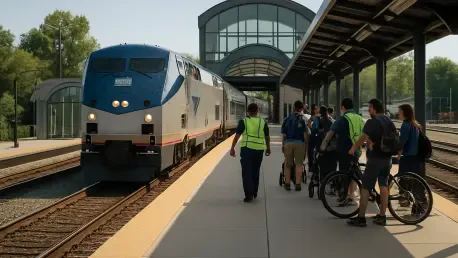

Peak-hour trains inching through the Potomac gateway have become the region’s daily metronome of delay, and Northern Virginia’s 74% population surge since 1990 has pressed that rhythm to the breaking point as demand outstrips a century-old rail throat built for another era. In this roundup, transit planners, freight operators, civic advocates, and local businesses weighed in on whether a coordinated construction push centered in Alexandria can finally change the tune.
Policy voices highlighted the Virginia Passenger Rail Authority’s coalition with Amtrak, VRE, CSX, and Alexandria as the rare alignment that turns vision into capacity, safety, and reliability. Several emphasized that previewing the fourth track, station overhaul, twin bridge replacements, and the $2.6 billion Long Bridge expansion is less about ribbon-cuttings and more about removing chokepoints so everyday mobility improves by 2030.
Inside the buildout: what the Alexandria–Potomac projects actually deliver
A fourth track to breathe: untangling the Alexandria–Arlington squeeze
Operations analysts pointed to the six-mile fourth track between Alexandria and Arlington as the pivotal move that separates passenger and freight flows. Modeled throughput gains suggest steadier slots for Amtrak and VRE, with fewer cascading delays when a single train slips out of sequence.
Freight stakeholders, however, cautioned that building on an active railroad while honoring CSX windows will test staging, flagging, and crew coordination. Neighborhood groups acknowledged construction headaches but argued that long-term congestion relief and on-time performance outweighed temporary noise and detours.
Stations made safer and smarter: Alexandria VRE’s overhaul and rider experience
Passenger-experience advocates rallied around the Alexandria VRE station redesign, especially the accessible platforms and new tunnel that replace a risky street-level crossing. Citing other corridors that removed at-grade conflicts, they expect shorter dwell times, better boarding, and cleaner wayfinding that lowers stress for daily riders.
Skeptics focused on budget discipline and near-term disruptions but conceded the upside if VRE can layer in expanded service and weekend options. Amtrak users also welcomed tighter connections, noting that safety investments signal a broader shift from merely moving trains to shaping a frictionless trip.
Bridging the gap—twice: replacing spans and syncing with the new Long Bridge
Engineering voices described the replacement of two adjacent Alexandria rail bridges as foundational housekeeping: matched clearances and higher design speeds prepare the corridor for the operating plan that the new capacity demands. The technical payoff, they said, is reliability that riders will feel, not just see on schematics.
Meanwhile, the Long Bridge addition—a separate two-track passenger span over the Potomac with new bike-ped crossings—drew praise as the keystone that removes the D.C. gateway bottleneck. Multiple sources stressed timing: if the bridges and upstream tracks open in concert by 2030, Virginia-backed Amtrak roundtrips can rise from eight to 13 with fewer conflicts.
Beyond the rails: streets, bikes, and a reconnected station district
Urban designers framed Alexandria’s streetscape work under the new bridges as the connective tissue that turns a station into an intermodal hub. Wider sidewalks, protected bike links, and better bus access were expected to knit neighborhoods to rail rather than wall them off.
Economic development voices noted that multimodal design often boosts ridership and street-level retail, creating a positive feedback loop. By rejecting the idea that rail is siloed hardware, the program positions safer streets and first/last-mile options as climate and equity strategies, not accessories.
Turning plans into payoffs: what riders, cities, and the economy should expect
Across interviews, the throughline was clear: more frequencies, fewer delays, and safer stations drive ridership growth—VRE near 20,000 daily and 1.4 million annual on Virginia-supported Amtrak—and ease roadway congestion at the margin. Business groups added that reliable rail stabilizes hiring and reduces lost time for regional trips.
Practitioners offered pragmatic advice: phase work to protect peak periods, lock in passenger–freight dispatch rules post-build, and align curb, bus, and bike management with the new rail capacity. Pilot off-peak and weekend VRE runs early, several argued, and pair them with unified fares and trip-planning tools to cement new habits.
The long view: a corridor built for growth, not gridlock
Longtime observers placed this moment in a steady arc—state right-of-way purchases, VRE’s establishment in 1992, and now Transforming Rail in Virginia—shifting rail from a niche commuter option to a backbone. With completion targeted for 2030, the upgrades positioned the corridor to meet demand, cut emissions, and reinforce the metro’s competitiveness.
This roundup concluded with a pragmatic call: keep the coalition intact, secure funding certainty, and track success by trips made easier, not just by projects delivered. Stakeholders ultimately converged on a simple measure—if riders experience smoother connections and more dependable choices, the D.C. corridor moved from choke point to choice. For deeper context, readers were encouraged to follow agency updates, local planning proceedings, and ridership reports as benchmarks accumulated.