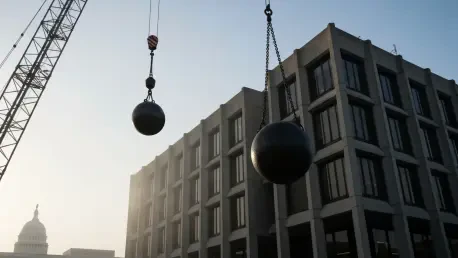

A legal firestorm is brewing in the nation’s capital as startling allegations surface that the White House is personally spearheading a plan to demolish several historic federal buildings, a move that critics say flagrantly sidesteps decades of established preservation law. The controversy, detailed in a sworn court declaration by a former government official, pits presidential authority against statutory protections designed to safeguard America’s architectural heritage. This emerging conflict raises profound questions about the stewardship of national assets and the procedural guardrails that govern executive action, setting the stage for a high-stakes battle over the future of Washington’s skyline and the rule of law itself.
Allegations of Executive Overreach
A Former Official’s Bombshell Declaration
The controversy erupted following a court declaration by Mydelle Wright, a former official with the General Services Administration (GSA), the agency tasked with managing federal properties. In her sworn statement, Wright alleges that the White House is actively preparing for the demolition of four architecturally significant structures: the Robert C. Weaver Federal Building, the Wilbur J. Cohen Federal Building, the GSA Regional Office Building, and the Liberty Loan Building. She claims the administration is taking the unprecedented step of independently soliciting bids or finalizing a bid package for the demolition work. This action, if true, would represent a direct circumvention of the GSA, the body legally mandated to oversee such projects. Wright’s declaration asserts that this maneuver violates foundational federal laws, including the National Historic Preservation Act (NHPA) and the National Environmental Policy Act (NEPA). These statutes require rigorous review processes and public consultation before any action can be taken that affects historic properties, safeguards that are now allegedly being ignored in a direct push from the executive branch.
Circumventing Established Legal Frameworks
At the core of the dispute is the alleged disregard for established legal procedure. The National Historic Preservation Act and the National Environmental Policy Act are not mere bureaucratic hurdles; they are pillars of federal preservation policy designed to ensure that decisions impacting national heritage are made transparently and with public input. Bypassing the GSA, as Mydelle Wright’s declaration claims is happening, effectively dismantles this entire framework. The GSA is legally responsible for conducting reviews to assess the historical significance of buildings and the environmental impact of their potential demolition. This process typically involves consultations with state historic preservation offices, advisory councils, and the public. Wright expressed profound alarm at this development, stating that she is unaware of any other instance in which a president has become personally involved in bypassing these critical protective measures. The allegations suggest a move to consolidate decision-making power within the White House, sidelining the very agency and the laws created to provide checks on such actions.
The Broader Context of Architectural Disputes
The Administration’s Architectural Philosophy
This conflict does not exist in a vacuum; it is set against the backdrop of the president’s publicly stated architectural preferences. Earlier in the year, an executive order was issued that championed a classical style for new federal buildings while explicitly denigrating modernist and “brutalist” architecture. Several of the buildings now allegedly targeted for demolition, such as the Weaver Building, are prime examples of the Brutalist style that emerged after World War II, while others hail from the New Deal era. Preservationists and architectural historians argue that these structures are not the president’s personal property to discard based on aesthetic taste. They contend that these buildings are “gems of America’s architectural history,” representing important chapters in the nation’s development and design evolution. The current dispute, therefore, is seen by many not just as a procedural violation but as an ideologically driven effort to erase a part of the nation’s architectural legacy that does not conform to a specific, mandated style.
Legal Battles and Government Rebuttals
In response to the explosive claims, attorneys for the federal government have mounted a forceful defense, categorically dismissing Wright’s declaration as “hearsay” and insisting it is unequivocally “wrong.” The government’s official position is that the GSA is not evaluating the buildings for demolition but rather for “disposal,” a process that involves transferring them out of federal ownership. They maintain that the agency is dutifully following all prescribed legal channels for this procedure. This entire dispute emerged within a separate but related lawsuit filed by preservationists to prevent the Trump administration from painting the granite facade of the historic Eisenhower Executive Office Building. Gregory Werkheiser, an attorney representing the preservationists, expressed deep skepticism, stating he has “no confidence” that the GSA retains control over the president’s building projects. The case is now before Judge Dabney Friedrich, who must weigh these competing claims and decide whether to issue an injunction to halt the work until a legally mandated review can be completed.
A Precedent for Preservation
The legal battle that ensued over the fate of these federal buildings ultimately became a landmark case in American historic preservation. The court’s decision, which leaned heavily on the testimony and procedural evidence presented, reinforced the statutory authority of the General Services Administration and the inviolability of laws like the NHPA and NEPA. It was determined that executive preference could not override the meticulous, congressionally mandated processes designed to protect national heritage. This conflict underscored the inherent tension between executive initiatives and the legislative frameworks intended to ensure transparent and responsible stewardship of public assets. The events prompted a renewed national conversation about the value of architectural diversity and led to legislative proposals aimed at strengthening the review processes to prevent future challenges of this nature, ensuring that the fate of the nation’s historic structures remained a matter of public record and legal due diligence rather than executive whim.