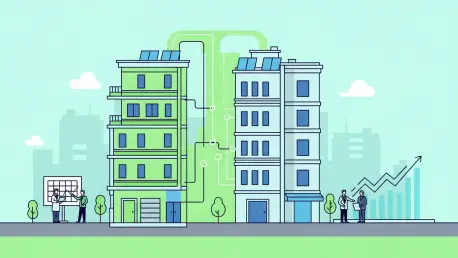

The vast glass and steel towers that define modern cityscapes are not only symbols of economic power but also colossal consumers of energy, with heating and cooling systems accounting for a substantial portion of their operational footprint. As the global community grapples with the urgent need for decarbonization, the often-overlooked materials packed within the walls and roofs of these structures are emerging as a critical frontier for innovation and investment. The commercial building insulation market is undergoing a profound transformation, moving beyond basic thermal resistance to embrace a future defined by sustainability, smart technology, and circular economy principles. This evolution is not merely an environmental imperative but a powerful economic engine, setting the stage for the market to swell from $15.1 billion in 2025 to a projected $19.74 billion by 2030, a growth trajectory fueled by a confluence of stringent regulations, technological breakthroughs, and a fundamental rethinking of what it means to build for the future.
The Regulatory and Economic Bedrock of Expansion
A primary catalyst for the insulation market’s vigorous expansion is the increasingly stringent web of global building energy regulations. Governments worldwide are tightening energy codes and mandating higher standards for thermal performance as a cornerstone of their climate action plans. These policies are designed to slash the immense energy consumption of the commercial building sector, which is a major contributor to greenhouse gas emissions. For building developers and owners, compliance is no longer optional. The mandates necessitate the use of advanced insulation solutions that can significantly reduce the energy required for heating and cooling, directly translating into lower operational costs and a smaller carbon footprint. This regulatory push creates a guaranteed and growing demand for high-performance insulation products, compelling manufacturers to innovate and supply materials that meet or exceed these new, ambitious benchmarks for energy efficiency and long-term sustainability.
Complementing this regulatory pressure is a surge in global construction activity, which provides a massive end-use market for insulation products. Rapid urbanization continues to drive the development of new office buildings, retail centers, and industrial facilities, particularly in emerging economies. In established markets, the trend is twofold: new construction is being built to higher efficiency standards from the ground up, while an enormous stock of existing buildings is ripe for energy-efficient retrofitting. The U.S. construction sector’s expenditure, which reached $2.15 trillion in 2024, offers a clear illustration of the scale of this opportunity. Every new commercial project and major renovation represents a significant sale for insulation manufacturers, and as sustainability becomes a key criterion in real estate investment and tenant attraction, the demand for superior, green insulation solutions is amplified, cementing its role as an indispensable component of modern construction.
The Technological Shift Toward Sustainable Solutions
The market’s trajectory is being reshaped by a significant pivot toward innovative and sustainable materials that challenge the dominance of traditional insulation. There is a heightened and explicit demand from architects, builders, and corporate clients for eco-friendly and low-carbon options, moving beyond mere thermal performance to consider the entire life cycle of a product. This has spurred the development and commercialization of advanced materials like bio-based insulation, which is derived from renewable resources such as hemp, cork, or cellulose. These products not only offer excellent insulating properties but also sequester carbon and are often biodegradable or easily recyclable at the end of their life. This shift reflects a broader industry recognition that the materials used to construct buildings are as important as the energy they consume, driving a wave of investment in green chemistry and materials science aimed at creating the next generation of building envelopes.
Beyond the physical materials, the integration of digital technology is revolutionizing how insulation systems are designed, implemented, and managed. The industry is rapidly adopting sophisticated tools like digital modeling and thermal simulation software, allowing architects and engineers to precisely predict a building’s energy performance and optimize the insulation strategy before construction even begins. This data-driven approach eliminates guesswork and ensures maximum efficiency. Furthermore, insulation is increasingly viewed as a key component within a larger ecosystem of smart energy management. When combined with AI-powered building automation systems and IoT sensors, advanced insulation helps create a highly responsive and optimized environment, minimizing energy waste in real-time. This convergence of material science and digital intelligence is elevating insulation from a passive building component to an active player in the quest for net-zero commercial buildings.
Navigating the Competitive and Geopolitical Landscape
The competitive landscape is characterized by established industry giants who are actively steering their corporate strategies to align with the green transition. Major players like Kingspan Group, Compagnie de Saint-Gobain S.A., BASF SE, and Dow Inc. are no longer just competing on price and thermal performance but are increasingly differentiating themselves through their sustainability credentials and commitment to innovation. This is evident in their product development pipelines and strategic acquisitions. For instance, Kingspan’s launch of Hemkor, a bio-based insulation product, and Saint-Gobain’s acquisition of International Cellulose Corporation are clear indicators of a corporate-level commitment to decarbonization. These moves are not only about meeting regulatory requirements but also about capturing the growing market segment of environmentally conscious clients and investors, positioning sustainability as a core pillar of long-term business growth and market leadership.
While the outlook for the green insulation market is overwhelmingly positive, its growth is not without challenges, particularly those arising from global trade dynamics. The industry relies on a complex global supply chain for raw materials such as polymers and fiberglass, making it susceptible to the impact of international trade tariffs and geopolitical instability. These factors can introduce volatility in material costs, creating pressure on manufacturers’ margins and potentially increasing the final price for consumers. However, this pressure also serves as a powerful catalyst for innovation and regional self-sufficiency. It encourages investment in domestic production facilities and accelerates research into alternative, locally sourced raw materials and advanced manufacturing techniques. In this way, geopolitical and economic headwinds, while challenging in the short term, are inadvertently stimulating the very innovation in energy-efficient technologies that will define the industry’s future success.
A Blueprint for a Greener Built Environment
The industry’s journey toward a nearly $20 billion valuation was ultimately paved by a strategic convergence of regulatory foresight and technological advancement. Key corporate players made decisive investments in sustainable product lines and digital optimization tools, successfully transforming market pressures into competitive advantages. The challenges posed by global supply chains were met with a renewed focus on domestic production and material science, which not only mitigated risk but also spurred further innovation. This period demonstrated that the path to decarbonizing the built environment was not a matter of compromise but of opportunity, where environmental responsibility became intrinsically linked to economic prosperity and market leadership.