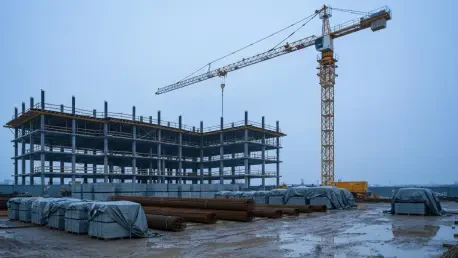

The Federal Reserve’s recent monetary policy adjustment, which lowered the benchmark interest rate for the third time this year, has sent a ripple of optimism through many sectors of the economy, yet the construction industry’s reaction has been conspicuously subdued. An extensive analysis reveals that while the 25-basis-point reduction is a welcome signal, it is perceived by industry leaders as more of a psychological reassurance than a potent catalyst for new development. The move offers a modest tailwind to projects already underway but lacks the force to overcome the significant headwinds currently preventing a broad-based surge in new nonresidential construction starts, painting a complex picture of an industry grappling with issues far beyond the cost of borrowing.
A Welcome but Insufficient Stimulus
Sustaining Momentum Without Moving the Needle
The gradual easing cycle initiated by the central bank is widely seen as a positive trend that fosters a sense of growing momentum and shores up confidence among contractors. This latest reduction is characterized as a “step in the right direction,” particularly for long-planned projects that are already deep into the development pipeline. For these ventures, the marginal decrease in borrowing costs provides an additional layer of assurance and may help sustain their progress into 2026. Scott Lyons, a market leader at DPR Construction, described the cut as a “psychological boost” that will help maintain the forward trajectory for projects currently in advanced planning stages. This sentiment is echoed by industry peers who see the move as a supportive signal, creating a more favorable environment for ongoing work and reinforcing decisions that have already been made. While beneficial for existing commitments, this boost in morale is not translating into a rush to break ground on new sites.
The overarching consensus among market experts is that an incremental rate reduction of this magnitude is simply insufficient to fundamentally reshape the financial feasibility of new groundbreakings. While the downward trend in rates is a positive indicator, the cut itself does not “move the needle very much” in the complex financial equations that underpin new development, according to Granger Hassmann of Adolfson & Peterson. The core issue is that the modest savings on borrowing are overshadowed by more dominant economic forces and structural challenges within the industry. Developers and investors considering new projects are weighing this small benefit against persistent high costs for materials, a severe labor shortage, and cautious lending standards. Consequently, the rate cut is seen less as a powerful incentive and more as a minor variable in a much larger and more complicated investment decision, failing to provide the decisive push needed to launch a new wave of construction.
The Persistent Obstacle of Tight Financing
A primary impediment that a minor rate adjustment cannot overcome is the continued tightness in financial markets. Lenders remain highly cautious, maintaining stringent underwriting standards that act as a significant gatekeeper for new projects. This is especially true for commercial asset classes that are currently grappling with significant oversupply issues, such as the office and research and development (R&D) sectors. Financial institutions are demonstrating a clear aversion to risk in these areas, effectively neutralizing the potential stimulus of lower rates. Scott Lyons emphasized that these institutions will “hold tight” on their lending criteria, continuing to insist on substantial pre-leasing commitments or other forms of tangible, proven demand before they are willing to finance new speculative construction. This conservative stance means that until the current oversupply of commercial space is absorbed by the market, access to capital will remain the primary bottleneck, regardless of the Federal Reserve’s monetary policy.
The cautious approach from lenders is rooted in clear market fundamentals that extend beyond interest rates. The oversupply in sectors like office buildings means that the risk of vacancy for new developments is exceptionally high, making lenders hesitant to back projects without tenants already signed. This dynamic creates a challenging environment where the cost of borrowing is a secondary concern to the primary question of a project’s viability and ability to generate revenue upon completion. A rate cut can make a loan cheaper, but it cannot create the tenant demand needed to justify the loan in the first place. Therefore, the financial gears for new construction in these struggling sectors remain largely jammed. Until there is a meaningful rebalancing of supply and demand, the flow of capital for new builds is expected to remain restricted, demonstrating a clear limit to what monetary policy alone can achieve in the face of sector-specific market conditions.
Deeper Structural Challenges Unaffected by Monetary Policy
The Short-Term versus Long-Term Rate Disconnect
A critical factor limiting the rate cut’s impact is the fundamental distinction between short-term and long-term interest rates. As Dan Levitt of Ryan Cos. explained, the Federal Reserve’s actions directly influence short-term rates. This provides a tangible, albeit marginal, benefit by slightly reducing the cost of construction financing, which is often tied to short-term benchmarks. It also offers a degree of relief to property owners who hold short-term or variable-rate loans on their existing assets. However, these benefits are confined to the construction phase and immediate financial management. The ultimate decision to proceed with a major new development hinges not on these temporary costs but on the long-term financial viability of the project. The core of this calculation is the cost of permanent, long-term debt, which is used to finance the building over its operational lifespan after construction is complete, and this is where the Fed’s influence wanes considerably.
The financial viability of major new construction is overwhelmingly driven by the cost of long-term debt, which is benchmarked against the 10-year Treasury yield, not the federal funds rate. Levitt asserted that there is “very little correlation” between a small Fed rate cut and the movement of the 10-year Treasury yield, which responds to a much broader set of economic indicators, including inflation expectations and global market forces. Because the Fed’s action does not significantly alter the long-term capital costs that are central to investment decisions, he concluded that this policy move is “unlikely to substantively stimulate nonresidential construction starts.” This disconnect means that even as short-term borrowing gets slightly cheaper, the fundamental economics for developers planning large-scale, multi-year projects remain largely unchanged, highlighting a structural limitation in the transmission of monetary policy to real-world construction activity.
An Unresolved Labor Shortage
Beyond any financial considerations, the construction industry is confronting a deep-seated structural challenge that lower interest rates cannot resolve: a chronic and severe shortage of skilled labor. This issue acts as a hard ceiling on the industry’s capacity for growth, irrespective of financial incentives. Scott Lyons identified this as a primary constraint, stating, “Across the country, there are more projects that people want to build than there are people to build them.” The problem is not a lack of will or capital for certain projects but a fundamental lack of the human resources required to execute them. This operational bottleneck means that even if a flood of new projects were to be greenlit tomorrow, the workforce is simply not large enough to handle the increased volume, which would lead to project delays, increased labor costs, and further complications. The labor deficit is a physical barrier to expansion that monetary policy is powerless to address directly.
Recent data from the U.S. Bureau of Labor Statistics underscores the depth of this crisis, showing “extraordinarily low” construction job openings and a sharp drop in hiring, which points to a shrinking pool of available talent. Lyons framed the solution not as a short-term fix but as a “generational” effort, suggesting that it will take a significant amount of time for the industry’s workforce development initiatives to cultivate a labor pool sufficient to meet current and future demand. This long-term perspective highlights the severity of the problem. While industries focus on apprentice programs and vocational training, these are solutions that will pay dividends over years, not months. In the immediate term, the scarcity of skilled workers remains a critical limiting factor that curtails the potential for a construction boom and ensures that the industry’s growth will be gradual and constrained by its own capacity limitations.
Pockets of Strength and Cautious Optimism
Resilient Sectors and a Stabilizing Market
Despite the overarching constraints, the analysis reveals significant pockets of strength within specific high-demand market sectors that appear to be largely insulated from interest rate fluctuations. Jason Gabrick of Ryan Cos. described these segments as “almost rate-proof due to robust demand and effective capitalization strategies.” Key areas where construction activity remains solid, regardless of the broader monetary policy climate, include data centers, life sciences, medical technology, and healthcare. These fields are propelled by powerful secular trends, such as the digital transformation of the economy and an aging population, which generate consistent and urgent demand for new, specialized facilities. This observation is substantiated by recent data from the Dodge Construction Network, which reported a striking 21.1% jump in construction groundbreakings in October, a spike largely propelled by a few high-value megaprojects with data centers being the predominant driver.
Adding to this positive outlook is a growing sense of stability and predictability across the market, a welcome change from the volatility of the pandemic era. Contractors are reportedly setting the stage for a stronger 2026, with confidence metrics from the Associated Builders and Contractors for sales, profit margins, and staffing all pointing toward expectations of growth over the next six months. Gabrick noted a significant improvement in market predictability, as key economic variables, including construction labor pricing, material costs, and inflation, have stabilized. Furthermore, the industry has effectively adapted to external pressures such as tariffs, which has allowed trade partners and vendors to provide greater cost assurance on projects. This newfound stability is crucial for the complex planning and execution required for large-scale construction, allowing for more reliable budgeting and scheduling, which in turn fosters greater confidence among developers and investors.
Laying the Groundwork for Future Growth
The Federal Reserve’s latest rate reduction was received as a supportive gesture, but it ultimately failed to ignite a new wave of construction starts. Its impact was largely neutralized by the formidable barriers of tight lending standards for oversupplied commercial sectors, the critical disconnect between short-term policy rates and long-term capital costs, and a deeply entrenched skilled labor deficit. These factors confirmed that monetary policy alone could not resolve the industry’s multifaceted challenges. However, the period was also defined by remarkable resilience in high-demand fields like data centers and healthcare, which continued to thrive on the strength of their own market dynamics. The industry’s broader adaptation to economic volatility and the stabilization of key costs laid a more predictable and solid foundation for future endeavors, suggesting that while the immediate response to the rate cut was muted, the essential groundwork for more vigorous and sustainable growth in the coming years was firmly established.