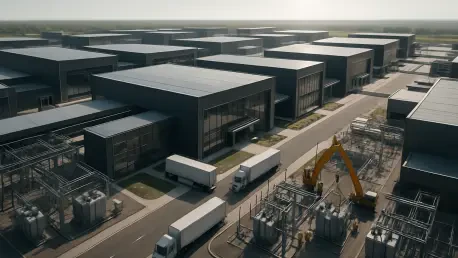

With a deep background in design, architecture, and the technological evolution of the construction industry, Luca Calaraili has become a leading voice on how innovation reshapes our built environment. His expertise spans from traditional structural integrity to the cutting-edge applications of AI and data-driven planning. Today, we explore the shifting landscape of construction momentum, examining how a surge in tech-heavy infrastructure is masking broader volatility in commercial and institutional markets and what this means for the future of the industry.
Commercial planning has seen significant growth recently, yet many sectors outside of data centers are seeing double-digit declines. How are firms reallocating resources to handle these massive tech campus builds, and what specific technical hurdles do these large-scale projects present compared to traditional office spaces?
The shift we are seeing is quite dramatic, as commercial planning would actually be down by 12.7% since March 2025 if we removed data centers from the equation. To keep up, firms are moving their most experienced project managers and specialized MEP engineers away from traditional office towers and into the high-stakes world of hyperscale facilities. Unlike a standard office, these tech campuses require immense power density and sophisticated cooling systems that must be integrated from the very first sketch on the drafting table. We aren’t just building shells anymore; we are building complex, life-sustaining environments for servers that operate 24/7. This transition requires a massive pivot in workforce training, as the precision needed for a $500 million individual data building is far more rigorous than what you’d find in a typical retail or commercial build.
While institutional planning has grown nearly 20% over the last year, recent data shows a sharp 8.8% monthly drop in these projects. What factors are driving this sudden volatility, and how should developers balance the steady demand for education and public buildings against this broader institutional cooling?
The recent 8.8% monthly drop in institutional projects is largely a natural reset following the outsized growth we saw in late 2025. It feels like the industry is catching its breath as elevated macroeconomic risks finally start to weigh on the decisions of public and private institutions. While sectors like education and public buildings are still posting small gains, developers have to be incredibly cautious and strategic about where they break ground. Balancing this volatility requires a focus on multi-use flexibility, ensuring that a project remains viable even if the broader sector continues to cool. It’s a period of “cautious momentum” where the 19.6% year-over-year growth provides a safety net, but the month-to-month fluctuations keep everyone on edge.
Macroeconomic pressures are beginning to slow planning for traditional retail and office projects, while AI-driven builds remain shielded. How are these economic risks altering long-term design strategies, and what specific metrics determine if a non-tech project moves from the drafting table to the construction site?
Economic risks are forcing a “survival of the fittest” mentality for non-tech projects, where only the most financially sound and essential designs make it to the construction site. We are seeing a weaker outlook for retail and office spaces because the traditional metrics of occupancy and foot traffic are being scrutinized more than ever before. For a project to move forward now, it has to demonstrate extreme resilience to interest rate fluctuations and a clear long-term utility that justifies the capital. Meanwhile, AI-driven builds are essentially shielded because the demand for digital infrastructure is viewed as a non-negotiable utility for the future economy. Designers are now being asked to bake in more efficiency and cost-saving measures at the planning stage just to keep traditional projects competitive.
Current planning includes massive multi-building campuses valued at billions of dollars in states like North Carolina and Iowa. What logistical challenges do these 10-to-17-building clusters create for local labor markets, and how do project managers ensure supply chains can sustain such high-intensity development?
When you look at a project like the $8.5 billion Amazon campus in Hamlet, North Carolina, which consists of 17 individual buildings, the logistical footprint is staggering. Similarly, the 10-building Microsoft development in Iowa, valued at $2.5 billion, creates a vacuum that pulls in local labor from hundreds of miles away. Project managers have to coordinate the delivery of specialized materials for dozens of structures simultaneously, which can easily bottleneck local supply chains if not managed with surgical precision. There is a palpable sense of urgency on these sites; you have to secure your steel, transformers, and specialized cooling units months or even years in advance. It’s a high-intensity environment where a single delay in the supply chain can ripple across 10 or 17 different building pads, risking hundreds of millions in capital.
Specialized institutional projects, such as outpatient pavilions and military renovations, continue to enter the pipeline despite a broader sector slowdown. What unique design requirements are currently trending in the healthcare and defense sectors, and how do these specific needs influence the overall stability of the industry?
These specialized projects act as the “ballast” for the construction industry, providing stability when other sectors are wavering. For instance, the $245 million MCLJ Outpatient Pavilion in San Diego and the $175 million Bachelor Enlisted Quarters renovation at Camp Pendleton show that healthcare and defense remain priority spends regardless of the wider market. In healthcare, we are seeing a trend toward highly flexible outpatient spaces that can be reconfigured for different medical technologies, while defense projects focus on modernized living and operational facilities. These projects are often technically demanding, involving strict security protocols and specialized medical infrastructure, which keeps the high-end segment of the labor market busy. Because these are often publicly funded or essential service projects, they provide a reliable floor for the Dodge Momentum Index, even when commercial interest cools.
What is your forecast for data center construction?
I expect data center construction to remain the primary engine of growth for the foreseeable future, likely maintaining its status as the “shielded” sector of the industry. As long as the race for AI dominance continues, we will see these massive $100 million-plus projects dominate the drafting tables, keeping the overall pipeline healthy even if other sectors feel tepid. My forecast is that we will see more states like North Carolina and Iowa become tech hubs as developers seek out large plots of land with reliable power access to support these billion-dollar clusters. While we may see occasional monthly resets, the 25.8% year-over-year increase in the overall index suggests that the data center boom is far from over. For the industry at large, the challenge will be ensuring that we don’t become a “one-trick pony” and that we find ways to revitalize the office and retail sectors alongside this tech-driven surge.