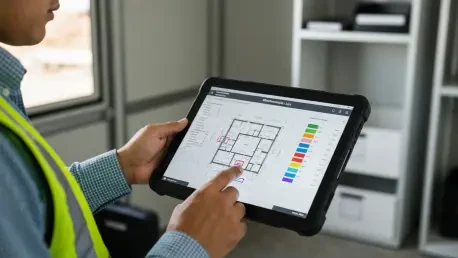

For countless professionals in the construction industry, the workday doesn’t conclude when the tools are put away; in fact, for many, the most mentally taxing work is just beginning. The grueling, after-hours ritual of construction estimating forces general contractors and subcontractors to spend their evenings and weekends hunched over digital blueprints, meticulously clicking through plans to perform “takeoffs.” This foundational process, which involves calculating every material quantity and associated cost, represents one of the building industry’s most persistent and punishing bottlenecks. It is a profoundly manual, slow, and error-prone task where a single miscalculation or oversight in a complex plan can completely erase a project’s profit margin. The immense pressure to be both fast and perfect has long meant that personal time is the first thing sacrificed, creating a culture of burnout and high-stakes risk that has defined the profession for decades. Now, a new wave of artificial intelligence aims to dismantle this archaic process, promising not just efficiency, but a restoration of work-life balance.
A Solution Forged from Experience
A significant portion of the credibility behind this technological shift comes from its origins, which are deeply rooted in the very industry it seeks to transform. Vega Apps, a Utah-based startup, was not conceived in a sterile tech incubator but was born from the direct, personal frustrations of its co-founder and CEO, Matthew King. With over two decades of experience in construction, much of it spent as an estimator, King personally endured the punishing cycle of “late nights, the rushed bids, and the mistakes that keep contractors awake.” His simple yet powerful statement, “I spent so many hours just clicking through plans… Click, click, click—for hours,” encapsulates the universal drudgery that his company now aims to eliminate. This authentic, founder-led approach distinguishes the platform from other technology solutions that often fail to grasp the nuanced realities of the construction world. The mission is not just to build software but to solve a problem that the founders themselves have lived.
This problem-first innovation is further reinforced by a founding team with a comprehensive and complementary skill set. The team’s collective expertise spans the critical pillars of the industry: King’s deep knowledge of estimating is balanced by co-founder Jason Peterson’s background in civil engineering and Seth Hopkin’s experience in on-site construction operations. This fusion of perspectives ensures the product is not just technologically advanced but also eminently practical and grounded in the day-to-day workflow of its intended users. They are building a tool for their peers, designed with an intrinsic understanding of the pressures, challenges, and complexities of the job site. This insider knowledge has allowed them to develop a solution that addresses the core pain points of the estimating process in a way that an outside tech company might overlook, lending the entire enterprise a level of authenticity and trust that is crucial for adoption in a traditionally slow-to-change industry.
The Strategic Application of AI
The journey to automate construction estimating revealed that the task’s complexity demanded a far more sophisticated approach than a single, all-purpose AI could provide. The initial assumption that one monolithic AI model could learn to read and interpret the vast diversity of construction plans was quickly debunked. In its place, Vega Apps engineered a suite of specialized, independently trained models, each serving as a focused expert on a specific function. One model might be a master of optical character recognition (OCR) on dense electrical or plumbing schematics, while another is trained exclusively to interpret scale, calculate precise floor areas, or measure a building’s height. By late 2024, the company had already developed around ten of these distinct models, creating a complex, multi-layered technological architecture. This strategy of deconstructing a multifaceted problem into smaller, manageable tasks allows the AI to achieve a level of accuracy and granularity that a generalized model could not, effectively automating each component of the once-painstaking manual process.
Despite the power of its technology, the company maintains a refreshingly pragmatic and honest stance on the current limitations of artificial intelligence. King is forthright in stating that the AI is not infallible and is not intended to be a complete replacement for human expertise. It cannot, for instance, resolve conflicting information between architectural and structural plans or interpret an architect’s ambiguous design intent. Instead, the platform is positioned as an incredibly powerful “starting point,” delivering a highly accurate baseline that still requires a final human “sanity check.” This candid appraisal—encapsulated in King’s sentiment, “I don’t think we’re anywhere close to a world where you just trust AI blindly”—grounds the company’s claims in reality. The goal is not to render estimators obsolete but to augment their capabilities. By eliminating the monotonous, repetitive clicking, the technology frees professionals to concentrate on higher-value activities such as strategic decision-making, value engineering, and strengthening client relations.
Beyond Speed to Accuracy and Risk Reduction
While the platform’s ability to reduce estimating timelines from weeks to mere minutes is a headline benefit, its more profound value lies in its capacity to enhance accuracy and mitigate the substantial financial risks inherent in bidding. King’s own career provides powerful anecdotes that underscore these high stakes, including a single missed $600,000 steel package and a lumber package that unexpectedly ballooned from a bid of $2.5 million to a final cost of $14 million during the supply chain crisis of the early 2020s. These are the kinds of catastrophic errors that can bankrupt a contractor. By automating the tedious process of quantity takeoffs, the AI systematically reduces the potential for human error, protecting companies from the existential threats of underbidding a job or miscalculating material needs. This focus on precision transforms the tool from a mere convenience into an essential instrument for business survival and profitability in a volatile market.
The platform further addresses financial risk by providing more than just precise quantity takeoffs. It integrates a dynamic material pricing engine that pulls data from national retailers and adjusts costs based on the project’s zip code, giving contractors a realistic and current cost baseline. After the AI completes its analysis of the plans, it doesn’t just present a list of measurements; it generates comprehensive purchase lists that can be used for procurement. This feature provides a vital shield against market fluctuations and the kind of pricing shocks that have become increasingly common. It empowers contractors to bid with greater confidence, knowing their numbers are based not on guesswork or outdated figures but on a detailed, data-driven analysis of both the project’s material needs and the current market conditions, fundamentally changing the risk equation for the better.
Reshaping the Industry Landscape
Launched on January 1, 2026, with support for 13 core construction trades, Vega Apps introduced a Software-as-a-Service (SaaS) model deliberately priced for accessibility. An annual subscription for a general contractor costs $3,600, a figure benchmarked to be less than the salary cost of a human estimator for just a few days. With lower-priced tiers available for subcontractors, the model is designed to be inclusive for businesses of all sizes. In a novel move, the company also offers a one-time fee service for homeowners, allowing them to upload their plans for around $150 to receive an unbiased material and cost analysis. This feature democratizes access to project data, empowering homeowners with a realistic cost baseline and fundamentally altering the dynamic of homeowner-contractor negotiations by fostering a new level of transparency. The company’s decision to bootstrap its growth, funded by the founders’ own construction business, has allowed it to maintain a sharp focus on solving these core problems for its users, free from the external pressures of venture capital.
This work culminated in a vision that extended far beyond its initial application. The platform’s technical foundation, an API named VegaConnect, signaled a broader, long-term strategy to integrate its powerful measurement models into other platforms used by architects and software developers. The most ambitious goal was the automation of building permit reviews, a notoriously slow bureaucratic process. By training AI models to apply state and local building codes directly to digital plans, the company envisioned a future where review times could be cut from weeks down to mere minutes. This forward-thinking approach illustrated that the mission was not just about improving a single task but about creating a more efficient and transparent ecosystem for the entire construction industry. By tackling a universally disliked aspect of the job, the technology ultimately delivered more than just business efficiency; it provided a pathway for construction professionals to reclaim their personal time, fundamentally improving the quality of life in one of the nation’s most demanding professions.