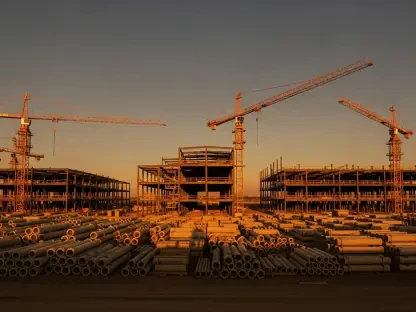

The current landscape of American mobility stands at a defining crossroads where the decision to fund or fail will dictate the nation’s economic trajectory for the next decade. As the initial surge of infrastructure spending from previous years begins to taper off, the American Public Transportation Association (APTA) has proposed a massive $268 billion investment strategy. This five-year roadmap seeks to allocate $138 billion for public transit and $130 billion for passenger rail. By shifting the perspective from simple utility maintenance to aggressive economic expansion, this proposal aims to ensure that the United States does not merely repair its tracks but fundamentally reengineers its competitive edge on the global stage.
Building on the Foundations of the Infrastructure Investment and Jobs Act
To grasp the urgency of this request, one must recognize the looming “funding cliff” that threatens to stall vital modernization efforts across the country. The success of recent federal initiatives provided a much-needed jolt to a system burdened by a massive backlog of repairs and outdated technology. However, those initial gains risk being lost if a permanent, institutionalized funding structure is not established immediately. This proposed $268 billion commitment is designed to bridge that gap, transforming temporary improvements into a long-term framework for stability. It serves as a necessary evolution, moving beyond basic repairs toward a future defined by high-tech, high-capacity connectivity.
The Economic Multiplier of Robust Public Transit
Maximizing Return on Investment and GDP Expansion
The fiscal logic behind this massive expenditure rests on a highly favorable 5-to-1 return ratio, where every $1 billion invested in transit generates $5 billion in Gross Domestic Product (GDP). This multiplier effect demonstrates that transit spending is a high-yield strategic investment rather than a drain on the treasury. Beyond the immediate boost to productivity, these funds are projected to generate approximately $251 million in tax revenue at all levels of government for every billion spent. By highlighting these figures, proponents are effectively reframing the debate, presenting transit as a self-sustaining engine of wealth creation that benefits both urban corridors and the national economy.
Streamlining Progress Through Regulatory Reform
Financial injection is only half the battle; the speed of implementation is equally critical to ensuring that capital is not wasted on bureaucratic delays. The APTA proposal emphasizes the need to slash “red tape” by streamlining environmental reviews and removing cumbersome requirements for municipal grants. These reforms are intended to lower the barrier for smaller cities and rural regions that often lack the administrative resources to navigate complex federal processes. By simplifying the path from a project’s inception to its completion, the government can ensure that infrastructure dollars are deployed with maximum efficiency, allowing communities to see tangible results in record time.
Strengthening Domestic Supply Chains and the Buy America Mandate
Transit investment acts as a powerful catalyst for the domestic industrial base, supporting over 3,000 suppliers located in 49 states. To reinforce this network, the proposal calls for a centralized “Buy America” database to help agencies source domestic materials that comply with federal standards. This focus on local manufacturing proves that a subway project in a coastal city provides high-quality jobs for steelworkers and engineers in the Midwest and South. Consequently, the rail and bus supply chain creates a web of economic interdependence, ensuring that federal spending stimulates growth far beyond the metropolitan areas where the vehicles actually operate.
Innovation and Private Capital in the Future of Mobility
The evolution of transportation funding is increasingly leaning toward creative models that blend public oversight with private sector agility. One of the most significant shifts involves raising the statutory cap on tax-exempt private activity bonds from $30 billion to $45 billion to unlock vast reserves of private capital. This move facilitates more robust public-private partnerships, allowing for the integration of disruptive technologies like zero-emission bus fleets and high-speed rail. As the industry moves toward a hybrid financial model, the focus is shifting toward sustainable, tech-driven solutions that reduce carbon footprints while increasing the overall efficiency of the national network.
Strategic Takeaways for Stakeholders and Policy Makers
For regional planners and private contractors, the potential influx of these funds demands a proactive shift in strategy and resource allocation. Local agencies must prioritize “shovel-ready” designs that align with new, streamlined regulatory standards to remain competitive for federal grants. Manufacturing firms should conduct thorough audits of their supply chains to ensure they meet the rigorous domestic sourcing requirements that will define future procurement. Furthermore, city leaders need to investigate alternative financing tools, such as private activity bonds, to supplement federal support. Those who align their local goals with these national objectives will be best positioned to thrive in this new era of mobility.
Conclusion: Transit as the Backbone of National Competitiveness
The decision to pursue this $268 billion investment reflected a fundamental understanding of infrastructure as a primary driver of modern prosperity. By successfully linking the productivity of urban hubs with the manufacturing power of rural areas, the strategy addressed the critical need for a unified national economic engine. Moving forward, stakeholders found it essential to maintain the momentum by adopting modular construction techniques and expanding green technology integration. Policy makers recognized that stagnation was the greatest risk, and they subsequently prioritized the creation of a seamless, multi-modal transport network. This commitment ensured that the nation remained a leader in the global economy, providing a blueprint for sustainable growth that other nations eventually sought to replicate.