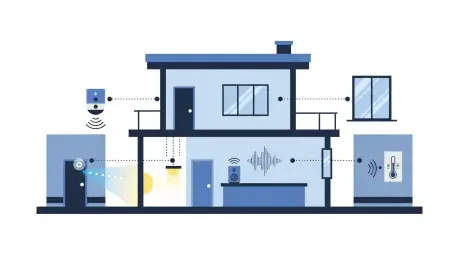

The concept of a connected home often conjures images of complex wiring and futuristic gadgets, but the reality is far more accessible, beginning not with a major overhaul but with a single, simple device. Transforming a living space into a responsive, automated environment is a scalable journey, one that allows individuals to build at their own pace and according to their specific needs. The modern smart home is best understood as a digital nervous system, a network of sensors, controllers, and applications that communicate with one another to streamline daily routines. For instance, a simple motion sensor can do more than just turn on a light; it can signal the thermostat to adjust the temperature and prompt the security system to arm itself when the last person leaves the house. The key to embarking on this journey without feeling overwhelmed is to start with low-commitment “gateway devices.” These initial components, such as a smart speaker or a few smart bulbs, serve as an introduction to the world of home automation, allowing users to experiment with voice commands, mobile apps, and simple automated routines. This foundational phase is crucial for discovering personal interaction preferences, which will ultimately guide the expansion of the entire smart ecosystem.
Building the Foundation with Gateway Devices
Embracing the Central Command Hub
The most logical and user-friendly entry point into the smart home ecosystem is often a smart speaker. Devices powered by assistants like Alexa or Google Home function as a central command hub, providing a voice-activated interface that demystifies the entire concept of home automation. Their setup is typically straightforward, requiring little more than a power outlet and a Wi-Fi connection. Once active, the speaker becomes the conversational core of the home, allowing users to control other connected devices, ask questions, set timers, and play music with simple vocal prompts. This initial interaction is invaluable, as it helps individuals determine their comfort level with voice control versus using a mobile application. For many, the ability to command their environment without lifting a finger is a transformative experience that solidifies the value of a connected home. This device serves as the brain for the first few simple automations, creating a unified experience from the outset and laying the groundwork for more complex integrations later.
Beyond acting as a controller for other gadgets, a smart speaker delivers significant standalone value that immediately enhances daily life. It can become an indispensable kitchen assistant for setting multiple cooking timers, a morning companion that provides a weather and news briefing, or a productivity tool that manages shopping lists and calendars. This utility builds a user’s confidence in the technology before they invest in additional components. As the central hub, it begins to learn routines and preferences, making its responses and suggestions more intuitive over time. This process is the first step toward creating a truly intelligent environment. The speaker’s ability to seamlessly connect with a vast array of third-party devices, from light bulbs to thermostats, makes it the perfect scalable foundation. By starting with this single, powerful device, users can gradually add new functionalities, ensuring each new addition integrates smoothly into the established command structure, preventing the fragmentation and compatibility issues that can plague more haphazard approaches to building a smart home.
Illuminating the Path with Smart Lighting
Once a central hub is in place, smart bulbs are the next logical and rewarding addition, offering an immediate and visually impactful introduction to home automation without requiring any electrical expertise. The installation process is as simple as changing a standard light bulb: just screw it in, connect it to the home Wi-Fi network through a user-friendly mobile app, and link it to the smart speaker. Instantly, users gain the ability to control their lighting with voice commands, from turning lights on and off to adjusting their brightness to a precise percentage. This simple upgrade provides a powerful demonstration of the convenience a smart home can offer. The benefits extend far beyond basic on/off functionality. Users can experiment with changing the color of the light to create specific moods—warm, soft tones for relaxation or cool, bright light for focus—or schedule lights to turn on gradually in the morning for a more natural wake-up experience. This tangible and easily controlled element of the smart home makes the concept of automation feel both practical and fun.
Delving deeper into smart lighting reveals its potential to be a cornerstone of more sophisticated automation routines, teaching users the fundamentals of creating “scenes.” A scene is a preset combination of settings across multiple devices that can be activated with a single command. For example, a “Movie Night” command could simultaneously dim the living room lights, change their color to a soft blue, and perhaps even signal another smart device to turn on the television. This introduces the concept of how different components of the smart home can work in unison to create a specific ambiance or accomplish a task. Furthermore, smart lighting can contribute to home security by scheduling lights to turn on and off at random intervals when the house is empty, simulating occupancy. It also offers energy efficiency benefits, as lights can be programmed to turn off automatically when a room is vacant or dimmed to consume less power. This combination of convenience, ambiance control, and practicality makes smart lighting a powerful second step that reinforces the value of a connected home.
Expanding the Ecosystem for True Automation
Integrating Control with Smart Switches
After mastering the basics with plug-and-play devices, upgrading to smart switches represents a more permanent and integrated step toward a fully automated home. Unlike smart bulbs, which only control the fixture they are installed in, a smart switch replaces the existing wall switch, granting smart control to any light or ceiling fan connected to it. This approach offers a more seamless and comprehensive solution, turning entire circuits “smart” rather than just individual bulbs. One of the most significant advantages of this method is the preservation of familiar, manual control. Guests or family members who are not accustomed to using voice commands or a mobile app can still operate the lights in the traditional way, eliminating any potential confusion or frustration. This dual-control functionality ensures that the home remains accessible to everyone, regardless of their technological comfort level. The installation is more involved than screwing in a bulb, often requiring basic knowledge of electrical wiring, but the result is a sophisticated and invisible integration that elevates the home’s core infrastructure.
The strategic implementation of smart switches lays the groundwork for more robust and reliable automation scenarios. Since the smart functionality is embedded in the wall, it remains active even if someone manually turns off the switch, a common issue with smart bulbs that become unresponsive if their power is cut at the source. This reliability is crucial for automations that depend on lighting, such as security routines or “welcome home” scenes that activate as a user approaches the house. Smart switches also enable control over a wider range of fixtures, including chandeliers with multiple decorative bulbs, outdoor floodlights, or ceiling fans, which would be impractical or impossible to outfit with individual smart bulbs. By integrating control at the circuit level, users can create more powerful and cohesive lighting groups, such as commanding all downstairs lights to turn off with a single voice command or scheduling all exterior lights to activate at sunset. This progression from individual device control to infrastructure-level control marks a key transition from a collection of smart gadgets to a truly interconnected smart home.
Unlocking Potential with Sensors
The most significant leap toward a truly responsive and autonomous smart home comes with the introduction of sensors. These devices act as the eyes and ears of the home, collecting real-time data about the environment and triggering actions without requiring any direct user command. Motion sensors, for example, can be programmed to do far more than just activate a security camera. They can turn lights on when someone enters a room and off when they leave, optimizing energy usage. A door or window sensor can send an alert to a smartphone if it is opened unexpectedly, but it can also signal the HVAC system to turn off if a window is left open for an extended period, preventing wasted energy. Other sensors, such as those that detect temperature, humidity, or even water leaks, provide a constant stream of information that allows the central hub to make intelligent decisions. This shift from user-initiated commands to environment-initiated automation is what defines a truly smart and proactive home, one that anticipates needs and addresses them autonomously.
By combining data from multiple sensors, users can create highly sophisticated and personalized automation routines, often referred to as the “conductor” of the smart home orchestra. Imagine a “good morning” routine triggered not by an alarm, but by a motion sensor detecting activity in the bedroom. This could prompt the smart blinds to open, the thermostat to adjust to a comfortable temperature, and the smart coffee maker to begin brewing. Similarly, a “goodnight” command could lock the doors, turn off all lights, arm the security system, and lower the thermostat. The power of sensors lies in their ability to enable the home to react to real-world conditions. A humidity sensor in the bathroom could automatically activate the exhaust fan during a shower, while a temperature sensor in a child’s room could trigger an alert if the room becomes too hot or cold overnight. The seamless interplay between these unobtrusive data collectors and the home’s various smart devices is what ultimately transforms a collection of gadgets into a cohesive, intelligent ecosystem that enhances comfort, convenience, and security in a deeply meaningful way.
The Learning Curve and Final Integration
Embarking on the smart home journey inevitably involved a learning curve, but contemporary products have been designed with the average consumer in mind, making the process more intuitive than ever before. User-friendly mobile applications with guided setup instructions and extensive online communities provided ample support for troubleshooting and inspiration. The most effective strategy was to begin with a single room, mastering its automation possibilities before expanding to other areas of the house. This incremental approach prevented the feeling of being overwhelmed and allowed for a more thoughtful and personalized system to be built over time. The ultimate value of the connected home was found not in the novelty of the gadgets themselves, but in their collective ability to create a living environment that was smoother, more comfortable, and genuinely more convenient, adapting seamlessly to the rhythms of daily life.