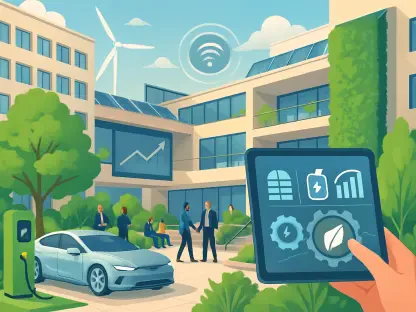

The modern commercial and residential building is no longer just a static structure of steel and glass; it has evolved into a dynamic, data-rich ecosystem facing unprecedented pressures. As global energy demands rise and digital connectivity deepens, building owners and managers are navigating a complex landscape defined by two powerful, and often conflicting, imperatives: the urgent need for greater energy sustainability and the non-negotiable requirement for robust cybersecurity. In this environment, the demand for intelligent building automation systems has surged, with open standards like KNX emerging as a critical solution. By providing a unified framework that addresses both energy efficiency and digital resilience, the KNX protocol is strategically positioned to meet the evolving demands of modern infrastructure, driving significant growth in a market that increasingly values both green credentials and digital peace of mind.
The Core Drivers of Market Expansion
The Convergence of Smart Building Functions
The evolution of building automation represents a fundamental paradigm shift away from isolated, single-purpose systems toward a fully integrated and intelligent network. In the past, functions such as heating, ventilation, and air conditioning (HVAC), lighting, access control, and security operated in separate silos, each with its own proprietary controls and communication protocols. This fragmentation created significant inefficiencies, limited the potential for holistic optimization, and presented a complex management challenge for facility operators. The contemporary approach, however, demands the convergence of these disparate functions into a single, seamless ecosystem. This integration is no longer a luxury feature but a core requirement for optimizing building performance, enhancing occupant comfort, and minimizing operational costs. KNX serves as the foundational technology enabling this transition by providing a globally recognized, vendor-agnostic open standard that acts as a common language for devices and systems from different manufacturers, effectively breaking down the barriers that once stifled true building intelligence.
This ability to foster interoperability is the cornerstone of KNX’s value proposition, particularly within complex building environments. By creating a unified network, the standard allows for the creation of sophisticated automation scenarios that would be impossible with siloed systems. For example, an occupancy sensor in an office can communicate across the network to not only turn off the lights in an empty room but also signal the HVAC system to adjust the temperature to an energy-saving setpoint and inform the security system to monitor the now-unoccupied zone more closely. This level of synergistic control transforms a building from a passive structure into an active environment that intelligently responds to the needs of its occupants in real time. For commercial projects like hotels, hospitals, and large office complexes—where solutions from dozens of specialized manufacturers must coexist—this open architecture is critical. It avoids vendor lock-in, ensuring that building owners can select the best-in-class products for each application while guaranteeing they will all work together harmoniously, creating a future-proof platform for innovation.
The Sustainability Imperative
A primary catalyst for the rapid adoption of advanced building automation is the escalating global focus on sustainability and energy efficiency, a trend driven by powerful macroeconomic and regulatory forces. One of the most significant pressures is the dramatic rise in building electrification. According to the International Energy Agency (IEA), buildings are projected to account for nearly 50% of final energy consumption by 2050, a substantial increase from today’s levels. This shift, spurred by the adoption of electric vehicles, heat pumps, and other technologies, places immense strain on electrical grids and makes intelligent load management an absolute necessity. Simultaneously, regulatory bodies worldwide are implementing stricter mandates for commercial real estate, requiring building owners to actively demonstrate, measure, and report on their carbon reduction efforts. This has transformed energy efficiency from a cost-saving initiative into a critical component of corporate responsibility and legal compliance.
In this context, KNX is positioned as a powerful solution that empowers building owners and facility managers to meet and exceed ambitious sustainability targets. The technology moves beyond simple on-off automation to enable sophisticated and dynamic energy management strategies. A KNX system can integrate data from a wide array of sensors to orchestrate a building’s energy consumption with remarkable precision. For instance, it can automate load shedding during peak demand hours by temporarily reducing power to non-critical systems, or it can adjust lighting and climate control based on real-time occupancy data and even the position of the sun. Furthermore, the detailed data logging and reporting capabilities inherent in KNX systems are instrumental for achieving and maintaining prestigious green building certifications. These certifications are no longer just plaques on a wall; they are valuable assets that increase property value, attract premium tenants, and provide tangible proof of a commitment to environmental stewardship.
Opportunities Across Residential and Commercial Sectors
The demand for KNX technology is rapidly expanding across both residential and commercial sectors, with the nature of the opportunities differing significantly between them. The commercial sector is poised to realize the most transformative benefits, with internal analysis projecting the smart buildings market will grow from its current valuation to US$63 billion by 2028, driven by investments in sustainability, digitalization, and cybersecurity. In this arena, KNX’s open, interoperable architecture is its most compelling feature. Complex commercial projects such as airports, hospitals, and corporate campuses often require integrating highly specialized systems from a multitude of different vendors. KNX’s ability to create a common communication backbone prevents the costly and restrictive problem of vendor lock-in, where a facility becomes dependent on a single manufacturer’s ecosystem. This flexibility not only reduces initial and long-term costs but also ensures that the building’s infrastructure remains agile and capable of incorporating future technological advancements without requiring a complete system overhaul.
While the commercial market presents the largest scale of opportunity, the steady global growth in smart home adoption remains a key driver for KNX in the residential market. The technology is exceptionally well-suited for consumers seeking a robust, reliable, and fully integrated solution for managing energy efficiency, comfort, and control within their homes. Unlike many consumer-grade, do-it-yourself smart home products that can result in a fragmented and often unreliable user experience, KNX provides a cohesive, professionally installed system that works seamlessly. This makes it an excellent choice for high-end applications such as luxury villas, custom residences, and large-scale residential developments where a unified, all-in-one system is desired. Homeowners can control lighting, automated shades, climate, security, and entertainment systems from a single interface, creating sophisticated living environments that are both comfortable and energy-efficient, reinforcing KNX’s position as a premium solution in the residential space.
Addressing the Critical Need for Security
Introducing KNX Secure a Foundation of Trust
As buildings become increasingly connected and data-driven, their vulnerability to cyber threats grows exponentially, elevating security from a desirable feature to an absolute necessity. Every smart device, from a networked light fixture to a climate control sensor, represents a potential entry point for malicious actors seeking to disrupt operations, manipulate critical systems, or steal sensitive data. The consequences of a breach can range from inconvenient disruptions to catastrophic failures impacting tenant safety and business continuity. In response to this escalating risk, the KNX standard has incorporated KNX Secure, a robust and multi-layered security framework designed to protect smart building systems against a wide spectrum of cyber threats. This comprehensive architecture is not an optional add-on but is woven into the core of the protocol, ensuring that the safe and reliable operation of all building functions is protected by default and providing a crucial foundation of trust for installers and end-users alike.
KNX Secure employs several advanced mechanisms to create a resilient and hardened system capable of withstanding modern cyber threats. At its core are features like advanced key management and system isolation, which work in tandem to safeguard the network against external intrusions and prevent unauthorized communication between different parts of the installation. Key management ensures that every device on the network is authenticated using strong, unique cryptographic keys, effectively blocking any rogue or unauthorized devices from joining and issuing commands. System isolation, meanwhile, allows the network to be logically divided into secure zones. This means that even if a less critical part of the network, such as public-area lighting, were to be compromised, the attacker would be prevented from accessing more sensitive systems like access control or building management controllers. This defense-in-depth strategy is further enhanced by segment coupling, which creates secure gateways that meticulously inspect and validate all traffic passing between different segments, providing an essential layer of protection in publicly accessible or unmonitored areas.
A Multi-Layered Approach to Cybersecurity
To provide comprehensive, end-to-end protection, the KNX Secure standard is broken down into two distinct but complementary application protocols: KNX IP Secure and KNX Data Secure. KNX IP Secure is designed to protect all communication that occurs over an IP network, such as a building’s Ethernet or Wi-Fi infrastructure. This protocol acts as the system’s primary perimeter defense, creating a secure, encrypted tunnel for any data that travels alongside standard network traffic. It is essential for protecting the system from external threats, whether they originate from the public internet or from other devices on the local network. By encrypting and authenticating all IP-based communication, KNX IP Secure effectively prevents common cyberattacks like eavesdropping, where an attacker could intercept and read commands, or man-in-the-middle attacks, where malicious commands could be injected into the data stream. This ensures that remote access, system-wide programming, and communication between different KNX installations remain confidential and tamper-proof.
While KNX IP Secure guards the perimeter, KNX Data Secure focuses on protecting the data exchanged between individual end devices directly on the KNX bus wiring. This layer of security is vital for protecting against internal threats, such as a compromised device or an attacker who has gained physical access to the building’s wiring. KNX Data Secure ensures that every single telegram—the small data packets containing commands and status updates—is individually encrypted and authenticated. This means that even if an attacker were to connect a rogue device directly to the bus, they would be unable to decipher the communication between legitimate devices or forge commands to manipulate them. This granular, device-level protection creates a zero-trust environment within the installation itself. Crucially, these integrated security capabilities are designed to help customers achieve full compliance with emerging and stringent regulations, such as the EU Cyber Resilience Act (CRA), making a KNX-based system a resilient and future-ready infrastructure choice.
A Look at an Integrated Future
The powerful synergy created by combining KNX’s robust security, open architecture, and advanced automation capabilities provided facility managers with unprecedented levels of operational insight and system-wide control. When integrated with high-level Building Management Systems (BMS) and facility-wide analytics platforms, the data flowing from a KNX network enabled a new era of improved operational transparency, enhanced efficiency, and greater responsiveness. This holistic integration led to tangible and valuable outcomes that extended far beyond simple convenience. It allowed for the significant reduction of carbon footprints through intelligent energy management, the improvement of tenant safety and comfort through responsive environmental controls, and the optimization of operational workflows through data-driven insights. The ability to monitor, analyze, and control an entire building from a single, unified platform transformed facility management from a reactive discipline into a proactive, strategic function that directly contributed to an organization’s bottom line.
The continued evolution of building automation was profoundly shaped by the integration of emerging technologies built upon this solid foundation. Artificial intelligence (AI), machine learning (ML), and the vast network of the Internet of Things (IoT) were leveraged to deliver more intelligent, adaptive, and predictive solutions that could anticipate needs and self-optimize in real time. In parallel, the development of highly intuitive user interfaces, including mobile applications and voice commands, made these complex systems more accessible and easier to manage. Furthermore, cloud integration expanded these capabilities exponentially by enabling secure remote access, vast data storage for analytics, and a host of additional smart services. KNX members and developers were at the forefront of these trends, actively combining the standard with IoT-driven insights and cloud-based platforms. Ultimately, this enhanced interoperability, with platforms like KNX serving as the essential backbone, was what enabled the seamless communication across a burgeoning ecosystem of smart devices and systems, paving the way for the smarter, safer, and more sustainable buildings that have become the hallmark of the modern world.