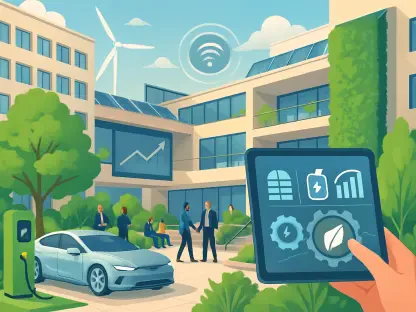

The monumental task of decarbonizing the built environment has emerged as a critical priority across the Asia-Pacific, where buildings contribute a staggering 25% to 40% of the region’s total carbon output. This pressing challenge is catalyzing a profound shift toward intelligent infrastructure, with a powerful combination of advanced digital technologies and increasingly stringent government regulations paving the way for a new era of smart buildings. This transition is not merely an environmental imperative but a fundamental reshaping of property design, construction, and management, driven by the urgent need to meet ambitious net-zero emission targets. The convergence of innovation and policy is creating a dynamic landscape where the performance and sustainability of a building are becoming as valuable as its physical location, fundamentally altering market dynamics for investors, developers, and corporate occupiers alike throughout the region.
The Technological Revolution in Real Estate
The Brains Behind Sustainable Construction
A sophisticated suite of digital tools is now serving as the central nervous system for modern, sustainable buildings, enabling unprecedented levels of efficiency and resource management. Karan Sinsinwar of AECOM Singapore aptly describes these innovations as the “brains behind sustainable buildings,” which orchestrate waste reduction and operational excellence from the blueprint phase through the entire lifecycle of a structure. Among the most transformative of these are digital twins, which are virtual replicas of physical buildings that allow engineers to simulate and rigorously test complex energy optimization strategies without any real-world disruption. This capability enables stakeholders to identify the most effective retrofitting or operational adjustments in a risk-free environment. Complementing this is the deployment of Artificial Intelligence (AI), which is being leveraged to proactively predict system failures, automate intricate building controls for HVAC and lighting, and intelligently align equipment operation with the intermittent availability of renewable energy sources. The practical impact of these technologies is substantial, with some pioneering projects already reporting up to a 20% reduction in material waste during construction and an astonishing 90% decrease in overall engineering time.
Market Adoption and Shifting Priorities
The technological shift is not happening in a vacuum; it is being actively embraced by key market players who recognize its dual benefits for compliance and competitive advantage. According to extensive research from JLL, corporate occupiers are at the forefront of this movement, rapidly integrating smart solutions to satisfy both evolving regulatory requirements and their own ambitious climate commitments. The data reveals a remarkable trend, with Kamya Miglani of JLL noting that an overwhelming 92% of corporations in the Asia-Pacific are already piloting AI solutions within their commercial real estate portfolios, with energy management standing out as the primary application. This widespread adoption reflects a deeper change in market valuation. Concurrently, investors are evolving their criteria, moving beyond a superficial reliance on “green labels” or certifications. Instead, they are demanding tangible, data-driven evidence of a building’s performance. JLL’s findings underscore this pivot, showing that 60% of investors are now actively monitoring specific energy efficiency metrics. This signals a clear, market-wide preference for real-time performance data, which provides a more accurate and reliable measure of a property’s sustainability and long-term value in a climate-conscious economy.
Overcoming Hurdles on the Path to Decarbonization
The Legacy Challenge of Existing Infrastructure
Despite the significant momentum behind smart building technology, formidable hurdles remain, particularly concerning the vast stock of older buildings across the Asia-Pacific. A primary challenge lies in decarbonizing this existing infrastructure, as these buildings were constructed long before modern energy efficiency standards were established and often lack the fundamental design principles needed for easy upgrades. The upfront costs associated with retrofitting these properties with modern sensors, control systems, and insulation are frequently prohibitive for many asset owners, creating a major barrier to widespread adoption. Beyond the financial obstacles, other significant issues persist. Many corporations still lack clear and comprehensive digitization strategies, leading to piecemeal and often ineffective technology implementation. Furthermore, the increased connectivity of smart buildings raises valid and widespread cybersecurity concerns that must be addressed to protect sensitive operational data. Compounding these problems is a pronounced shortage of professionals with the specialized skills required to design, install, and manage these sophisticated building automation and data analytics systems, creating a critical talent gap that slows progress.
Bridging the Gap Between Risk and Action
A notable disconnect between the perception of climate-related risks and the implementation of tangible solutions continues to challenge the real estate investment landscape. While a significant portion of investors acknowledges the threat, their actions often lag behind. Data reveals that while 44% of investors identify the risk of climate-related obsolescence as the top concern for their portfolios, only a quarter of them have actually implemented corresponding adaptation measures to mitigate this threat. This gap suggests a complex interplay of factors, including short-term financial pressures, uncertainty about the return on investment for green technologies, and a lack of standardized metrics for assessing climate risk. However, this inertia is being increasingly challenged by evolving regulatory landscapes across the region. Governments are progressively mandating the disclosure of asset-level energy consumption and emissions data, effectively turning this information into a new and non-negotiable benchmark for compliance. This regulatory pressure is forcing investors and asset owners to prioritize decarbonization, reinforcing the indispensable role that smart building technology must play in achieving the Asia-Pacific’s ambitious net-zero goals and ensuring the long-term viability of their real estate assets.
Forging a Sustainable Future
The journey toward a decarbonized built environment in the Asia-Pacific was ultimately defined by the convergence of technological innovation and strategic action. The initial challenges, from the high costs of retrofitting legacy buildings to the notable gap between investor risk awareness and proactive measures, were systematically addressed through collaborative frameworks. It became clear that isolated efforts were insufficient. Instead, progress was accelerated when governments, technology firms, and property stakeholders forged partnerships that incentivized smart building adoption and standardized performance metrics. This alignment created a market where data-driven sustainability was no longer a niche interest but a core component of asset valuation. The integration of digital twins and AI moved from pilot programs to standard practice, providing the crucial intelligence needed to optimize energy use and reduce operational waste. The successful navigation of this transition demonstrated that overcoming the financial and logistical hurdles of decarbonization was not just an environmental necessity but a powerful catalyst for economic resilience and innovation in the region’s real estate sector.