
The operational fabric of our built environment is undergoing a fundamental transformation, moving far beyond the static, rule-based automation that has characterized building management for decades. Generative AI (GenAI) is now poised to become the central nervous system of smart buildings, representing a complete paradigm shift toward environments that are not just reactive but are truly predictive, adaptive, and continuously self-optimizing. This evolution is driven by GenAI’s sophisticated ability to learn from vast, heterogeneous datasets, allowing it to infer complex relationships and uncover granular patterns that were previously undetectable. The result is a system that transitions from simple, pre-programmed responses to proactive adaptation, generating highly accurate forecasts, dynamic control strategies, and data-driven recommendations that promise to redefine efficiency, sustainability, and occupant well-being. This technological trajectory is rapidly moving toward the advent of Agentic AI—highly autonomous systems capable of independently setting operational goals and orchestrating complex tasks across disparate subsystems with minimal human intervention, heralding a future of continuous, self-optimizing building performance.
The New Frontier of Building Operations
At the heart of the GenAI revolution lies a profound reorientation toward the human experience within the built environment, shifting the focus from mere functionality to holistic well-being. Advanced machine learning models can now meticulously ingest and analyze a continuous stream of historical and real-time environmental data, including factors like lighting, ventilation, temperature, and even ambient noise levels. This allows for the dynamic and continuous fine-tuning of these conditions to create personalized environments that actively cater to individual productivity preferences and wellness goals. This capability extends beyond simple adjustments, enabling the creation of bespoke routines and atmospheres that can enhance focus, reduce stress, and promote health. This evolution transforms the building from a static structure into a responsive and intelligent partner, opening new avenues for premium, tenant-facing services and subscription-based amenities that were once the domain of science fiction, thereby creating new monetization opportunities for property owners and managers.
Beyond its impact on occupant comfort, Generative AI delivers substantial and quantifiable gains in operational efficiency and long-term sustainability. By concurrently evaluating complex variables such as occupancy patterns, historical energy consumption trends, external weather conditions, and fluctuating utility pricing, these intelligent systems can formulate and execute optimal energy strategies in real time. These data-driven insights translate into tangible actions, such as dynamically adjusting HVAC output to match actual demand, optimizing lighting schedules based on natural light availability and room usage, and performing intelligent load balancing to minimize costly peak demand charges. This same predictive power completely revolutionizes traditional maintenance protocols, shifting the paradigm from a reactive, break-fix model to a truly proactive one. By detecting the earliest signs of equipment degradation and accurately forecasting potential failure conditions, GenAI helps prevent catastrophic downtime, significantly extend the operational lifespan of critical assets, and reduce overall repair expenditures, ensuring the building runs more smoothly and economically.
The Digital Twin and the Agentic Future
The transformative power of Generative AI is dramatically amplified when it is synergistically integrated with digital twin technology, creating a powerful new tool for building management and resilience planning. A digital twin is a dynamic, virtual model of a physical building that continuously ingests live sensor data and analyzes historical records to simulate its complex systems and environmental interactions in real time. However, GenAI elevates this concept far beyond simple replication. A GenAI-driven digital twin becomes an active, intelligent simulation environment where building engineers and managers can model the potential impact of significant system changes before they are ever implemented in the physical world. This allows them to stress-test emergency response protocols, such as fire evacuations or security breaches, in a completely safe and controlled virtual space, thereby identifying potential bottlenecks and refining procedures without disrupting actual operations. When combined with Augmented or Virtual Reality (AR/VR), these sophisticated models transform into immersive training platforms that can accelerate employee onboarding and improve operational readiness for complex scenarios.
This powerful synergy between GenAI and digital twins points directly toward the impending rise of Agentic AI, a more advanced form of artificial intelligence characterized by high levels of autonomy and goal-oriented behavior. In this future-forward scenario, these autonomous agents could leverage digital twins as their own virtual sandboxes, enabling them to independently explore and test alternative system configurations, simulate the effects of emergent behaviors, and propose novel, data-driven solutions to complex operational problems. In essence, the digital twin becomes the primary training ground for an AI that functions as a virtual facilities engineer, one that is constantly learning from simulations, refining its strategies, and adapting to new information to achieve optimal building performance with minimal human intervention. This continuous loop of simulation, learning, and optimization promises a future where buildings not only manage themselves but also proactively evolve to meet changing conditions and occupant needs, representing the ultimate realization of a truly intelligent and autonomous built environment.
Building the Foundation for Intelligence
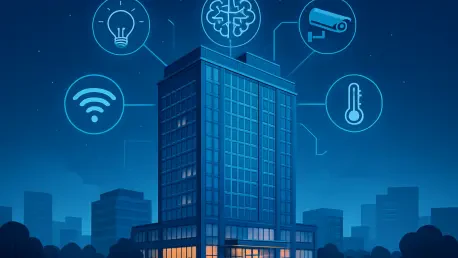
This advanced intelligence, however, cannot operate effectively on an outdated or insufficient infrastructure; the successful deployment of GenAI is fundamentally dependent on robust physical and digital foundations. The massive and continuous data flows generated by thousands of IoT sensors, building automation platforms, and external data sources can easily overwhelm legacy copper networks, creating bottlenecks that cripple real-time decision-making. Consequently, the transition to high-capacity optical fiber is no longer a forward-thinking upgrade but an immediate necessity. Fiber-optic networks provide the substantially higher bandwidth, longer reach, and improved reliability required to support the data-intensive demands of GenAI applications. This foundational upgrade ensures that information can be transmitted instantaneously and without degradation, enabling the rapid analysis and action that are the hallmarks of an intelligent building, from real-time security threat detection to dynamic environmental control adjustments that optimize energy use second by second.
A corresponding evolution is required in the building’s computing architecture, with a hybrid model emerging as the most effective and resilient approach. This model strategically combines the immense processing power of cloud data centers with the low-latency responsiveness of on-premises edge computing. Large-scale AI model training, complex historical data analysis, and long-term data storage are tasks best suited for the virtually limitless resources of the cloud. In contrast, workloads that are highly sensitive to delays, such as immediate threat detection from security cameras, precise control of HVAC systems, or life-safety applications, require the instantaneous processing that only on-premises edge computing can provide. Deploying robust edge infrastructure ensures rapid response times, safeguards proprietary operational data by keeping it local, and critically, maintains operational continuity and building functionality even during a loss of external network connectivity. This hybrid approach offers the best of both worlds: the raw power of the cloud for deep learning and the swift, reliable intelligence of the edge for mission-critical operations.
Underpinning both the physical network and the hybrid computing architecture is the critical and accelerating convergence of Information Technology (IT) and Operational Technology (OT) systems. For Generative AI to function to its full potential, the traditional and often rigid silos that have long separated facilities management from information technology must be decisively dismantled. Historically, OT systems like HVAC, lighting, and access control operated in isolation from the corporate IT network. However, in an intelligent building, these once-separate domains must be viewed and managed as a single, deeply integrated ecosystem. This convergence is essential to enable the seamless, secure, and bidirectional data exchange required for holistic building intelligence. It allows GenAI to draw insights from across the entire operational landscape, correlating data from disparate sources to make more informed and impactful decisions, thereby unlocking the full potential of a centrally managed, data-driven operational strategy that is both efficient and secure.
Charting a Strategic Course for Integration
The immense benefits unlocked by Generative AI are accompanied by significant and complex risks that demand a proactive and sophisticated governance strategy. The expanded connectivity and data exchange across newly converged IT and OT domains inherently widen the building’s attack surface, creating novel vectors for both cyber and physical compromise. Furthermore, GenAI systems introduce their own unique set of vulnerabilities, including the risks associated with opaque, “black box” decision-making processes that are difficult to audit, the potential for malicious prompt injection attacks to manipulate AI behavior, and the ever-present danger of sensitive data leakage in large language models. To counter these multifaceted threats, organizations must implement a layered, zero-trust security posture as a foundational principle. This approach dictates that GenAI systems be subjected to the same rigorous oversight as human operators, including continuous identity verification, comprehensive activity monitoring, strict access controls based on the principle of least privilege, and regular, thorough audits to ensure compliance and detect anomalies.
A successful transition to an AI-driven building was ultimately a testament to strategic foresight and holistic planning. Organizations that effectively navigated this complex technological shift did not view it merely as a software upgrade but as a fundamental overhaul of their operational philosophy. This journey began with defining clear, measurable business objectives and choosing an integration model that aligned with their resources, expertise, and risk tolerance. Crucially, this strategy was underpinned by a comprehensive governance framework and supported by new leadership roles, such as a Chief AI Officer, to ensure cross-functional alignment and accountability. They recognized that the human element was paramount, investing heavily in upskilling their workforce to manage these new systems while proactively addressing ethical considerations surrounding data privacy and surveillance. This internal strategy was reinforced by a commitment to external, industry-wide standards, which provided a vendor-neutral roadmap for ensuring that the deployment of GenAI was secure, interoperable, and aligned with best practices, culminating in environments that were not only intelligent but also resilient, responsible, and fundamentally attuned to human needs.